Key Findings
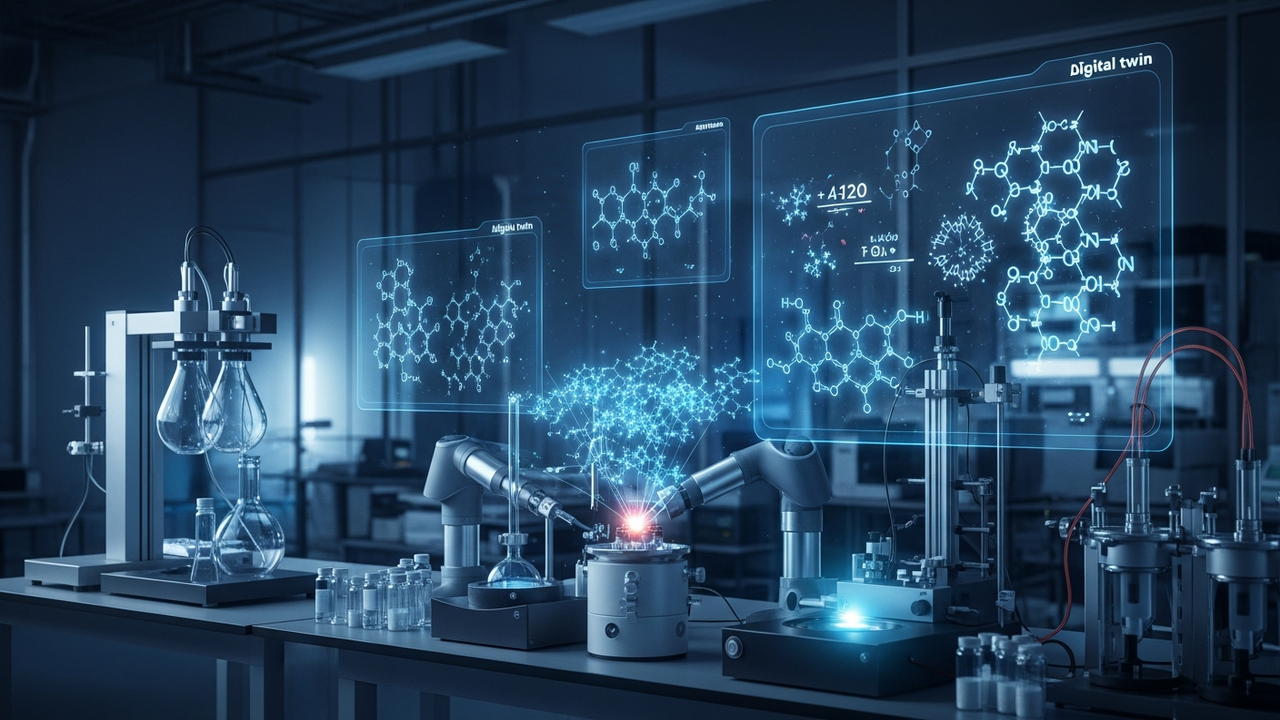
CatDT (Catalysis Digital Twin) has been introduced as a high-fidelity, condition-aware catalyst simulator specifically designed for autonomous heterogeneous catalyst discovery. This innovative digital twin demonstrates predictive capabilities that align with experimental data with remarkable accuracy across multiple benchmarks, promising to significantly accelerate the design of novel catalytic materials.
Technical / Clinical Details
CatDT achieves a comprehensive simulation of catalytic behavior under complex reaction environments by seamlessly integrating modeling for gas-solid and liquid-solid interfaces. The platform incorporates state-of-the-art AI technologies, notably UniMech for efficient reaction pathway discovery and a memory-augmented reinforcement learning loop to enhance the accuracy of reaction energy barrier calculations. UniMech efficiently explores the most favorable pathways within vast reaction networks, while the reinforcement learning loop, by learning from past computational results, enables more reliable barrier calculations. CatDT has been validated against various gas-solid benchmark systems (e.g., CO oxidation, ammonia synthesis), demonstrating excellent agreement between its predictions and corresponding experimental data. This opens the door to evaluating and optimizing catalytic performance theoretically, without the need for extensive physical experimentation.
Background & Context
Heterogeneous catalysts are foundational to the chemical industry, indispensable for the production of everything from pharmaceuticals and fuels to plastics and environmental remediation. However, the discovery of new, high-performance catalysts has historically been a time-consuming and costly process, heavily reliant on trial-and-error and extensive experimentation. The application of digital twin technology, particularly with AI and machine learning, to catalyst design offers the potential to overcome this bottleneck and dramatically accelerate the discovery process. Tools like CatDT elevate computational catalysis science to a new level, promoting the development of more sustainable and efficient chemical processes.
Strategic Significance & Outlook
Autonomous catalyst discovery platforms like CatDT will play a pivotal role in accelerating the design of catalysts for novel material classes. This enables the development of catalysts customized for specific industrial requirements (e.g., high-efficiency synthesis at low temperatures, specific selectivity) at an unprecedented speed. In the future, by integrating CatDT with self-driving labs, fully automated workflows for catalyst discovery, optimization, and scale-up could be realized, leading to groundbreaking advancements in clean energy technologies, environmental catalysis, and fine chemical production. This technology holds the potential to strengthen the competitiveness of the chemical industry and contribute to achieving global sustainability goals.
Source: https://arxiv.org/html/2606.05050v2
Get our weekly technology intelligence — free
Receive an infographic that lets you judge at a glance whether each field’s analysis report is worth reading.
Subscribe Free — Weekly Tech Intelligence
By subscribing, you’ll receive Troy-Technical’s weekly technology intelligence newsletter.
- Your email and selected fields are used only to deliver the newsletter.
- We never share your information with third parties.
- You can unsubscribe anytime via the link in each email.
See our Privacy Policy for details.
Takes about a minute · Unsubscribe anytime






Comments