
Key Findings
A research team at the University of Toronto’s Acceleration Consortium has leveraged an AI-driven autonomous self-driving lab (SDL) to discover six novel 3D-printable metal alloys that exhibit exceptional strength under extreme conditions. This breakthrough demonstrates the potential to dramatically shorten the discovery cycle for complex new materials from years to just weeks.
Technical / Clinical Details
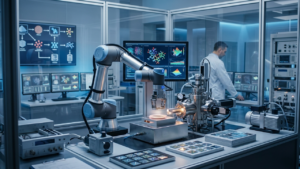
This discovery was achieved through an ‘active learning’ approach. The team first employed computer modeling and machine learning algorithms to predict the most promising candidates from millions of possible alloy compositions. Subsequently, a robot-assisted manufacturing system, such as a 3D printer, rapidly synthesized and produced these candidate alloys. An automated testing system then evaluated properties such as high-temperature resistance and oxidation resistance. The evaluation results were fed back to the AI model in real-time, allowing the AI to continuously learn and propose the next optimized alloy composition in a closed-loop iterative cycle. This highly efficient process led to the identification of six new metal alloys in a remarkably short period of just weeks. Notably, some of these new alloys even surpassed Inconel 625, a high-performance alloy widely used in the aerospace industry, in terms of oxidation resistance. This clearly demonstrates the extreme effectiveness of AI and autonomous labs in exploring complex material systems.
Background & Context
In sectors such as aerospace, defense, and advanced manufacturing, there is a constant and growing demand for high-performance materials that are lightweight yet capable of withstanding extreme environments (high temperatures, high pressures, corrosive atmospheres). While the evolution of 3D printing technology has broadened the possibilities for developing new alloys by enabling the efficient manufacturing of complex geometries, the process of discovering optimal alloy compositions remained a significant bottleneck. Traditional alloy development relied heavily on extensive experimentation and trial-and-error, typically requiring 10 to 20 years for a new alloy to reach practical application. AI-driven autonomous labs are anticipated as a game-changing solution to resolve this bottleneck and enable faster innovation.
Strategic Significance & Outlook
The research findings from the University of Toronto hold the potential to profoundly transform the future of metal alloy development. This AI-driven active learning approach will accelerate the discovery of high-performance 3D-printable materials across a wide range of fields, including next-generation engine components and lightweight structures in the aerospace industry, high-performance components in the automotive industry, and heat-resistant materials in the nuclear industry. The dramatic reduction in development time will provide a competitive advantage for companies and accelerate the market introduction of new products. In the future, such autonomous labs are expected to become the standard for materials science research, enabling the design and discovery of materials previously deemed impossible, thereby driving innovation across industries.
Get our weekly technology intelligence — free
Receive an infographic that lets you judge at a glance whether each field’s analysis report is worth reading.
Subscribe Free — Weekly Tech Intelligence
By subscribing, you’ll receive Troy-Technical’s weekly technology intelligence newsletter.
- Your email and selected fields are used only to deliver the newsletter.
- We never share your information with third parties.
- You can unsubscribe anytime via the link in each email.
See our Privacy Policy for details.
Takes about a minute · Unsubscribe anytime





Comments