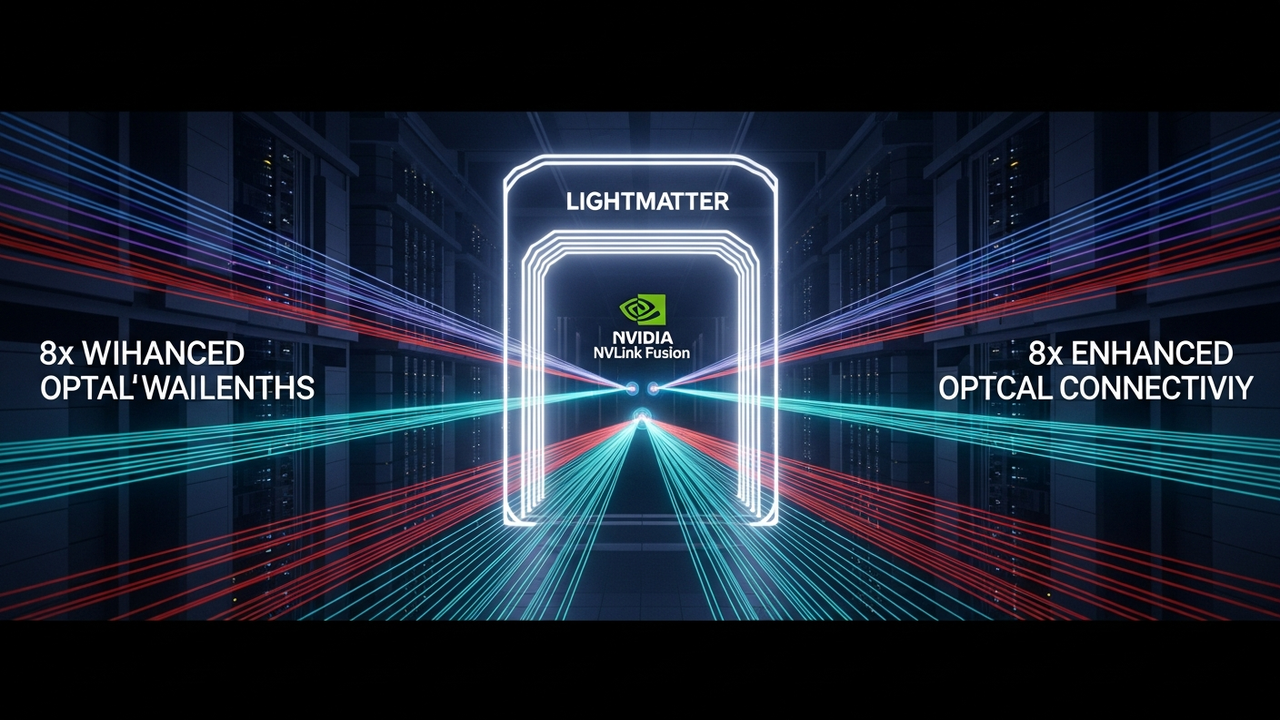
Lightmatter, a pioneer in photonic computing, has announced groundbreaking advancements in its photonic computing and interconnect technology for AI data centers, including its entry into the NVIDIA NVLink Fusion ecosystem.
Key Findings
Lightmatter has successfully achieved the world’s first 16-wavelength bidirectional optical DWDM (Dense Wavelength Division Multiplexing) link, which has increased fiber bandwidth density by eightfold per single optical fiber. This achievement is a critical technology underpinning the company’s Passage M1000 3D photonic superchip, designed to enable massive scale-up bandwidth for AI model training clusters.
Technical Details
Electrical interconnects are facing physical limitations in terms of power consumption, latency, and bandwidth density as AI workloads continue to scale. Lightmatter’s photonic technology addresses these challenges by utilizing photons as the medium for data transmission. The 16-wavelength bidirectional DWDM link means that 16 different optical wavelengths are simultaneously used to transmit and receive data over a single optical fiber, dramatically increasing effective data transmission capacity. Compared to traditional copper cabling and existing optical interconnects, Lightmatter’s solution offers significantly higher bandwidth at lower power consumption, enabling the ultra-fast communication required between AI accelerators within data centers. The Passage M1000 3D photonic superchip combines advanced 3D packaging technology with silicon photonics to closely integrate optical connectivity with computing units, achieving highly efficient AI processing.
Background & Context
AI training and inference require processing vast amounts of data and constant data movement between GPUs and AI accelerators within data centers. This data movement often becomes the system’s performance bottleneck, particularly problematic in large-scale AI clusters. Lightmatter’s participation in the NVIDIA NVLink Fusion ecosystem signifies that its photonic interconnect technology has been recognized for its value and effectiveness by an industry leader. NVIDIA NVLink is widely adopted as a high-speed interconnect between GPUs, and the integration of Lightmatter’s technology is expected to further enhance the overall efficiency and scalability of AI systems. This is a crucial step towards enabling AI developers to build larger, more complex models and obtain results more quickly.
Strategic Significance & Outlook
Lightmatter’s technology is poised to revolutionize AI data center architectures and lay the foundation for next-generation AI computing capabilities. Achievements like the 16-wavelength bidirectional DWDM link clearly demonstrate that optical connectivity is essential for overcoming the limitations of electrical connections and shaping the future of AI. Widespread adoption of this technology is expected to dramatically reduce AI model training times and significantly cut power consumption, improving AI’s sustainability and economic viability. Furthermore, higher-performance AI infrastructure is anticipated to drive new innovations in various fields where AI is applied, such as autonomous driving, drug discovery, and climate change modeling. Lightmatter will strengthen its leadership in this domain and play a vital role in defining the future of AI computing.
Source: https://lightmatter.co/
Get our weekly technology intelligence — free
Receive an infographic that lets you judge at a glance whether each field’s analysis report is worth reading.
Subscribe Free — Weekly Tech Intelligence
By subscribing, you’ll receive Troy-Technical’s weekly technology intelligence newsletter.
- Your email and selected fields are used only to deliver the newsletter.
- We never share your information with third parties.
- You can unsubscribe anytime via the link in each email.
See our Privacy Policy for details.
Takes about a minute · Unsubscribe anytime




Comments