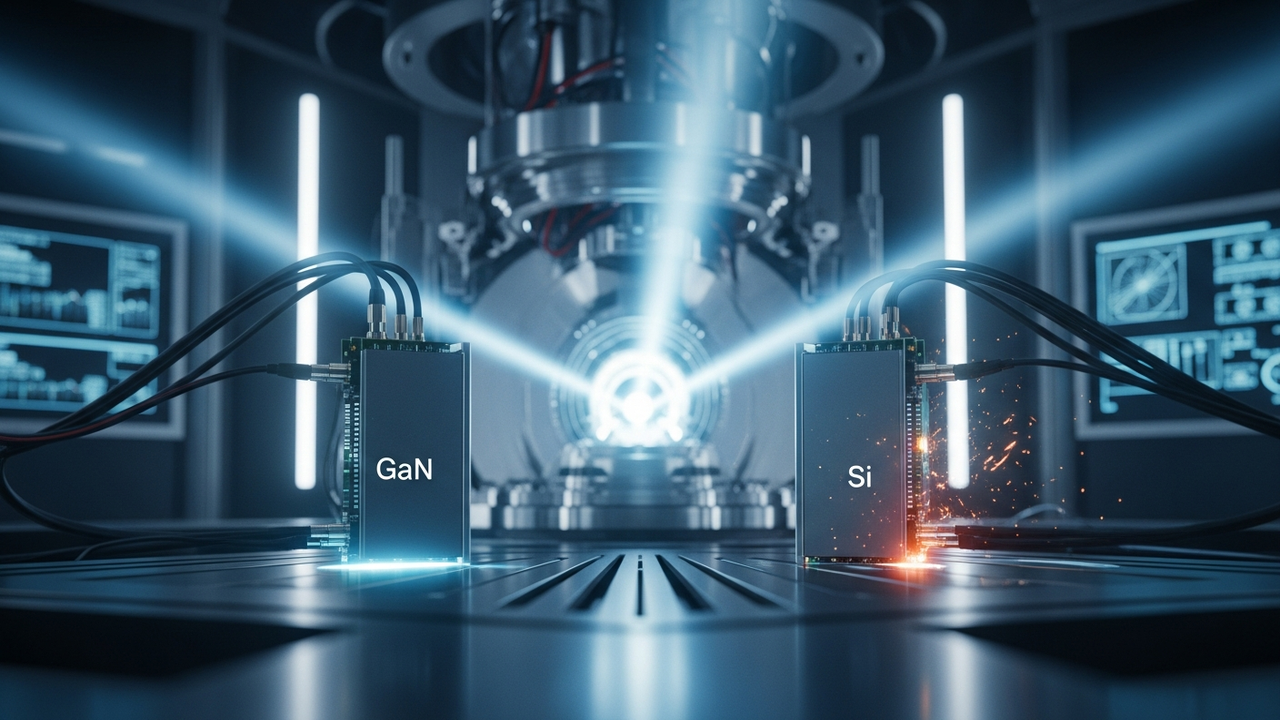
Key Findings
Gallium Nitride (GaN)-based power amplifiers, developed specifically for space applications, have demonstrated exceptional radiation hardness, surpassing conventional silicon (Si)-based devices in simulated high-energy proton and heavy ion radiation environments. This 발표 clearly indicates that GaN devices can provide stable, long-term performance even in the harsh radiation conditions of space, offering the potential to dramatically enhance the reliability and lifespan of next-generation space communication systems and high-efficiency power converters.
Technical Details
The study meticulously evaluated changes in electrical characteristics (e.g., drain current, on-resistance, gate leakage current, gain) of GaN High Electron Mobility Transistors (HEMTs) used in power amplifiers, after exposure to 100 MeV-class protons and heavy ions (iron, xenon). Results showed significantly suppressed performance degradation compared to traditional Si MOSFETs and SiC MOSFETs under equivalent radiation doses. Notably, the devices exhibited robust resistance to single-event effects (SEE), with a low propensity for radiation-induced soft errors or latch-up phenomena. It is believed that GaN’s wide bandgap property and high electron mobility facilitate the recombination of radiation-generated carriers, enhancing the device’s inherent resilience. This demonstrates that GaN devices can achieve superior performance in both Total Ionizing Dose (TID) tolerance and SEE hardness in space environments.
Background & Context
As space missions become increasingly complex and prolonged, electronic components onboard require ever-higher levels of radiation hardness and reliability. Traditional silicon-based devices face risks of performance degradation and failure due to radiation, often necessitating redundant designs or costly radiation-hardened packaging. GaN technology, with its superior electrical properties (high power, high efficiency, high-temperature operation) coupled with intrinsic radiation hardness, has long been anticipated for space applications. The findings of this research mark a crucial milestone, confirming GaN’s potential to fulfill these expectations and provide a new viable option for spacecraft system design.
Strategic Significance & Outlook
GaN-based power amplifiers are expected to be adopted across a wide range of space applications, including transponders for communication satellites, power delivery systems for deep-space probes, payload electronics for Earth observation satellites, and future lunar/Mars base power infrastructure. The practical implementation of this technology will contribute to faster and higher-capacity space communications, improved power conversion efficiency, and reduction in spacecraft mass and volume, thereby enabling more ambitious space missions. Future work will focus on long-term reliability assessments under a broader spectrum of space environmental conditions and optimization of manufacturing processes for commercialization.
Source: #
Get our weekly technology intelligence — free
Receive an infographic that lets you judge at a glance whether each field’s analysis report is worth reading.
Subscribe Free — Weekly Tech Intelligence
By subscribing, you’ll receive Troy-Technical’s weekly technology intelligence newsletter.
- Your email and selected fields are used only to deliver the newsletter.
- We never share your information with third parties.
- You can unsubscribe anytime via the link in each email.
See our Privacy Policy for details.
Takes about a minute · Unsubscribe anytime






Comments