Key Findings
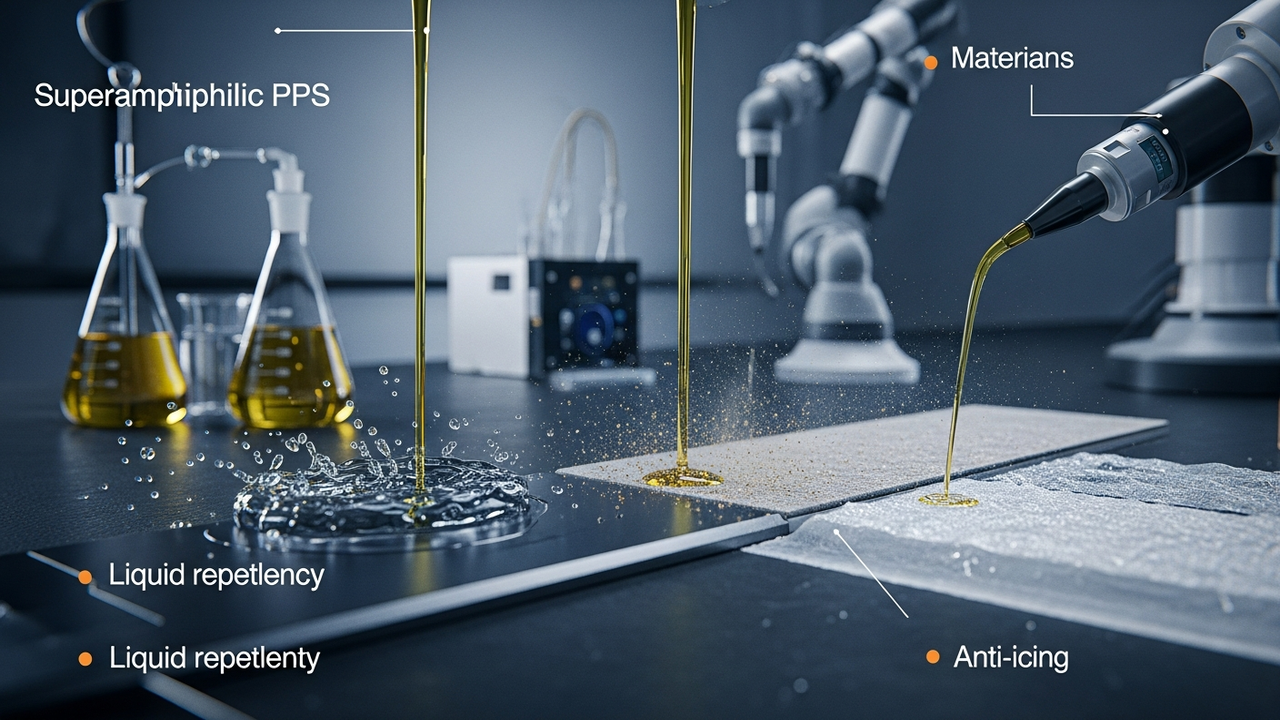
A breakthrough multifunctional polyphenylene sulfide (PPS)-based composite coating has been developed. This novel material possesses superamphiphobic properties, meaning it strongly repels both water and oil, alongside excellent mechanical durability and delayed icing characteristics. It overcomes the traditional trade-offs between performance and durability in conventional coatings, opening new avenues for diverse industrial applications such as anti-corrosion, self-cleaning, and anti-icing, making it a significant development.
Technical / Clinical Details
The developed PPS composite coating achieves its superamphiphobicity by optimizing the surface microstructure and chemical composition through the integration of specific polymers and nanoparticles. It exhibits a water contact angle exceeding 150° and high contact angles for oil droplets, ensuring minimal liquid adhesion. Furthermore, the coating boasts superior mechanical abrasion resistance, significantly enhancing its durability in real-world operating conditions. Its anti-icing capability has been experimentally confirmed to extend the freezing initiation time of water droplets by approximately 30% to 50% compared to conventional surfaces, thereby improving operational reliability in cold environments. This characteristic is particularly vital for applications like aircraft wings and wind turbine blades, where ice accumulation is a critical performance challenge.
Background & Context
In modern industry, material surface functionalization is paramount for improving product performance and lifespan. Especially in equipment operation under extreme conditions, functions such as corrosion prevention, anti-fouling (self-cleaning), and anti-icing are highly demanded. Traditional anti-corrosion coatings often struggle to simultaneously provide self-cleaning and anti-icing properties, necessitating the application of multiple layers to achieve these functions. The advent of the PPS composite coating enables a single material to fulfill these requirements, contributing to manufacturing process simplification and cost reduction.
Strategic Significance & Outlook
Given its multifunctional nature, this superamphiphobic PPS coating is expected to find broad applications across various sectors, including enhancing aircraft safety in the aerospace industry, reducing maintenance for marine vessels and offshore structures, and improving efficiency for power transmission lines and wind power generation equipment in the energy sector. Future efforts will focus on developing large-scale manufacturing processes, evaluating applicability to diverse substrates, and conducting long-term field tests to accelerate its practical implementation and market penetration. This technology holds the potential to revolutionize various industries as a high-value material solution.
Get our weekly technology intelligence — free
Receive an infographic that lets you judge at a glance whether each field’s analysis report is worth reading.
Subscribe Free — Weekly Tech Intelligence
By subscribing, you’ll receive Troy-Technical’s weekly technology intelligence newsletter.
- Your email and selected fields are used only to deliver the newsletter.
- We never share your information with third parties.
- You can unsubscribe anytime via the link in each email.
See our Privacy Policy for details.
Takes about a minute · Unsubscribe anytime






Comments