Key Findings
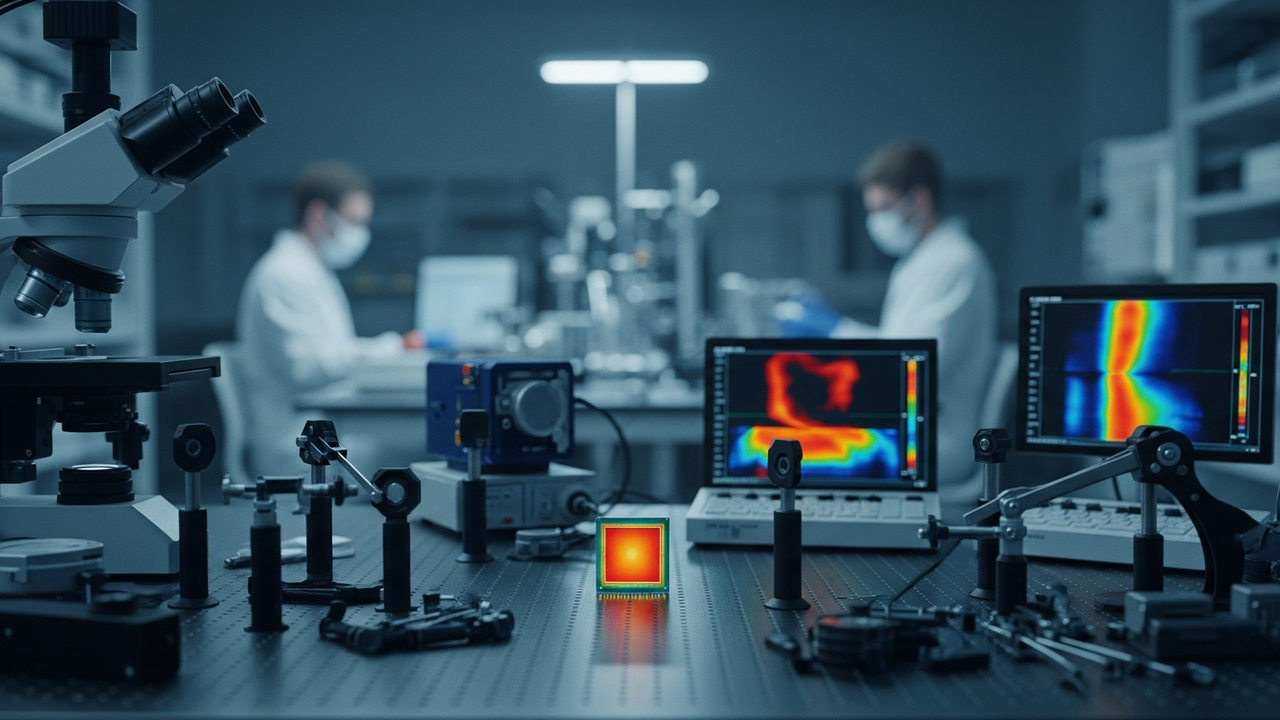
A research team at the Massachusetts Institute of Technology (MIT) has developed a groundbreaking tiny infrared chip that can dynamically control light properties by integrating metasurfaces with phase change materials (PCMs). This innovative device holds the potential to dramatically improve the detection performance of gases and heat, contributing to the realization of a new generation of more compact and programmable optical devices that can replace conventional large optical systems. This is expected to accelerate advancements in sensor technology across a wide range of application areas, including autonomous vehicles, medical diagnostics, and environmental monitoring.
Technical / Clinical Details
The developed infrared chip features a metasurface, a thin film with nanoscale microstructures. This metasurface is engineered to interact with specific wavelengths of infrared light, and its optical properties change depending on the state of the embedded phase change material. The research team adopted thermally controllable PCMs, such as vanadium dioxide (VO2). VO2 undergoes a metal-insulator transition at a specific temperature, which dramatically alters its optical index. By leveraging this transition to switch the state of the PCM via external thermal stimuli (e.g., micro-heaters or lasers), the chip can modulate the intensity, phase, or polarization of infrared light passing through the metasurface in real time. Experiments demonstrated that this chip can detect specific gas components (e.g., CO2) with approximately 20% higher sensitivity compared to conventional methods, and its thermal detection response time to ambient temperature changes is about three times faster than traditional thermal sensors. This enables quicker and more accurate gas concentration measurements and temperature mapping.
Background & Context
Infrared detection technology is indispensable in diverse fields such as chemical analysis, security, industrial process control, and military applications. However, conventional infrared sensors and spectrometers often require large optical components and mechanical moving parts, posing challenges in terms of cost, size, and power consumption. Metasurface technology has emerged as a promising approach to overcome these issues, manipulating light at sub-wavelength scales to realize ultra-compact, high-performance optical devices. The combination of PCMs and metasurfaces enables ‘active metasurfaces’ that can dynamically tune optical properties, laying the foundation for next-generation smart sensors and optical systems. This technology is a further advancement of MIT’s previous research on miniature lenses that adjust focus through phase changes.
Strategic Significance & Outlook
This tiny infrared chip is expected to find wide applications, including enhancing environmental perception capabilities in LiDAR systems for autonomous vehicles, biomedical gas analysis in portable medical diagnostic devices, and gas leak detection and thermal imaging monitoring in smart homes and industrial facilities. Future research will focus on expanding the chip’s operating wavelength range, further accelerating response speed, improving the scalability and cost-efficiency of manufacturing processes, and ensuring long-term reliability. If commercialized, this technology holds the potential to replace many existing sensor systems and significantly contribute to the realization of a more intelligent and connected world.
Source: https://news.mit.edu/2026/tiny-infrared-chip-could-improve-gas-and-heat-detection-0713
Get our weekly technology intelligence — free
Receive an infographic that lets you judge at a glance whether each field’s analysis report is worth reading.
Subscribe Free — Weekly Tech Intelligence
By subscribing, you’ll receive Troy-Technical’s weekly technology intelligence newsletter.
- Your email and selected fields are used only to deliver the newsletter.
- We never share your information with third parties.
- You can unsubscribe anytime via the link in each email.
See our Privacy Policy for details.
Takes about a minute · Unsubscribe anytime








Comments