Key Findings
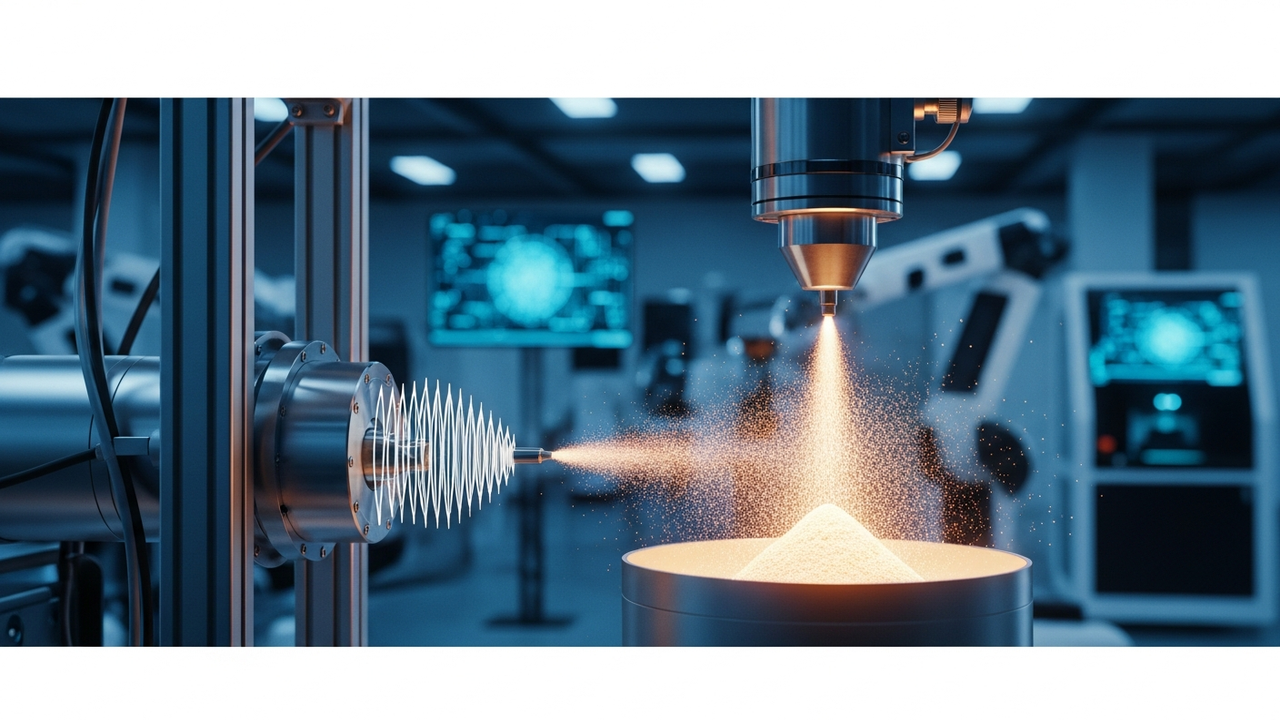
In recent research published in MDPI, the ultrasonic atomization process for TiZrNbHfTa refractory high-entropy alloys (HEAs) has been thoroughly characterized, establishing a new method for producing high-quality powders for additive manufacturing (AM). This technology demonstrates the ability to control powder homogeneity, sphericity, and porosity to high standards, achieving optimal particle size distribution for key AM processes like Laser Powder Bed Fusion (LPBF) and Powder Directed Energy Deposition (DED). This marks a significant breakthrough poised to revolutionize the manufacturing of high-performance components in the aerospace, defense, and energy industries.
Technical / Clinical Details
Ultrasonic atomization is a technique that uses high-frequency ultrasonic vibrations to break down molten metal into fine droplets, which then solidify into powder. This study specifically targeted TiZrNbHfTa, an HEA composed of five refractory elements. Experiments optimized ultrasonic frequency, molten metal flow rate, and cooling gas conditions to efficiently produce powders with a narrow particle size distribution, primarily in the range of 20-60 micrometers. The resulting powders exhibited very high sphericity, approximately 95%, and were confirmed to be largely free of internal defects and porosity. X-ray diffraction (XRD) analysis showed that the powders maintained a uniform solid solution structure, with extremely low element segregation, a characteristic feature of HEAs. This implies the ability to produce powders with more uniform compositional distribution and finer grain structures compared to conventional gas atomization methods. Such high-quality powders are essential for AM processes like LPBF and DED, as they enhance interlayer bonding strength and improve the mechanical properties of the final products.
Background & Context
Refractory high-entropy alloys are attracting attention as next-generation materials for applications in extreme environments, such as aerospace engine components, nuclear power plant components, and high-temperature industrial equipment, due to their excellent high-temperature strength, corrosion resistance, and radiation resistance. However, manufacturing these complex alloys using conventional processing methods has been challenging, and a stable supply of high-quality powders, particularly for AM applications, has been a critical issue. Ultrasonic atomization technology has emerged as a promising solution to overcome this challenge, offering lower energy consumption and more controlled powder characteristics compared to traditional gas atomization.
Strategic Significance & Outlook
The establishment of this ultrasonic atomization technology will accelerate its application to the production of AM powders for other refractory HEAs and complex alloys, not just TiZrNbHfTa. Future research will need to focus on further optimizing the manufacturing process, customizing different powder characteristics, and scaling up to large-scale production. A stable supply of these high-quality HEA powders, coupled with advancements in AM technology, will enable innovative component design and manufacturing in aerospace, defense, energy, and even medical sectors. In the long term, these lighter, high-performance, and longer-lasting components are expected to dramatically improve the performance of existing industrial equipment and create billions of dollars in economic value.
Source: https://www.mdpi.com/2674-0516/5/3/25
Get our weekly technology intelligence — free
Receive an infographic that lets you judge at a glance whether each field’s analysis report is worth reading.
Subscribe Free — Weekly Tech Intelligence
By subscribing, you’ll receive Troy-Technical’s weekly technology intelligence newsletter.
- Your email and selected fields are used only to deliver the newsletter.
- We never share your information with third parties.
- You can unsubscribe anytime via the link in each email.
See our Privacy Policy for details.
Takes about a minute · Unsubscribe anytime








Comments