Key Findings
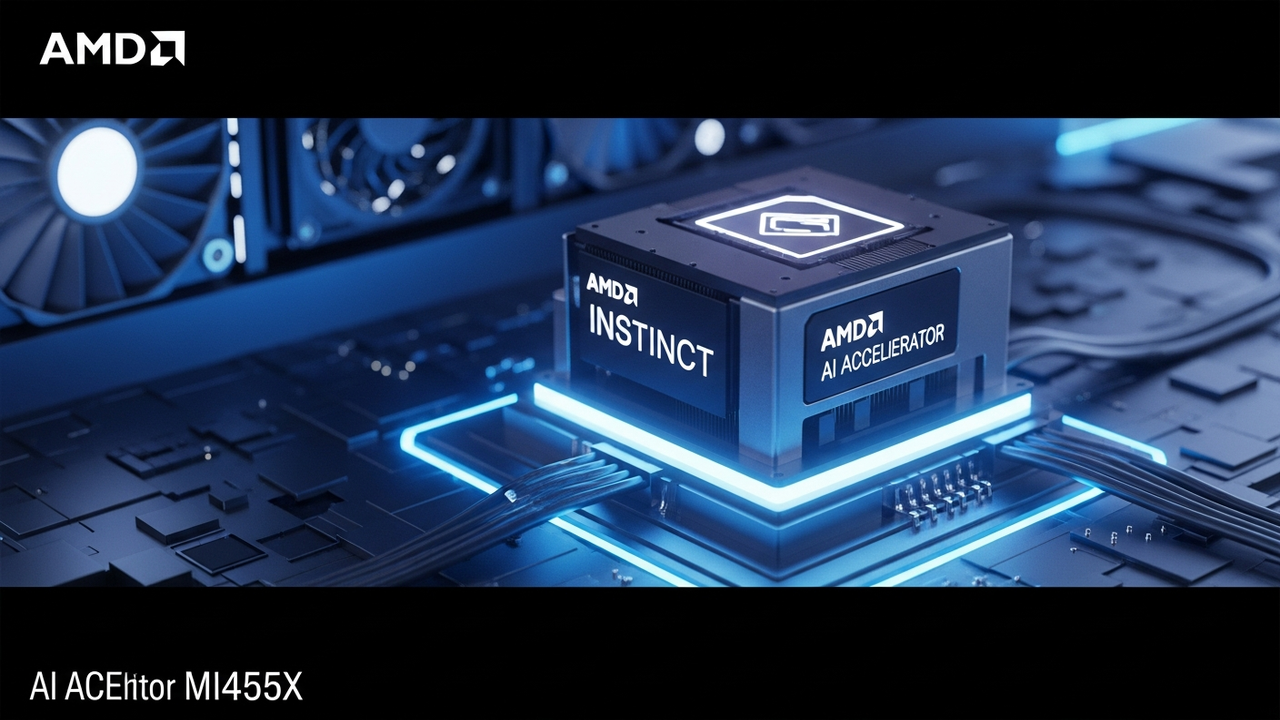
AMD has unveiled its Instinct MI455X AI accelerator, signaling a strengthened challenge to Nvidia in the data center AI market. This new accelerator combines AMD’s CDNA 5 architecture with its Helios rack-scale architecture, notable for featuring a significantly larger 432GB of HBM4 memory, which substantially surpasses the 288GB expected in Nvidia’s upcoming Rubin GPU.
Technical & Product Details
- CDNA 5 Architecture: The Instinct MI455X is powered by AMD’s latest AI-optimized architecture, CDNA 5. This architecture is engineered to deliver exceptional computational performance and efficiency for training and inference of large-scale AI models.
- Helios Rack-Scale Architecture: Designed not only as a standalone GPU but also as an integral part of the Helios rack-scale architecture, the MI455X enables efficient inter-accelerator communication. This maximizes AI computing capabilities at the rack level, catering to the demanding needs of hyperscalers and large enterprises.
- Massive HBM4 Memory: The most prominent feature of the Instinct MI455X is its colossal 432GB of HBM4 (High Bandwidth Memory). This capacity is approximately 1.5 times greater than the 288GB expected in Nvidia’s Rubin GPU, providing a significant advantage for memory-intensive AI workloads such as large language models (LLMs) and multimodal models, where memory bandwidth often acts as a bottleneck.
- Performance Rivalry with Nvidia Rubin: AMD indicates that the MI455X will offer competitive theoretical peak FLOPS against Nvidia’s Rubin, suggesting an intensifying battle in the data center AI accelerator market. This direct comparison sets a clear competitive benchmark for the industry.
Background & Industry Context
While Nvidia holds a commanding share of the AI chip market, AMD continues its aggressive push with its high-performance Instinct series. The availability and efficient utilization of HBM are crucial factors determining the performance and cost-effectiveness of AI accelerators. As Nvidia’s Rubin GPU emphasizes addressing memory bottlenecks in AI inference, AMD’s introduction of the MI455X with a much larger HBM4 capacity represents a strategic move to capitalize on the increasing demand for memory-intensive AI workloads. This also contributes to enhancing diversity and choice within the broader AI ecosystem.
Future Outlook
The arrival of the AMD Instinct MI455X is set to further intensify competition in the data center AI accelerator market. Particularly for next-generation AI models where memory capacity directly correlates with performance, the MI455X’s 432GB of HBM4 could be a significant differentiator. The ongoing innovation race between Nvidia and AMD is expected to accelerate the evolution of AI technology, ultimately leading to more powerful and efficient AI solutions. This competition is vital for providing customers with superior options and driving the overall advancement of AI infrastructure.
Get our weekly technology intelligence — free
Receive an infographic that lets you judge at a glance whether each field’s analysis report is worth reading.
Subscribe Free — Weekly Tech Intelligence
By subscribing, you’ll receive Troy-Technical’s weekly technology intelligence newsletter.
- Your email and selected fields are used only to deliver the newsletter.
- We never share your information with third parties.
- You can unsubscribe anytime via the link in each email.
See our Privacy Policy for details.
Takes about a minute · Unsubscribe anytime








Comments