Key Findings
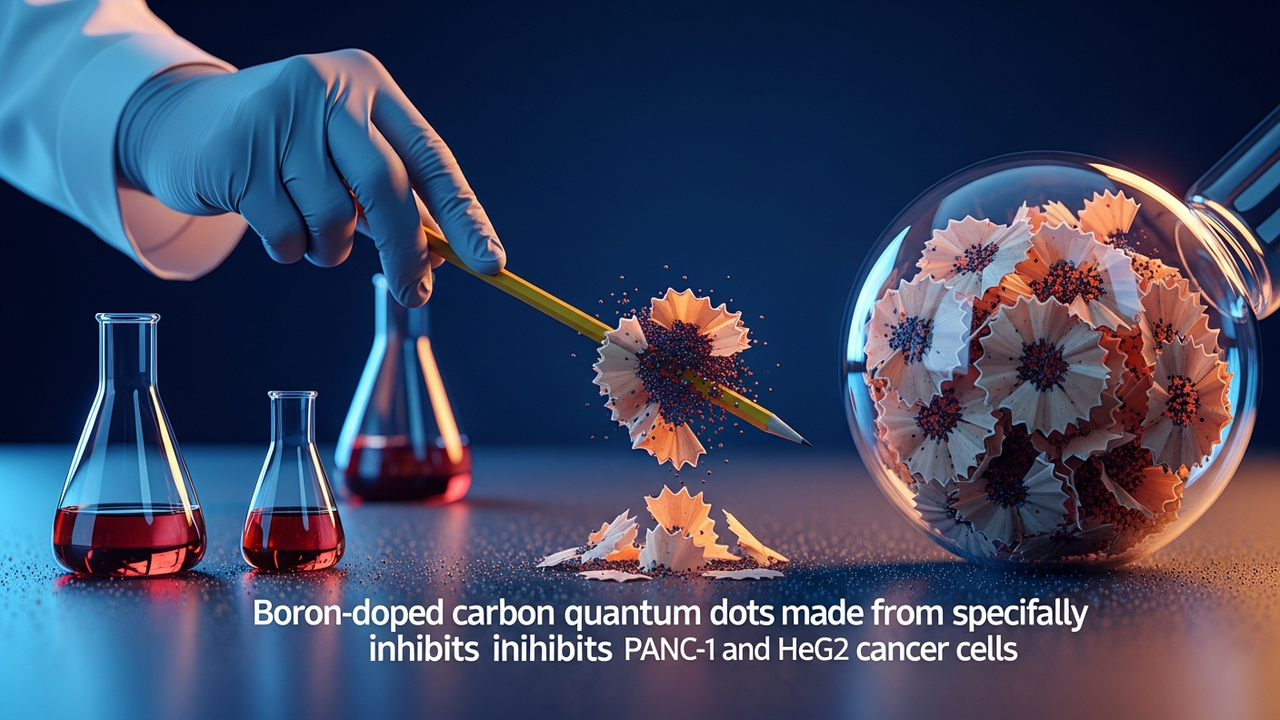
Researchers have successfully developed boron-doped carbon quantum dots (B-C-dots) from a sustainable and inexpensive source—pencil shavings—demonstrating selective antiproliferative activity against PANC-1 (pancreatic cancer) and HepG2 (liver cancer) cells, while proving harmless to healthy 3T3-L1 fibroblasts. This breakthrough offers a promising avenue for targeted cancer therapy with reduced side effects.
Technical / Clinical Details
The B-C-dots were efficiently synthesized using a combination of hydrothermal and microwave methods. Transmission electron microscopy (TEM) analysis confirmed their quasi-spherical morphology with an average diameter of approximately 6 nanometers. Optical characterization revealed stable, excitation-independent luminescence, achieving a high photoluminescence quantum yield of 38%. In cytotoxicity assays, the B-C-dots effectively suppressed the proliferation of PANC-1 and HepG2 cells, while showing minimal impact on normal cells, suggesting a high therapeutic index. Furthermore, these B-C-dots are noted for their excellent biocompatibility, indicating promising safety profiles for in vivo applications.
Background & Context
Carbon quantum dots (CQDs) have gained significant attention recently as promising nanomaterials for bioimaging and drug delivery systems, owing to their low toxicity, excellent biocompatibility, and tunable fluorescent properties. The ‘upcycling’ of waste materials for CQD production offers significant advantages in terms of reduced environmental footprint and improved cost-efficiency. Boron doping is recognized as a crucial strategy to precisely tune the electronic structure and luminescence properties of CQDs, thereby imparting specific biological functionalities. This study paves a new direction in integrating sustainable materials science with cancer nanomedicine.
Strategic Significance & Outlook
These findings suggest that B-C-dots hold immense potential as next-generation theranostic agents, enabling high-resolution bioimaging and selective targeted therapy. Future research may focus on developing integrated systems using these nanomaterials for early cancer biomarker detection, targeted delivery of anticancer drugs, and real-time monitoring of therapeutic efficacy. Moreover, their production from common waste material like pencil shavings hints at low-cost, large-scale manufacturing potential, which could facilitate their adoption in regions with limited access to advanced medical technologies, promoting global health equity.
Get our weekly technology intelligence — free
Receive an infographic that lets you judge at a glance whether each field’s analysis report is worth reading.
Subscribe Free — Weekly Tech Intelligence
By subscribing, you’ll receive Troy-Technical’s weekly technology intelligence newsletter.
- Your email and selected fields are used only to deliver the newsletter.
- We never share your information with third parties.
- You can unsubscribe anytime via the link in each email.
See our Privacy Policy for details.
Takes about a minute · Unsubscribe anytime







Comments