Key Findings
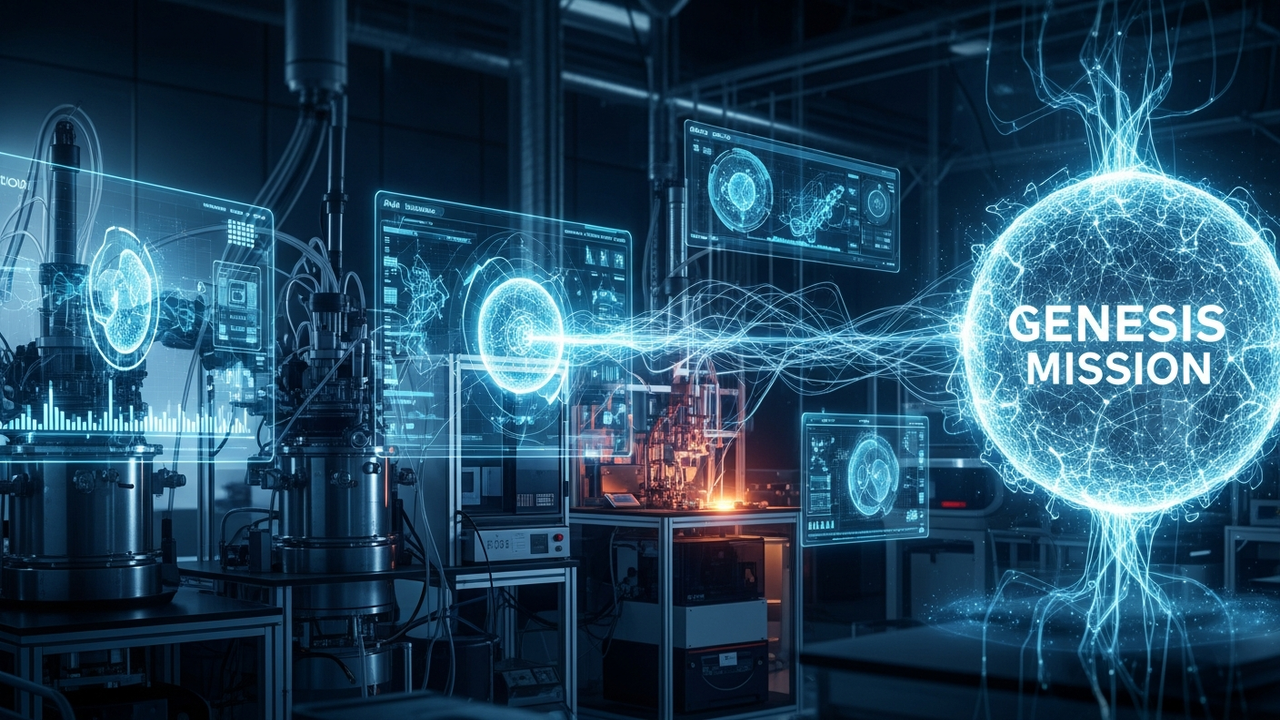
The U.S. Department of Energy (DOE)’s ‘GENESIS MISSION’ is a groundbreaking initiative aiming to achieve autonomy in bioprocess manufacturing through the integration of artificial intelligence (AI) and digital twin technologies. This project seeks to optimize the entire continuum from biological design to manufacturing outcomes, with the ambitious goal of dramatically improving yields, reducing costs, and significantly enhancing the robustness of bioindustrial processes.
Technical / Clinical Details
At the core of the GENESIS MISSION is the use of AI to interconnect several critical elements:
- Experimental Data: Vast datasets generated from high-throughput experiments.
- Structural Analysis: Detailed analytical data of biomolecules and cellular structures.
- Computational Models: Mathematical and computational models describing biological processes.
- Biodiversity Discovery: Exploration of new microorganisms and enzymes.
- Digital Twins: Virtual replicas of organisms (cell lines or microbes), bioreactors, and biochemical processes.
By integrating and analyzing these elements, AI enables researchers to explore a vast design space in bioprocessing. Digital twins simulate physical processes in real-time, predict future behaviors, and test various ‘what-if’ scenarios in a virtual environment. This accelerates optimization during the development phase, reducing the number and cost of experiments. For example, AI can accurately predict how a specific microbial strain will behave in a bioreactor and how much of a target substance it will produce, then autonomously adjust culture conditions to achieve maximum yield. This promises revolutionary efficiencies in the production of pharmaceuticals, biofuels, and biomaterials.
Background & Context
The bioeconomy holds significant potential to contribute to energy security, environmental protection, and economic growth through the development of sustainable products and processes. However, optimizing bioprocesses remains a major challenge due to the inherent complexity of biological systems and difficulties in scaling them up. Traditional trial-and-error approaches are time-consuming and costly, creating bottlenecks for innovation. The introduction of AI and digital twin technologies is seen as key to overcoming these challenges and transforming bioindustry into data-driven, autonomous manufacturing. The U.S. government is bolstering strategic investments in such advanced technologies to maintain leadership in the bioeconomy.
Strategic Significance & Outlook
The success of the GENESIS MISSION has the potential to fundamentally transform the efficiency and sustainability of bioindustrial manufacturing. Improved yields and reduced costs will enhance the market competitiveness of bio-products such as biofuels, bioplastics, and pharmaceuticals, accelerating their adoption. In the future, the realization of fully autonomous biomanufacturing platforms is expected, where the entire process from R&D to commercial production is optimized with minimal human intervention. This will usher in a new golden age for biotechnology, providing a foundation for innovative solutions to global challenges. Investors are closely monitoring the disruptive impact of this technology on the entire industry and the new market opportunities it will create.
Source: https://www.energy.gov/documents/ostp-genesis-mission-science-and-technology-challenges
Get our weekly technology intelligence — free
Receive an infographic that lets you judge at a glance whether each field’s analysis report is worth reading.
Subscribe Free — Weekly Tech Intelligence
By subscribing, you’ll receive Troy-Technical’s weekly technology intelligence newsletter.
- Your email and selected fields are used only to deliver the newsletter.
- We never share your information with third parties.
- You can unsubscribe anytime via the link in each email.
See our Privacy Policy for details.
Takes about a minute · Unsubscribe anytime





Comments