Key Findings
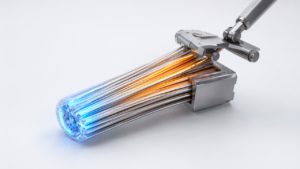
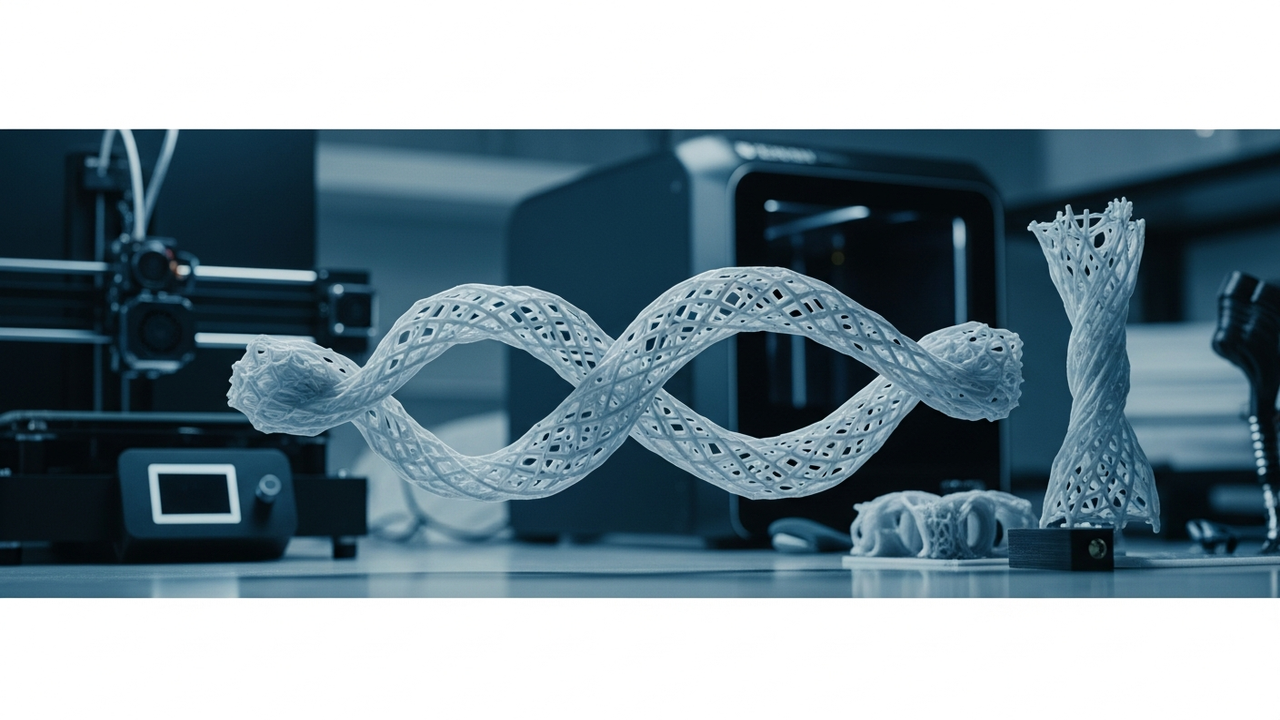
A research team at Pusan National University in South Korea has achieved a world-first by developing a groundbreaking 3D-printable smectic Liquid Crystal Elastomer (LCE) ink. This innovative material filament can dynamically switch between opposing movements—elongation and contraction—when heated, all from a single material. This breakthrough shatters the primary limitation of conventional 3D printing for soft, shape-changing materials, which was previously restricted to a single actuation mode. It holds immense potential to significantly expand the versatility and functionality of soft robotics and wearable devices.
Technical / Clinical Details
Conventional Liquid Crystal Elastomers (LCEs) are smart materials that change shape in response to external stimuli like heat or light, but their actuation mode was fixed by the material’s molecular alignment. This meant an LCE designed to elongate would always elongate, and one designed to contract would always contract, offering only unidirectional motion. The Pusan National University team developed a new smectic LCE ink and combined it with specialized 3D printing technology, enabling localized control of molecular alignment during the printing process. Specifically, as the ink is extruded from the printhead, techniques such as external magnetic fields or fluidic control are used to change the orientation of the liquid crystal molecules, known as ‘mesogens,’ within the LCE polymer chains in real-time. This allows different actuation characteristics to be imparted within the same filament; for instance, one part might elongate upon heating while another contracts. This precise molecular alignment control makes the macroscopic shape change of the material programmable, enabling complex movements—such as bending, opening, closing, or twisting—in response to heat without external mechanical parts. This technology is directly applicable to miniature robots for minimally invasive medical devices, actuators for more human-like soft robots, or adaptive surfaces that change shape according to environmental conditions.
Background & Context
Soft robotics, due to its flexibility and safety, is highly anticipated for applications in human-robot collaboration, delicate object manipulation, and medical fields. These robots utilize ‘smart materials’ as artificial muscles that change shape in response to external stimuli, but single-mode actuation has limited design freedom and made complex movements difficult to achieve. Traditional 3D printing technologies struggled with uniformity and molecular alignment control, imposing limits on the manufacturing of multifunctional soft materials. Pusan National University’s breakthrough represents a significant advancement in the convergence of 3D printing and smart materials science, solving a long-standing challenge in the field.
Strategic Significance & Outlook
The development of this 3D-printable smectic LCE ink is poised to revolutionize diverse fields, including soft robotics, wearable devices, biomimetic actuators, and minimally invasive medical instruments. The ability to achieve multiple modes of actuation from a single material will significantly simplify robot design, enabling the creation of lighter, more compact, and functionally complex devices. For example, applications previously unimaginable, such as heat-responsive opening and closing valves, sensors that deform under specific pressures, or miniature robots that navigate the body for drug delivery, may now become feasible. This technology will also contribute to reducing manufacturing costs and accelerating development timelines, expanding the application scope of smart materials and is expected to have a significant impact on industry and society globally.
Source: https://www.pusan.ac.kr/eng/CMS/Board/Board.do?mCode=MN104&&mode=view&board_seq=1510341&
Get our weekly technology intelligence — free
Receive an infographic that lets you judge at a glance whether each field’s analysis report is worth reading.
Subscribe Free — Weekly Tech Intelligence
By subscribing, you’ll receive Troy-Technical’s weekly technology intelligence newsletter.
- Your email and selected fields are used only to deliver the newsletter.
- We never share your information with third parties.
- You can unsubscribe anytime via the link in each email.
See our Privacy Policy for details.
Takes about a minute · Unsubscribe anytime