Key Findings
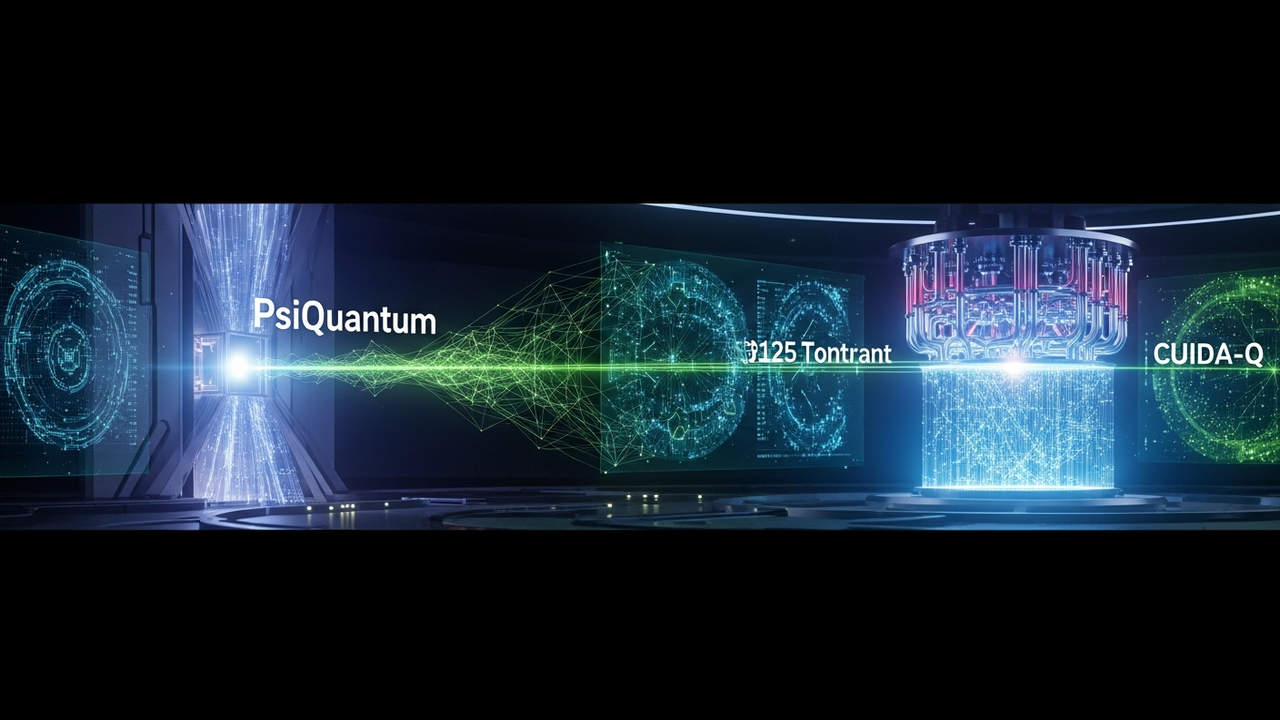
PsiQuantum has been awarded a significant $125 million contract under the U.S. Defense Advanced Research Projects Agency (DARPA)’s Quantum Benchmarking Initiative (QBI) program. This substantial investment is set to accelerate research and development towards the realization of fault-tolerant quantum computing. In tandem, the company announced the integration of NVIDIA’s CUDA-Q quantum computing platform into its “Construct” fault-tolerant quantum application development software suite. These two advancements collectively represent crucial milestones towards the development of large-scale, practical quantum computers.
Technical / Clinical Details
- **Significance of the DARPA Contract**: The DARPA QBI program aims to establish benchmarks for the development and evaluation of large-scale quantum computers. PsiQuantum’s contract award signifies recognition of its approach to fault-tolerant quantum computing—particularly its light-based quantum computing architecture—as strategically vital for U.S. national security and technological superiority. The funding will be allocated to R&D efforts crucial for achieving fault-tolerant qubits, improving error correction techniques, and constructing large-scale quantum systems.
- **Integration with NVIDIA CUDA-Q**:
- **Construct Suite**: PsiQuantum’s Construct is a comprehensive software environment designed for designing, simulating, and executing fault-tolerant quantum algorithms.
- **Role of CUDA-Q**: NVIDIA CUDA-Q is a powerful platform aimed at accelerating quantum algorithms and controlling quantum devices. Its integration with Construct will enable developers to leverage NVIDIA’s GPU acceleration for more efficient simulation of larger quantum circuits, thereby accelerating the architectural design and algorithm development for fault-tolerant quantum computers.
- **Impact on Developers**: This integration will empower quantum software developers to explore complex quantum problems more rapidly and lower the barriers to implementing fault-tolerant quantum computing. It will also strengthen the quantum application development ecosystem.
- **Fault-Tolerant Quantum Computing**: Fault-tolerant quantum computers are essential for enabling practical large-scale quantum computations, as they can autonomously correct errors caused by qubit decoherence and noise. PsiQuantum leads in this field with an approach that utilizes photons as qubits.
Background & Context
Quantum computing holds the potential to solve complex problems intractable for current classical computers—such as new drug discovery, material design, and cryptography—but it faces significant challenges related to qubit instability. Fault-tolerant quantum computing is the next frontier, aiming to overcome these issues and enable large-scale, reliable quantum computers applicable to real-world problems. Significant investments from government agencies like DARPA indicate the recognition that quantum technologies offer strategic advantages at a national level.
Strategic Significance & Outlook
PsiQuantum’s DARPA contract and NVIDIA CUDA-Q integration are set to accelerate the roadmap toward achieving fault-tolerant quantum computing. This will drive forward research and demonstration of quantum error correction and enhance the ability to efficiently control and manipulate a larger number of qubits. In the long term, these advancements have the potential to expedite the timeline for quantum computers to deliver practical value across industries such as pharmaceuticals, finance, and defense. PsiQuantum’s approach underscores the critical importance of optical technology in shaping the future of quantum computing.
Source: https://www.psiquantum.com/news
Get our weekly technology intelligence — free
Receive an infographic that lets you judge at a glance whether each field’s analysis report is worth reading.
Subscribe Free — Weekly Tech Intelligence
By subscribing, you’ll receive Troy-Technical’s weekly technology intelligence newsletter.
- Your email and selected fields are used only to deliver the newsletter.
- We never share your information with third parties.
- You can unsubscribe anytime via the link in each email.
See our Privacy Policy for details.
Takes about a minute · Unsubscribe anytime