Key Findings
Researchers at the Massachusetts Institute of Technology (MIT) have introduced a groundbreaking mathematical framework designed to revolutionize the design and manufacturing of bio-inspired adaptive materials. This innovative approach holds immense potential for applications ranging from soft robotics to next-generation morphing aircraft wings, enabling materials to dynamically respond and adjust to their external environments.
Technical / Clinical Details
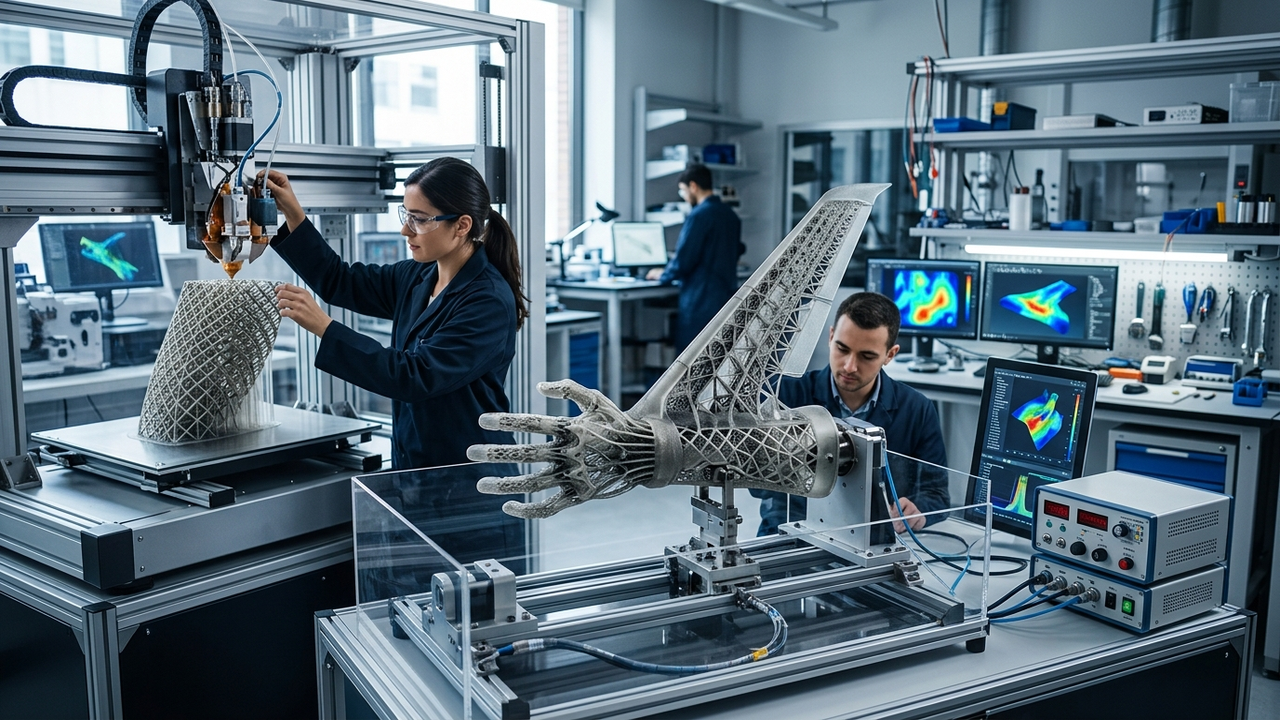
The core of this framework lies in mathematically modeling biological principles, specifically how living organisms self-organize and adapt to their surroundings. By combining these models with advanced digital design and 3D printing technologies, the team has enabled the efficient fabrication of adaptive materials with intricate geometries and functionalities. A crucial element of this research is the planned integration of AI models, which are expected to dramatically accelerate the prediction of material properties and the rapid exploration of optimal designs. This synergistic approach aims to reduce the iterative trial-and-error process, thereby shortening development cycles and leading to faster innovation in advanced materials.
Background & Context
Traditional material design typically involves creating materials with fixed properties tailored for specific applications. However, emerging fields such as soft robotics and smart structures demand materials that are far more flexible and adaptive, capable of real-time responses to environmental changes. The framework developed by MIT represents a significant leap forward in addressing these demands, offering a solution to the long-standing challenge of translating complex biological concepts into engineered manufacturing processes. This capability is critical for developing systems that can self-regulate, self-repair, or reconfigure in dynamic environments.
Strategic Significance & Outlook
The implications of this technology are vast, spanning various sectors including aerospace, where it could lead to more fuel-efficient morphing wings; healthcare, for personalized biocompatible devices; and consumer products, for innovative tactile interfaces. Further enhancing the integration with AI could pave the way for autonomous material discovery and design, establishing a foundational technology for future innovations. This research signifies a paradigm shift in how functional materials are conceived, designed, and brought into existence, promising a future where materials are as responsive and intelligent as biological systems.
Get our weekly technology intelligence — free
Receive an infographic that lets you judge at a glance whether each field’s analysis report is worth reading.
Subscribe Free — Weekly Tech Intelligence
By subscribing, you’ll receive Troy-Technical’s weekly technology intelligence newsletter.
- Your email and selected fields are used only to deliver the newsletter.
- We never share your information with third parties.
- You can unsubscribe anytime via the link in each email.
See our Privacy Policy for details.
Takes about a minute · Unsubscribe anytime