Key Findings
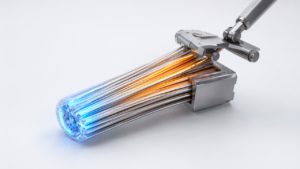
Fabbaloo, a prominent 3D printing media outlet, has reported on the development of an innovative 3D printing technology specifically designed for smectic liquid crystal elastomers (LCEs). This novel technique enables the independent programming of opposing actuation behaviors—such as expansion and contraction—into different sections of a single filament. This advancement facilitates the creation of highly functional, self-deforming surfaces and structures with promising applications in aerodynamic control, haptic displays, and soft robotics.
Technical / Clinical Details
Liquid Crystal Elastomers (LCEs) are smart materials known for their ability to reversibly change shape in response to external stimuli like temperature or light. Smectic LCEs are characterized by their layered molecular arrangement, exhibiting significant deformation along specific directions. This new 3D printing technology integrates high-resolution additive manufacturing processes with precise control over LCE molecular alignment. Specifically, local magnetic fields or light irradiation are utilized to adjust the orientation of liquid crystal molecules within individual filament sections as the print head moves. This allows for programming complex, multi-responsive behaviors, where, for instance, one section might expand upon heating while an adjacent section contracts, all within the same filament. Such spatially differentiated actuation was previously challenging to achieve with conventional LCE fabrication methods, often requiring intricate post-processing or multi-material approaches.
Background & Context
Fields such as soft robotics, wearable devices, and smart actuators demand materials that can flexibly respond to external stimuli and undergo complex deformations. Traditional LCE manufacturing has been largely limited to bulk synthesis or thin-film formation, making precise micro-scale patterning and programming diverse responses within a single structure significant technical challenges. This new 3D printing technology overcomes these hurdles, providing unprecedented design freedom for LCE-based devices. In aerodynamic control, for example, it could lead to aircraft wing surfaces that deform in real-time to improve fuel efficiency. In haptic displays, it could create novel interfaces offering diverse tactile feedback to users, enhancing immersive experiences.
Strategic Significance & Outlook
This 3D printing technology for LCEs holds immense potential for the development of highly functional and adaptive next-generation products. Anticipated applications include soft robots that autonomously adapt to their environment, braille displays for visually impaired individuals, and flexible actuators for smart medical devices. Future research will likely focus on improving printing speed, expanding the range of compatible materials, and increasing the complexity of programmable actuation behaviors. These advancements are expected to accelerate the practical adoption of LCE technology, driving innovation across various industrial sectors and enabling a new class of intelligent, responsive systems.
Source: https://www.fabbaloo.com/news/3d-printed-liquid-crystal-elastomers-learn-to-expand-and-contract
Get our weekly technology intelligence — free
Receive an infographic that lets you judge at a glance whether each field’s analysis report is worth reading.
Subscribe Free — Weekly Tech Intelligence
By subscribing, you’ll receive Troy-Technical’s weekly technology intelligence newsletter.
- Your email and selected fields are used only to deliver the newsletter.
- We never share your information with third parties.
- You can unsubscribe anytime via the link in each email.
See our Privacy Policy for details.
Takes about a minute · Unsubscribe anytime