Key Findings
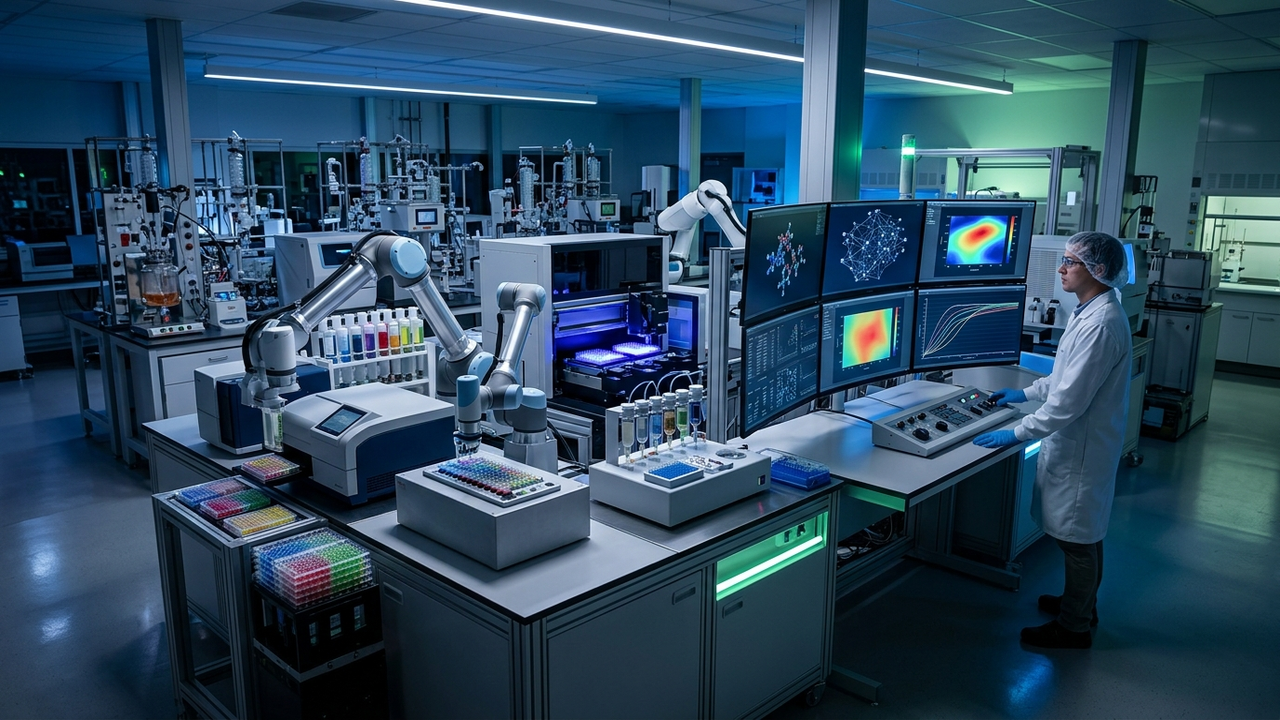
A paper published in Scifiniti, titled ‘AI-Guided Self-Driving Laboratories for Advanced Materials Discovery,’ posits that AI-guided autonomous materials discovery laboratories (self-driving labs) have the potential to dramatically accelerate the pace of novel material and metallurgical discovery. This innovative approach suggests that by autonomously executing a sequence of processes—including material formulation, processing, and testing—with significantly reduced human intervention, the traditional discovery cycle of decades can be compressed into just a few weeks.
Technical / Clinical Details
Autonomous materials discovery labs function by combining closed-loop machine learning (ML) algorithms with advanced robotic experimental systems and fundamental principles of traditional materials engineering. The ML algorithms learn from historical data and current experimental results to optimize and propose the next best material compositions or process conditions. Based on these proposals, robotic arms and automated synthesis equipment precisely formulate and process materials, including heat treatment or mechanical manipulation. Subsequently, automated testing apparatuses measure the material’s properties (e.g., strength, conductivity, thermal stability), and these results are fed back into the ML algorithms, continuing the learning cycle. This iterative process repeats until optimal material properties or processing conditions are discovered, efficiently exploring the material design space. Human researchers are freed from repetitive experimental tasks, allowing them to focus on high-level goal setting and system oversight.
Background & Context
The development of new materials is foundational to technological innovation and industrial competitiveness, yet the process is inherently time-consuming and costly. Especially for materials with complex compositions or those where multiple process parameters interact, finding optimal conditions has involved extensive trial-and-error. The concept of autonomous labs has gained significant attention recently as a means to overcome this bottleneck and dramatically improve the efficiency of material development. This enables faster technological progress in many strategic industrial sectors, including sustainable energy, high-performance electronics, and advanced manufacturing.
Strategic Significance & Outlook
AI-guided autonomous materials discovery labs are poised to become a pivotal technology shaping the future of materials science research. Further development and widespread adoption of these platforms are expected to enable the faster and more cost-effective discovery of materials with novel properties previously unattainable. In the future, these labs could form international networks, accelerating global materials innovation through shared knowledge and data. Companies and research institutions can strategically adopt this technology to enhance their R&D competitiveness and create new market opportunities. This is expected to accelerate responses to major challenges facing humanity, such as environmental, energy, and medical issues.
Source: https://www.scifiniti.com/3104-4719/3/2026.0041
Get our weekly technology intelligence — free
Receive an infographic that lets you judge at a glance whether each field’s analysis report is worth reading.
Subscribe Free — Weekly Tech Intelligence
By subscribing, you’ll receive Troy-Technical’s weekly technology intelligence newsletter.
- Your email and selected fields are used only to deliver the newsletter.
- We never share your information with third parties.
- You can unsubscribe anytime via the link in each email.
See our Privacy Policy for details.
Takes about a minute · Unsubscribe anytime








Comments