Key Findings
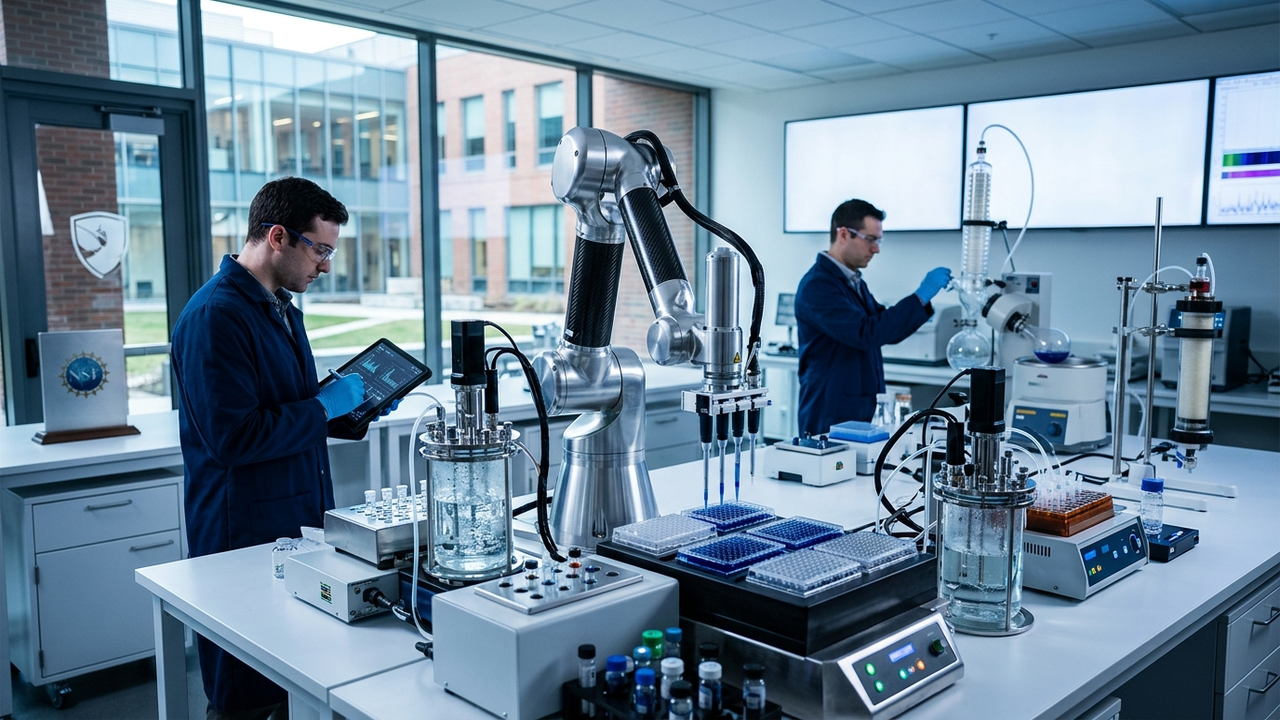
Professor Abigail Doyle of Princeton University and her collaborators have been awarded a substantial $19.5 million grant from the National Science Foundation (NSF) to establish an open-access, AI-enabled autonomous chemistry laboratory. This pioneering lab aims to accelerate the discovery of new catalytic reactions and nurture the next generation of chemical researchers, holding the potential to fundamentally transform the paradigm of R&D in the chemical sciences.
Technical / Clinical Details
The autonomous chemistry laboratory will function as a closed-loop system, integrating AI-guided robotics with advanced analytical instrumentation. The AI system, based on existing chemical data and machine learning algorithms, will propose novel synthesis pathways and catalyst candidates. These proposals will then be automatically synthesized, and reaction conditions optimized by robotic arms and liquid handling systems, with real-time analysis of reaction products. The analytical results will be fed back into the AI, improving model accuracy and automatically designing subsequent experiments. This enables rapid and efficient execution of the catalyst discovery, optimization, and scale-up processes without human intervention. The lab’s open-access design will allow researchers worldwide to submit ideas, design and execute experiments via the cloud, and obtain results. This integration of diverse researcher insights is expected to accelerate chemical discoveries.
Background & Context
The discovery of new reactions and catalysts in chemistry is crucial for the advancement of diverse industrial sectors, including pharmaceuticals, materials, and energy. However, traditional chemical synthesis research is labor-intensive, time-consuming, and limited in its high-throughput experimental capabilities. The concept of autonomous laboratories has garnered significant attention recently as a means to overcome these bottlenecks and dramatically improve the efficiency of chemical research. This substantial NSF investment demonstrates that autonomous research infrastructure is recognized as a critical strategic element for strengthening U.S. scientific and technological competitiveness and driving global innovation.
Strategic Significance & Outlook
The establishment of this autonomous chemistry laboratory will have a profound impact on the field of chemistry. By accelerating the discovery of new catalytic reactions, more efficient and environmentally friendly synthesis processes can be developed, potentially leading to reduced drug manufacturing costs and the creation of new functional materials. Furthermore, its role as an open-access platform is expected to foster collaboration and knowledge sharing among the global scientific community, accelerating overall innovation in chemistry. In the future, this lab could serve as a model for laboratory automation and AI-driven discovery, paving the way for similar autonomous research infrastructures in other scientific disciplines. From the perspective of training next-generation chemists, it will provide practical opportunities for AI and robotics education, playing a vital role in nurturing future scientific leaders.
Get our weekly technology intelligence — free
Receive an infographic that lets you judge at a glance whether each field’s analysis report is worth reading.
Subscribe Free — Weekly Tech Intelligence
By subscribing, you’ll receive Troy-Technical’s weekly technology intelligence newsletter.
- Your email and selected fields are used only to deliver the newsletter.
- We never share your information with third parties.
- You can unsubscribe anytime via the link in each email.
See our Privacy Policy for details.
Takes about a minute · Unsubscribe anytime





Comments