Key Findings
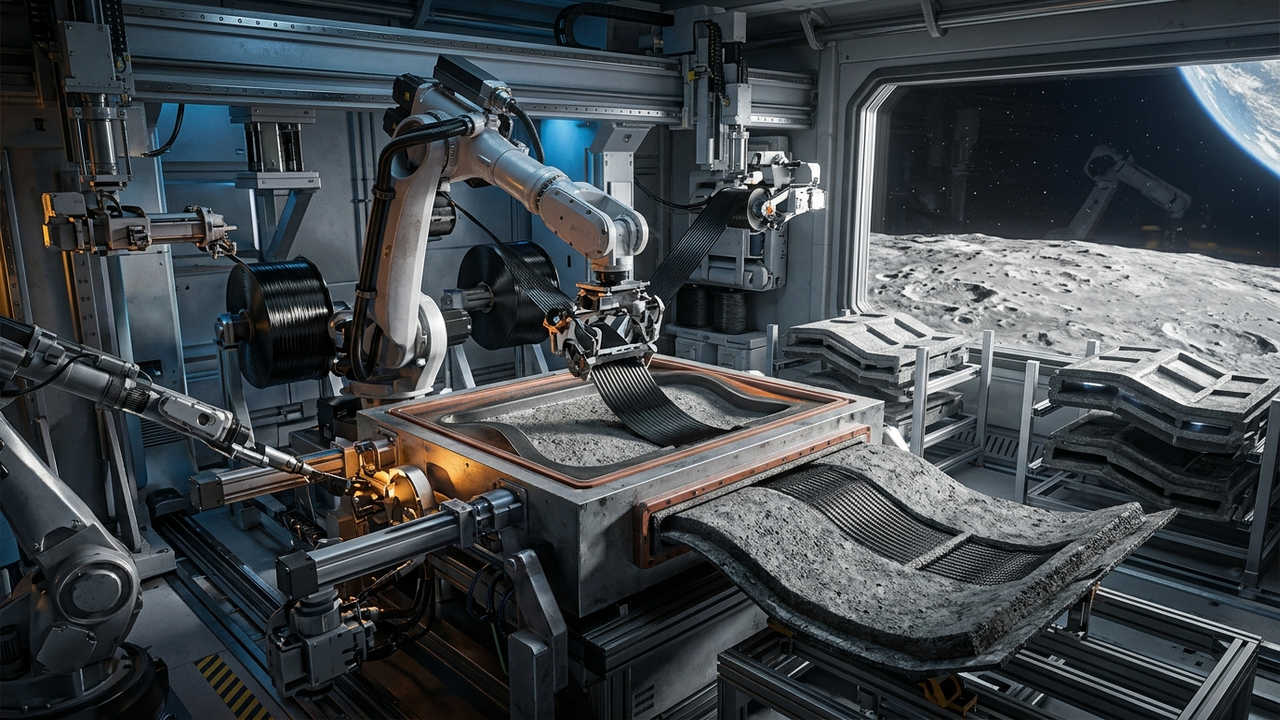
Groundbreaking research has been published detailing an innovative manufacturing process for structural shields intended for future lunar habitats, to be fabricated directly in orbit. The study focuses on embedding unidirectional carbon fibers into regolith simulants, effectively creating robust composite materials. Critically, this geopolymerization-based process demonstrates a significant reduction in curing time and water consumption compared to traditional geopolymerization techniques, offering substantial practical advantages for manufacturing in the resource-constrained environment of space.
Technical Details
The proposed manufacturing process ingeniously utilizes regolith, abundant on the lunar surface, as the primary raw material. High-strength unidirectional carbon fibers are then integrated as a reinforcing agent to construct composite structures with superior mechanical properties. Geopolymerization is a chemical reaction where silica and alumina-rich materials react with an alkaline solution to form a polymeric structure. This process proceeds at near-ambient temperatures, which is advantageous for minimizing energy consumption in space. The innovation lies in refining this geopolymerization process to drastically reduce the required curing time and water usage. Given that water is an extremely precious resource in space, minimizing its consumption dramatically enhances the sustainability of autonomous manufacturing activities on the Moon. By strategically embedding unidirectional carbon fibers, the resulting composite material exhibits high tensile strength and rigidity in specific directions, making it ideal for shielding inhabitants from lunar radiation and micrometeoroid impacts.
Background and Industry Context
Lunar exploration and the establishment of future lunar bases represent a significant objective for both national space agencies and private enterprises worldwide. However, the immense cost of transporting construction materials from Earth poses one of the greatest barriers to sustainable lunar operations. Consequently, the development of in-situ resource utilization (ISRU) manufacturing technologies that leverage local lunar resources has become an urgent priority. While research on using regolith as a construction material has been ongoing, approaches that enhance structural strength and reliability through composite materials like carbon fibers, as demonstrated in this study, are crucial for realizing safer and more durable lunar habitats. This technology significantly reduces reliance on Earth-based resupply and is pivotal for improving the economic feasibility and sustainability of space exploration.
Strategic Significance and Outlook
This in-space manufacturing technology, combining unidirectional carbon fibers with regolith simulants, promises to dramatically reduce the transportation costs associated with lunar structural construction. Furthermore, it paves the way for resource-based construction for deep space missions where Earth-supplied materials are prohibitively expensive or impractical. Future research will need to validate this process with actual lunar regolith, assess long-term durability, and address the automation and scale-up of manufacturing. The successful establishment of this technology is expected to form a cornerstone for enabling a permanent human presence on the Moon and opening new frontiers in space infrastructure development.
Source: https://www.mdpi.com/2079-6439/14/9/100
Get our weekly technology intelligence — free
Receive an infographic that lets you judge at a glance whether each field’s analysis report is worth reading.
Subscribe Free — Weekly Tech Intelligence
By subscribing, you’ll receive Troy-Technical’s weekly technology intelligence newsletter.
- Your email and selected fields are used only to deliver the newsletter.
- We never share your information with third parties.
- You can unsubscribe anytime via the link in each email.
See our Privacy Policy for details.
Takes about a minute · Unsubscribe anytime








Comments