Key Findings
This article provides a comprehensive overview of quantum dots (QDs), semiconductor nanocrystals capable of precise optical and electronic property tuning at the nanoscale. It specifically highlights the increasing significance of cadmium-free InP QDs and addresses stability challenges for perovskite QDs in display applications, emphasizing the critical role of size and composition control in customizing QD characteristics.
Technical / Clinical Details
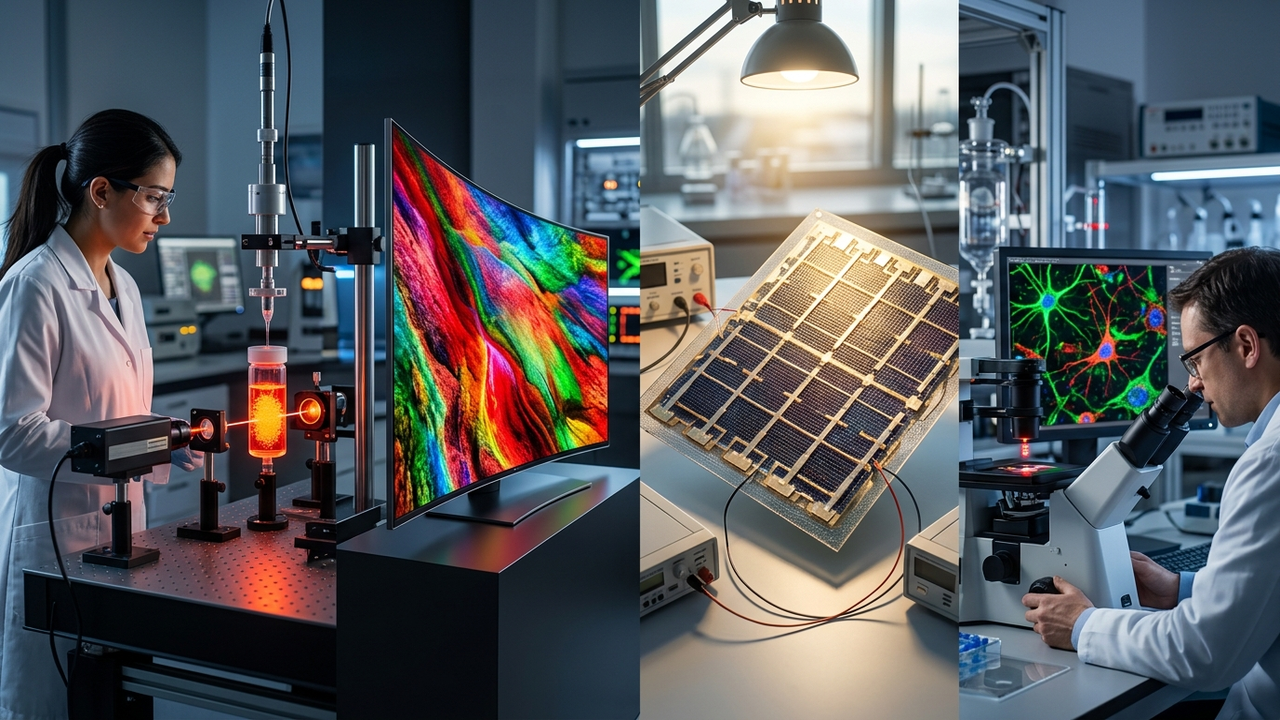
QDs, typically ranging from 2 to 10 nanometers, exhibit quantum confinement effects, allowing for precise tuning of their absorption and emission spectra. Key material compositions include CdSe (high quantum efficiency, stability), InP (less toxic, cadmium-free alternative), perovskites (high color purity, efficiency, but stability concerns), and carbon-based QDs (excellent biocompatibility). These materials find diverse applications in QLED televisions, LED lighting, solar cells, and biomedical fields such as bioimaging and drug delivery, as well as in sensors. Their high brightness and color purity are particularly beneficial for advanced displays, while their potential for efficient solar energy conversion through mechanisms like multiple exciton generation (MEG) holds significant promise.
Background & Context
Quantum dot technology has seen rapid advancements in materials science and photonics over the past few decades. The growing demand for high-performance, environmentally friendly materials has made the development of cadmium-free QDs a major industry trend. In display technology, QLEDs have gained traction for offering wider color gamuts and higher energy efficiency. In solar cells, QDs are being explored to surpass theoretical efficiency limits. In bioimaging, their superior photostability and customizable emission properties are anticipated to enhance disease diagnosis accuracy.
Strategic Significance & Outlook
The future of QD technology hinges on improving material stability, reducing toxicity, lowering manufacturing costs, and achieving scalability for mass production. Enhancing the stability of perovskite QDs and optimizing the performance of cadmium-free QDs will be crucial for widespread commercialization. Future applications are expected to include more efficient solar cells, ultra-high-definition displays, advanced medical diagnostic tools, and even quantum information technologies, solidifying QDs’ role as a core nanotechnology. Continued research and development in these areas will drive the next generation of QD-enabled innovations globally.
Source: https://www.gophotonics.com/community/what-are-quantum-dots
Get our weekly technology intelligence — free
Receive an infographic that lets you judge at a glance whether each field’s analysis report is worth reading.
Subscribe Free — Weekly Tech Intelligence
By subscribing, you’ll receive Troy-Technical’s weekly technology intelligence newsletter.
- Your email and selected fields are used only to deliver the newsletter.
- We never share your information with third parties.
- You can unsubscribe anytime via the link in each email.
See our Privacy Policy for details.
Takes about a minute · Unsubscribe anytime








Comments