Key Findings
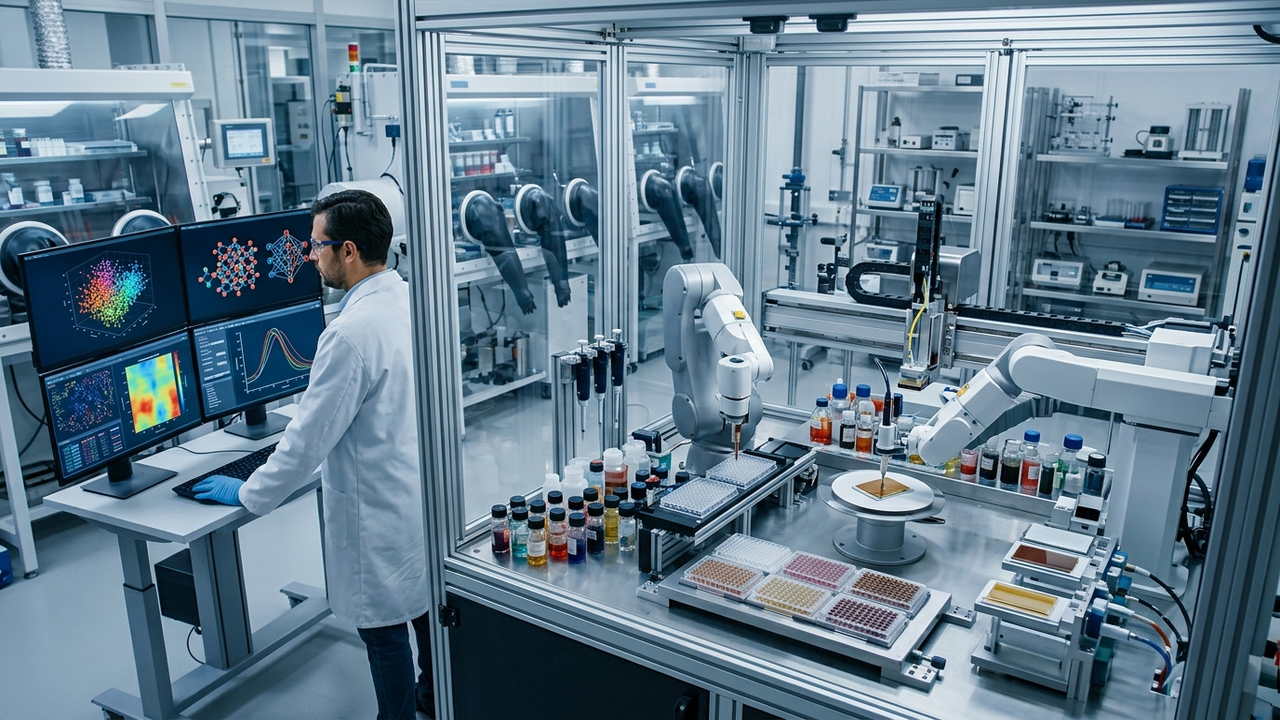
This research demonstrates that machine learning (ML) prediction models can significantly accelerate the discovery of highly phase-stable formamidinium-based perovskites. Specifically, by utilizing large experimental datasets generated from an automated fabrication platform for ML analysis, the study for the first time identified complex degradation behaviors in perovskites that could not be captured by conventional single descriptors. This achievement directly contributes to the development of high-efficiency and long-lifetime next-generation solar cells.
Technical / Clinical Details
The research team initially used an automated fabrication platform to synthesize formamidinium-based perovskites of various compositions, collecting extensive data on their phase stability. Subsequently, an mRMR-GPR (minimum redundancy maximum relevance-Gaussian process regression) model was constructed based on this dataset. The mRMR-GPR model effectively captures non-linear interactions between multiple material descriptors (e.g., ionic radius, electronegativity, lattice constants), enabling highly accurate predictions of phase stability. This model successfully reduced prediction error by approximately 30% compared to conventional simple regression models. This predictive capability allows for the elimination of unstable candidate materials before experimental synthesis, dramatically improving the efficiency of research and development.
Background & Context
Perovskite solar cells hold immense promise as next-generation solar cells due to their high power conversion efficiency and potential for low-cost manufacturing. However, a major challenge for their commercialization has been their lack of long-term stability against humidity and heat. Formamidinium-based perovskites, in particular, exhibit high conversion efficiencies but their phase stability is notoriously difficult to control. This research introduces a materials informatics approach to address this stability challenge in a data-driven manner. This is part of a broader trend in materials development, with a strong focus on automation and AI, particularly in research institutions in Japan, and plays a crucial role in international competitiveness, benchmarking against similar efforts in the US and Europe.
Strategic Significance & Outlook
The integration of machine learning prediction and automated fabrication platforms will be an indispensable element in shaping the future of perovskite materials research. This approach is expected to evolve further, potentially developing into ‘closed-loop labs’ that completely autonomous the entire process from material synthesis to characterization and lifetime testing. This will accelerate the discovery and optimization not only of formamidinium-based perovskites but also other unstable high-performance materials. Ultimately, AI-designed and optimized phase-stable perovskites are expected to become commercially available, significantly contributing to the widespread adoption of photovoltaic technology and the realization of a cleaner energy society. The vision is for a fully autonomous discovery cycle where AI predicts materials, robots synthesize and evaluate them, and AI learns from the results for further refinement.
Get our weekly technology intelligence — free
Receive an infographic that lets you judge at a glance whether each field’s analysis report is worth reading.
Subscribe Free — Weekly Tech Intelligence
By subscribing, you’ll receive Troy-Technical’s weekly technology intelligence newsletter.
- Your email and selected fields are used only to deliver the newsletter.
- We never share your information with third parties.
- You can unsubscribe anytime via the link in each email.
See our Privacy Policy for details.
Takes about a minute · Unsubscribe anytime









Comments