Key Findings: KIER Breaks World Record with 26.7% Efficient Perovskite/CIGS Tandem Solar Cell, Advancing Flexible PV for Diverse Applications
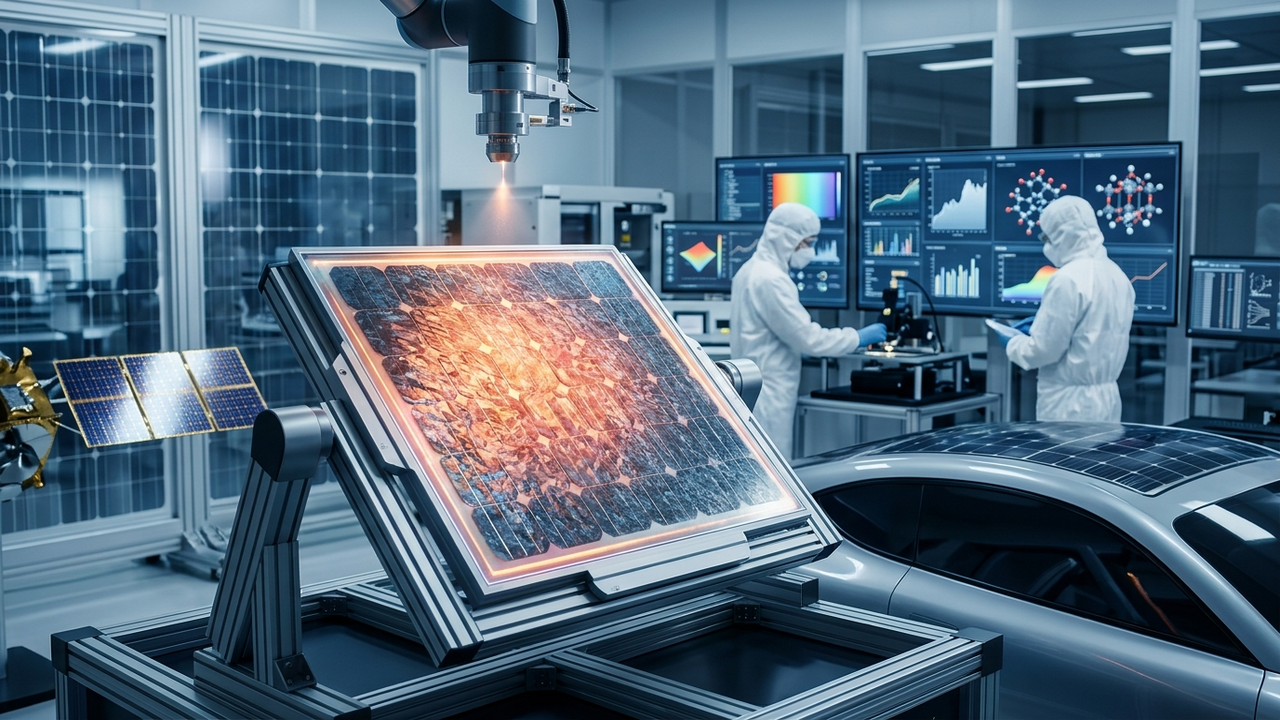
The Korea Institute of Energy Research (KIER) has achieved a new world record power conversion efficiency of 26.7% for perovskite/CIGS (copper-indium-gallium-selenide) tandem solar cells, a figure independently certified by the Fraunhofer Institute for Solar Energy Systems (ISE) and acknowledged by the US National Laboratory of the Rockies (NLR). This landmark accomplishment represents a significant milestone in the development of next-generation photovoltaic technology. Crucially, the technology’s inherent lightweight and flexible nature positions it for transformative applications in sectors previously challenging for traditional solar cells, including space, automotive, and building-integrated photovoltaics (BIPV).
Technical Details: Overcoming Efficiency Losses and Material Optimization
KIER’s research team successfully tackled major efficiency losses that typically plague perovskite/CIGS tandem solar cells through an innovative approach. At the core of this breakthrough is the development of advanced interfacial layer materials coupled with a meticulous optimization of the top transparent electrode and charge transport layer. The interfacial layer plays a critical role in facilitating efficient charge carrier transport between the perovskite and CIGS sub-cells while minimizing recombination losses. Previous devices often suffered from efficiency degradation due to defects at these interfaces, a challenge KIER has effectively overcome with its novel material design.
Specifically, improvements in the transmittance of the top transparent electrode and enhanced conductivity and stability of the charge transport layer were key drivers for boosting overall conversion efficiency. These optimizations allow for a broader range of the solar spectrum to be utilized effectively, ensuring that both the perovskite and CIGS layers perform at their maximum potential within their respective absorption bands. This technology effectively transcends the “heavy” and “rigid” limitations of conventional silicon solar cells, maximizing the benefits of lightweight and flexible thin-film photovoltaics.
Background and Application Potential
Perovskite solar cells are widely recognized for their high efficiency and low-cost potential but have faced challenges related to durability and lead content. CIGS solar cells, conversely, offer high stability and excellent performance but have been limited in efficiency. The tandem structure, combining both, leverages their respective strengths and mitigates weaknesses, leading to superior device performance. KIER’s achievement is particularly significant as it opens up possibilities for widespread adoption in innovative applications such as spacecraft, drones, electric vehicle roofs, and BIPV, where lightweight and aesthetic integration are paramount. The flexible form factor also simplifies retrofitting on existing structures, helping to accelerate renewable energy deployment in urban environments.
Strategic Significance and Outlook
This world record underscores South Korea’s emerging leadership in next-generation solar cell technology. KIER’s innovation is set to accelerate the commercialization of perovskite/CIGS tandem solar cells, potentially making a substantial impact on the global photovoltaic market. Researchers and engineers are expected to build upon these results, focusing on further improvements in stability, cost reduction, and scalable manufacturing techniques. For investors, the expanding market for lightweight and flexible solar cells presents new growth opportunities with KIER’s technology, stimulating further investment in sustainable energy solutions and positioning South Korea as a key innovator in the global clean energy transition.
Get our weekly technology intelligence — free
Receive an infographic that lets you judge at a glance whether each field’s analysis report is worth reading.
Subscribe Free — Weekly Tech Intelligence
By subscribing, you’ll receive Troy-Technical’s weekly technology intelligence newsletter.
- Your email and selected fields are used only to deliver the newsletter.
- We never share your information with third parties.
- You can unsubscribe anytime via the link in each email.
See our Privacy Policy for details.
Takes about a minute · Unsubscribe anytime





Comments