Background
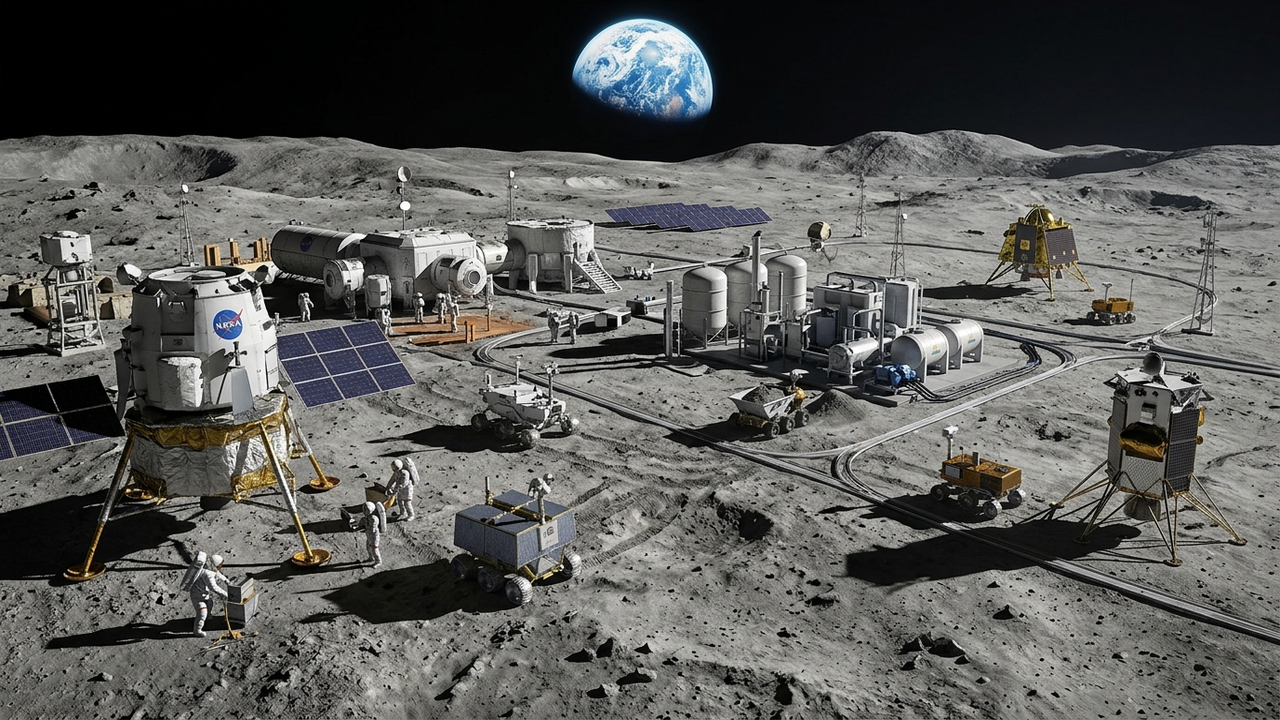
The Artemis program represents a pivotal resurgence in U.S. human lunar exploration, building upon the legacy of the Apollo era. Unlike its predecessors, Artemis is characterized by extensive international partnerships and significant private sector involvement, fundamentally reshaping the space development model. National space agencies are now leading exploration while strategically leveraging commercial innovation and cost-efficiency to accelerate progress. This ambitious endeavor aims to transform the Moon from a mere object of scientific inquiry into a permanent operational base, establishing foundational infrastructure for future human missions. This strategic shift is driven by the imperative to expand the space economy beyond Low Earth Orbit and ensure the sustainability of deep space activities, transitioning the Moon from a ‘final frontier’ to a ‘new habitation and industrial zone’ through a blend of international cooperation and commercial competition.
Key Findings
NASA’s Artemis program is rapidly advancing the critical infrastructure required for sustained human lunar exploration. A central objective is the establishment of a continuous human presence on the Moon by the late 2020s, a goal critically underpinned by In-Situ Resource Utilization (ISRU) technology. This strategy involves a multi-faceted approach, integrating insights from advanced robotic missions and significant contributions from private space companies. By leveraging ISRU, the program seeks to convert indigenous lunar materials, such as water ice and regolith, into essential resources. This capability is paramount for significantly reducing dependency on costly Earth resupply missions, thereby laying the groundwork for self-sufficient, long-term lunar outposts.
Technical Details and ISRU Focus
The technical blueprint for lunar infrastructure development is meticulously structured, beginning with extensive lunar mapping and resource prospecting. Robotic missions, notably the Lunar Reconnaissance Orbiter (LRO) and India’s Chandrayaan-1, have been instrumental in identifying potential resource locations, particularly water ice. Further bolstering these efforts are Commercial Lunar Payload Services (CLPS) landers from private entities like Intuitive Machines and Astrobotic, which are tasked with delivering vital cargo and demonstrating nascent technologies on the lunar surface. The core technical thrust is In-Situ Resource Utilization (ISRU), focusing on the extraction and processing of lunar materials—specifically water ice and regolith (lunar soil)—to produce potable water, breathable oxygen, and rocket propellant. This transformative capability is designed to establish the Moon as a crucial fuel depot, supporting both extended lunar stays and future deep-space missions, including human expeditions to Mars. Key architectural elements facilitating orbital and surface access include the Lunar Gateway station and SpaceX’s Human Landing System (HLS).
Strategic Implications and Future Outlook
The continued maturation and widespread implementation of ISRU technology promise to revolutionize the scale, autonomy, and functionality of future lunar bases. Critically, the strategic exploitation of lunar water ice resources possesses the potential to transform the Moon into an indispensable Earth-Mars transit hub, significantly reducing the logistical hurdles of deep space travel. Looking ahead, a robust lunar infrastructure will serve as an unparalleled launchpad, enabling more ambitious human missions deeper into the solar system. This strategic evolution, however, is not without its challenges. It necessitates the urgent development of comprehensive international legal frameworks governing space resource utilization, along with robust mechanisms for the governance and oversight of burgeoning private space activities. Addressing these regulatory and ethical considerations will be crucial in ensuring the sustainable and permanent expansion of humanity into the cosmos.
Source: https://sanandres.uep.edu.py/ProductPdf/T8SZ0S/704540/Somebody%20Else%20Is%20On%20The%20Moon.pdf
Get our weekly technology intelligence — free
Receive an infographic that lets you judge at a glance whether each field’s analysis report is worth reading.
Subscribe Free — Weekly Tech Intelligence
By subscribing, you’ll receive Troy-Technical’s weekly technology intelligence newsletter.
- Your email and selected fields are used only to deliver the newsletter.
- We never share your information with third parties.
- You can unsubscribe anytime via the link in each email.
See our Privacy Policy for details.
Takes about a minute · Unsubscribe anytime





Comments