Key Findings
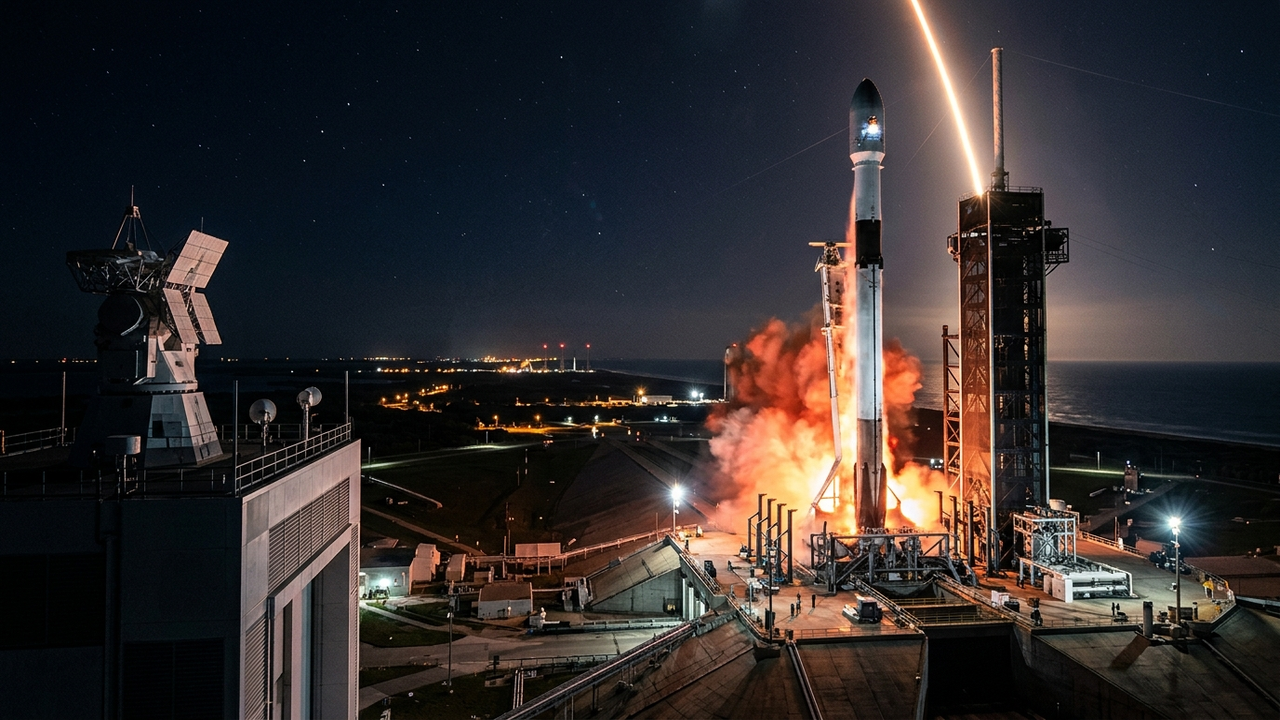
City Labs has successfully launched the world’s first commercial nuclear-powered satellite on a SpaceX Falcon 9 rideshare mission. This satellite incorporates compact betavoltaic batteries, leveraging tritium decay to provide a continuous, solar-independent power source in space, thereby demonstrating a groundbreaking technological advancement. This represents a significant leap in space power systems and unequivocally signals the commercial space industry’s entry into the nuclear age.
Technical & Clinical Details
Betavoltaic batteries convert the energy of electrons emitted during the beta decay of a radioactive isotope (in this case, tritium) directly into electrical energy. Tritium, an isotope of hydrogen, emits relatively safe, low-energy beta particles, making it suitable for compact power sources. These batteries are ideal for power supply under extremely harsh conditions where solar panels are ineffective, such as during prolonged lunar nights, in deep space environments, or in areas with high radiation levels. Their primary advantage lies in their ability to provide stable power for decades or even over a century without requiring refueling.
Background & Context
Historically, the development and utilization of nuclear power sources in space have been predominantly monopolized by government agencies (e.g., NASA’s Radioisotope Thermoelectric Generators, RTGs). However, City Labs’ success indicates that this advanced technology can now be commercialized by private enterprises, forming part of a larger trend towards the commercialization of the entire space industry. While solar power is widely used for many space missions, its effectiveness is limited in deep space or lunar polar regions, making reliable, long-duration power systems indispensable for the expansion of the commercial space economy.
Strategic Significance & Outlook
The realization of commercial nuclear-powered satellites dramatically enhances the durability and autonomy of space infrastructure, opening up a wide range of applications. They will be utilized for extending the lifespan of communication satellites, powering lunar bases and Mars missions, and serving as energy sources for new scientific instruments in deep space exploration. This technology marks a crucial step towards achieving more ambitious goals, such as permanent human habitation in space and the mining of space resources. It is anticipated that the entry of other commercial companies developing similar nuclear power systems will accelerate, further boosting competition and innovation in the space power market.
Source: https://www.wallstreetendeavor.com/post/commercial-space-just-entered-the-nuclear-age
Get our weekly technology intelligence — free
Receive an infographic that lets you judge at a glance whether each field’s analysis report is worth reading.
Subscribe Free — Weekly Tech Intelligence
By subscribing, you’ll receive Troy-Technical’s weekly technology intelligence newsletter.
- Your email and selected fields are used only to deliver the newsletter.
- We never share your information with third parties.
- You can unsubscribe anytime via the link in each email.
See our Privacy Policy for details.
Takes about a minute · Unsubscribe anytime







Comments