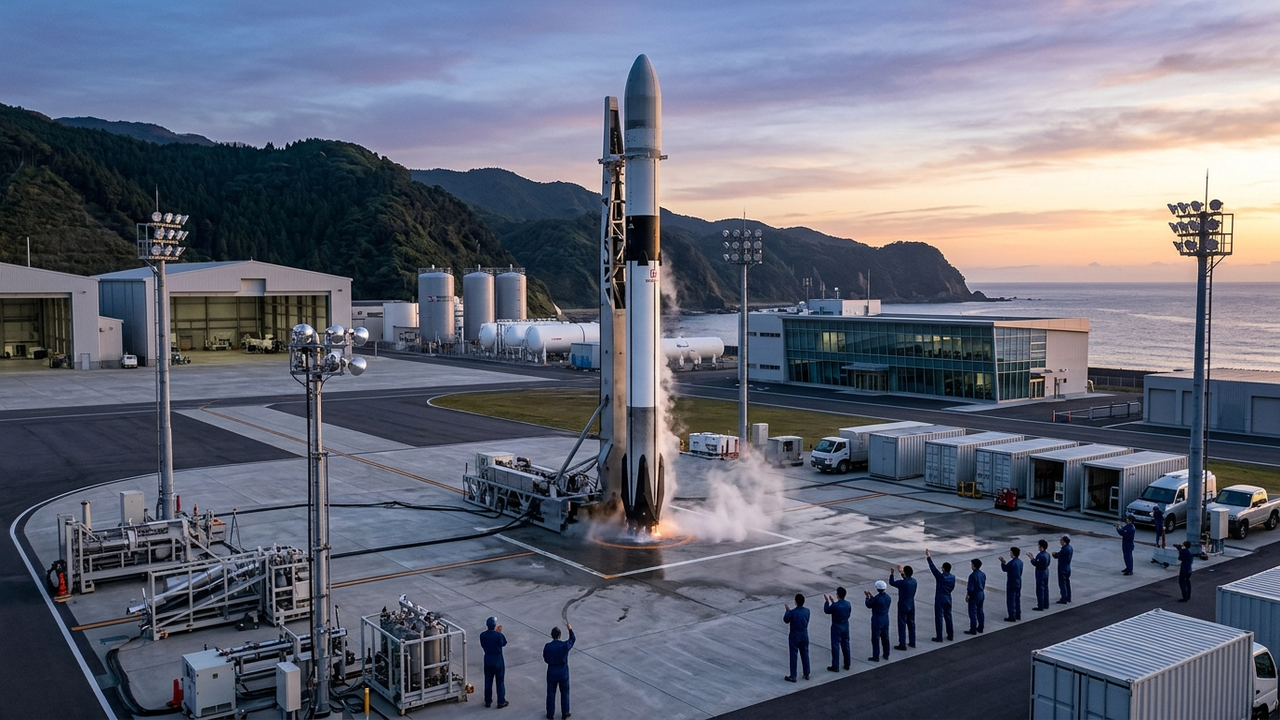
Key Findings: Honda Achieves First Private Japanese Reusable Rocket Launch and Landing
Honda has successfully launched and landed a reusable rocket, marking an innovative milestone as the first Japanese private company to achieve such a feat in the aerospace industry. This accomplishment, leveraging JAXA’s (Japan Aerospace Exploration Agency) RV-X experimental rocket technology, holds the potential to drastically cut space mission costs and significantly boost the efficiency of space access. Honda’s success notably strengthens the role of private companies in Japan’s space development, heralding the advent of a new commercial space era.
Technical Details: Advanced Reusable Rocket Technology and Cost Reduction Benefits
Honda’s successful reusable rocket technology is underpinned by advanced guidance and control systems, coupled with engine re-ignition capabilities that enable Vertical Takeoff and Vertical Landing (VTVL). This allows the rocket’s first stage to precisely return to a designated landing site after launch for reuse. Compared to conventional expendable rockets, this approach dramatically reduces rocket manufacturing and maintenance costs, leading to a significant decrease in per-launch expenditures. This facilitates more frequent launches, lowering the economic barrier for diverse commercial and scientific projects, including satellite constellation deployment, in-space material experiments, and space tourism. This technology is particularly crucial for private companies seeking to establish their independent space transport capabilities.
Background & Industry Context: Japan’s Space Industry at an Inflection Point
Japan’s space industry is currently undergoing a major transformation, driven by aggressive government investments and accelerated entry of private enterprises. Over the past four to five years, government investment has doubled, with strategic space-related funding exceeding ¥1 trillion. Honda, traditionally an automotive manufacturer, venturing into aerospace and achieving success in reusable rocket technology, symbolizes an industry convergence beyond traditional boundaries. This reflects a growing recognition of space not merely as a domain for scientific endeavor but as a strategic industry vital for economic growth, national resilience, and security. The broader Japanese space startup ecosystem is also maturing, with companies undergoing IPOs and M&A activities.
Future Outlook: Enhancing Japan’s Presence in Global Space Competition
Honda’s reusable rocket success is critically important for elevating Japan’s competitiveness in the global space transportation market. By establishing its unique reusable technology, Japan can secure autonomous access to space and enhance its international presence, especially amidst the pioneering efforts of international companies like SpaceX. This technological innovation lays the groundwork for Japan to play a leading role in future large-scale projects such as lunar exploration, space-based solar power generation, and space debris removal. Furthermore, innovations in the space sector are expected to generate synergistic technological advancements, feeding back into Honda’s core businesses like autonomous driving, robotics, and new material development.
Get our weekly technology intelligence — free
Receive an infographic that lets you judge at a glance whether each field’s analysis report is worth reading.
Subscribe Free — Weekly Tech Intelligence
By subscribing, you’ll receive Troy-Technical’s weekly technology intelligence newsletter.
- Your email and selected fields are used only to deliver the newsletter.
- We never share your information with third parties.
- You can unsubscribe anytime via the link in each email.
See our Privacy Policy for details.
Takes about a minute · Unsubscribe anytime





Comments