Key Findings
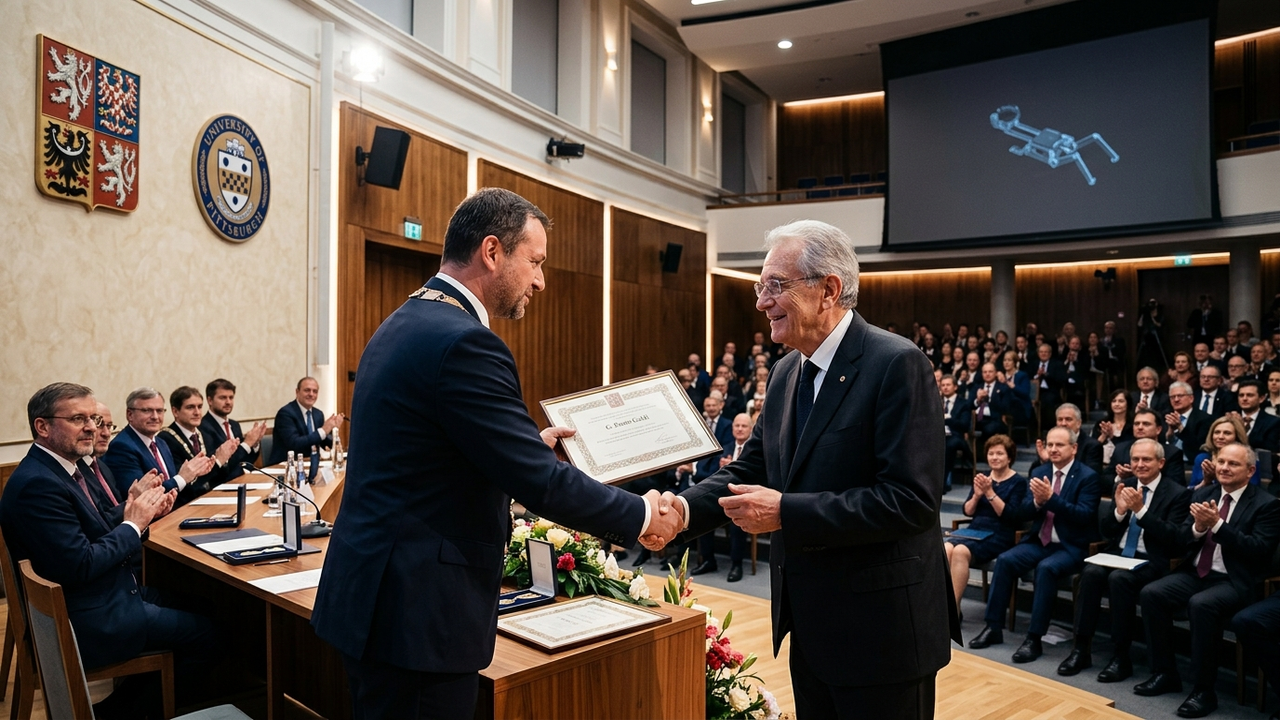
Professor G. Paolo Galdi from the Swanson School of Engineering at the University of Pittsburgh has been bestowed the honor of being elected a Foreign Member of the Learned Society of the Czech Republic, recognizing his profound contributions to the fields of fluid dynamics and applied mathematics. Professor Galdi’s research applications range widely, from improving models for large-scale structures such as bridges to developing models for blood flow within the human body and designing new microrobots that navigate blood vessels for targeted drug delivery. Notably, one of his projects, funded by the National Science Foundation (NSF), is generating significant results that are paving new avenues in micro- and nanotechnology.
Technical Details
Professor Galdi’s laboratory focuses on developing advanced mathematical models and simulation techniques to describe the complex interactions between fluids and solid structures. For large-scale structures, his team constructs models that accurately predict the effects of wind and water currents on bridges and buildings, enabling safer and more efficient designs. In the realm of microrobotics and biofluids, his research analyzes how nanoscale particles and microrobots move within confined spaces like blood vessels and how they transport drugs through interactions with the surrounding fluid. This work specifically concentrates on the behavior of microscopic particles in highly viscous fluids (such as blood), the impact of Brownian motion, and the optimization of actuation mechanisms driven by external magnetic fields or ultrasound. His NSF project provides foundational insights by precisely modeling these physical phenomena, thereby facilitating the development of next-generation medical microrobots.
Background & Industry Context
Fluid dynamics plays a fundamental role across a broad spectrum of disciplines, including engineering, physics, biology, and medicine. Professor Galdi’s research bridges the gap between fundamental and applied sciences, significantly expanding the possibilities of micro- and nanorobotics, particularly in the medical field. Traditional drug delivery systems often act systemically, carrying the risk of side effects. In contrast, targeted microrobots offer a revolutionary solution by delivering drugs directly to specific pathological sites, enhancing therapeutic efficacy while minimizing adverse effects. Furthermore, in the assessment of infrastructure safety, more precise fluid dynamics models are indispensable for the maintenance of aging infrastructure and disaster prevention.
Strategic Significance & Outlook
The continued advancement of Professor Galdi’s research will play a crucial role in shaping the future of personalized and precision medicine. The realization of intravascular microrobots promises numerous applications, including localized delivery of anticancer drugs for cancer treatment, thrombolysis, and diagnostic imaging. His fluid dynamics models also have potential applications in other bioengineering fields, such as artificial organ design and medical device optimization. His election as a Foreign Member of the Learned Society of the Czech Republic underscores the high international regard for his research, and further international collaborations and contributions to technological innovation are anticipated.
Get our weekly technology intelligence — free
Receive an infographic that lets you judge at a glance whether each field’s analysis report is worth reading.
Subscribe Free — Weekly Tech Intelligence
By subscribing, you’ll receive Troy-Technical’s weekly technology intelligence newsletter.
- Your email and selected fields are used only to deliver the newsletter.
- We never share your information with third parties.
- You can unsubscribe anytime via the link in each email.
See our Privacy Policy for details.
Takes about a minute · Unsubscribe anytime






Comments