


Key Findings
The robotic system successfully detached 100 target navel oranges in California orchard trials without causing punctures, bruising, or peel abrasion. The average residual stem length was 3.10 ± 3.34 millimeters, with a median of 1.81 millimeters. Notably, 52% of the fruit satisfied the stringent quality requirement of less than 2 millimeters of remaining stem, while 92% met the standard fresh-market threshold of less than 10 millimeters.
Technical Details
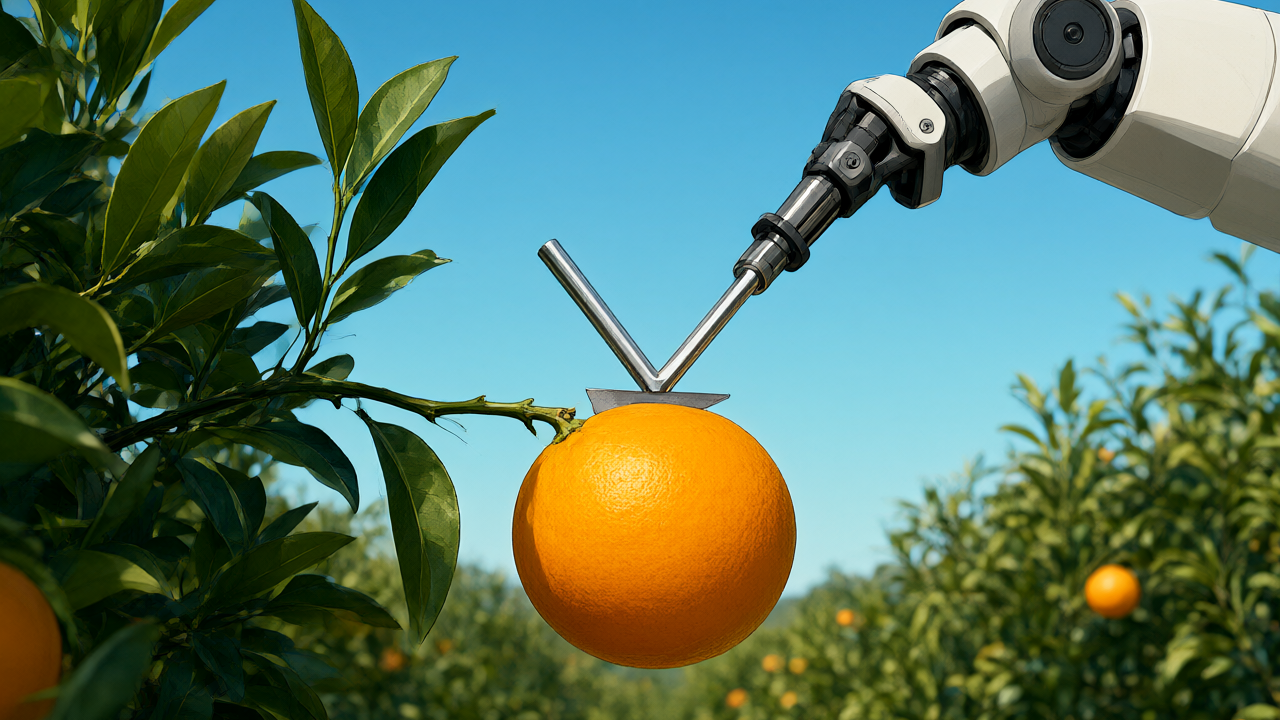
The system replaces a motorized alignment stage with a passive mechanical centering mechanism. The end-effector consists of a compliant three-finger gripper printed from flexible thermoplastic polyurethane and a V-shaped guide capable of accommodating stems misaligned by up to 30 degrees. To align the stem, the robot executes a choreographed sequence: a 10-degree clockwise rotation, a 10-degree counterclockwise rotation about the tool axis, and a 5-to-10-degree downward rotation of the arm’s fourth joint. Once settled in the V-guide, commercial citrus clippers with concave blades cut the stem flush with the peel.
The hardware is integrated into a platform featuring a Bonsai Robotics mobile rover, a Fairino FR3 six-degree-of-freedom manipulator, and an Intel RealSense D457 RGB-D camera. A YOLOv8 instance-segmentation network, trained on 2,790 images, handles detection. While the model achieved 95.5% mean average precision for oranges, it reached only 53.3% for thin stems, leaving final alignment to the passive guide.
Background & Context
Fresh-market citrus requires short stems to prevent neighboring fruit from being punctured during transport; otherwise, the produce is downgraded to juice-bound classification. Previous designs by the Fresno team used an active two-axis positioning stage that achieved high precision (0.81 ± 0.46 mm mean stem length) but increased weight and control complexity.
Significance & Outlook
The transition to a passive system reduced the end-effector weight from 1.5 kilograms to 0.5 kilograms and decreased the actuator count from four to two. By eliminating stepper motors, drivers, and limit switches, the operation time per cycle dropped from 10.79 seconds to approximately 9.1 seconds. This simplification provides a viable path toward the commercial robotic harvesting of table-grade citrus.
Source: https://bioengineer.org/robot-passively-centers-citrus-stems-for-precise-cuts-with-simpler-hardware/
Get our weekly technology intelligence — free
Receive an infographic that lets you judge at a glance whether each field’s analysis report is worth reading.
Subscribe Free — Weekly Tech Intelligence
By subscribing, you’ll receive Troy-Technical’s weekly technology intelligence newsletter.
- Your email and selected fields are used only to deliver the newsletter.
- We never share your information with third parties.
- You can unsubscribe anytime via the link in each email.
See our Privacy Policy for details.
Takes about a minute · Unsubscribe anytime