
Key Findings
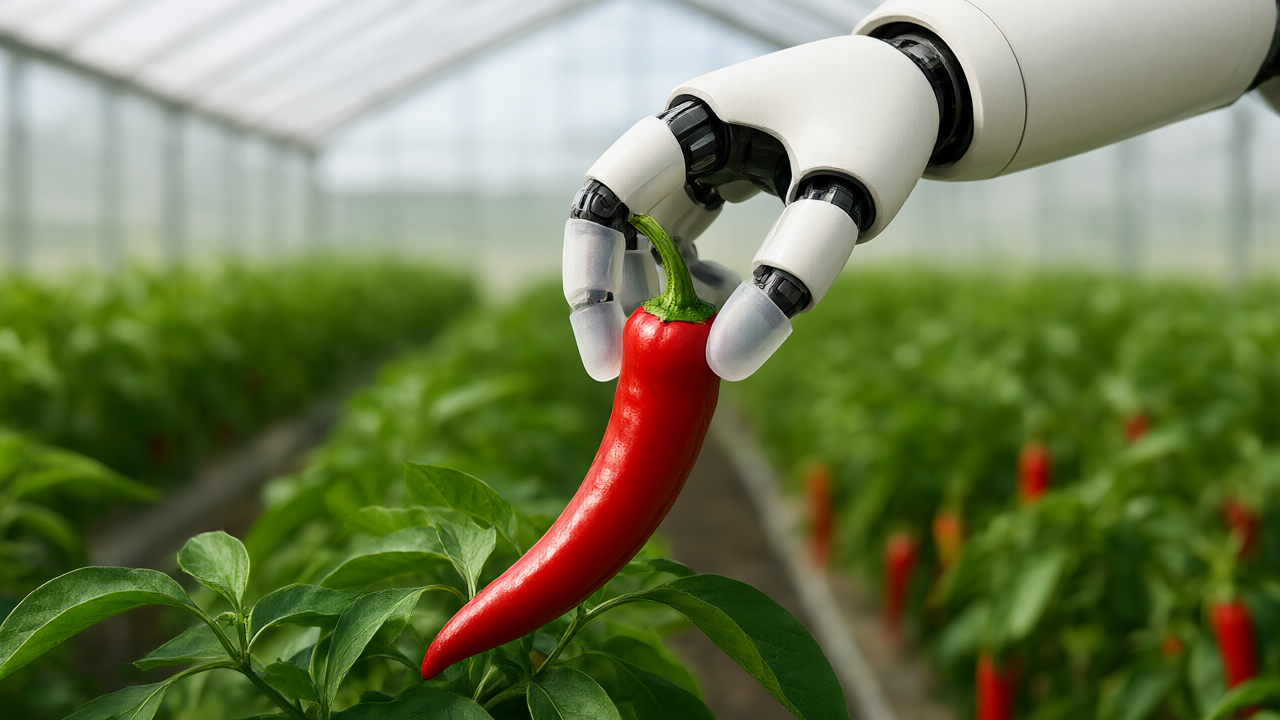
The developed robotic end effector achieved a 100 percent success rate in picking two different sizes of chili peppers during laboratory testing. The process took 3.5 seconds for smaller fruits and 4 seconds for larger ones. The system succeeds by replicating the human method of clamping the fruit, pulling along the stem, and folding it sideways to ensure the stem snaps cleanly at its natural break point.
Technical Details
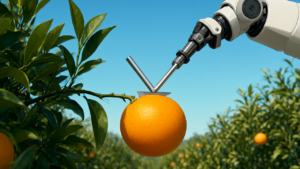
The end effector measures 185 millimeters long and 80 millimeters wide. It utilizes soft silicone gripping fingers on two sides and a combined pulling-and-bending mechanism on the third. The device grips only one-quarter to one-third of the fruit’s surface to minimize collisions with adjacent peppers. The operational sequence is as follows:
- A visual system locates the target fruit.
- A linear electric cylinder closes the silicone grippers on the lower part of the fruit.
- The effector pulls along the stem’s axis while a motor-driven rotating disk bends the stem laterally.
The researchers used a multibody dynamics simulation to optimize this “clamp-pull-fold” action. The simulation modeled the fruit as an ellipsoid and the silicone pads as hyperelastic Mooney-Rivlin material. Results indicated that combined action is superior to pulling or bending alone, as it concentrates stress asymmetrically on the abscission layer without requiring the large swing angles that risk damaging neighboring branches.
Background & Context
Agricultural robotics for chili peppers is challenging because fruits grow in dense, upward-facing clusters. Previous designs had significant drawbacks: a tomato-specific device risked scratching fruits, a two-finger silicone gripper had a harvesting rate below 80 percent, and cutting devices risked spreading pathogens between plants. In China, where 38.6 percent of global pepper output was produced in 2024, labor costs account for over 60 percent of total production costs.
Significance & Outlook
By decomposing human picking into three kinematic stages—holding, pulling, and bending—the team created a compact tool capable of navigating dense clusters. While the current clamping force is a preset value, the researchers have already reserved space for tactile sensors on the fingertips for future iterations.
Source: https://bioengineer.org/robot-hand-mimics-human-fingers-to-pick-chili-peppers-without-damage/
Get our weekly technology intelligence — free
Receive an infographic that lets you judge at a glance whether each field’s analysis report is worth reading.
Subscribe Free — Weekly Tech Intelligence
By subscribing, you’ll receive Troy-Technical’s weekly technology intelligence newsletter.
- Your email and selected fields are used only to deliver the newsletter.
- We never share your information with third parties.
- You can unsubscribe anytime via the link in each email.
See our Privacy Policy for details.
Takes about a minute · Unsubscribe anytime