


Key Findings
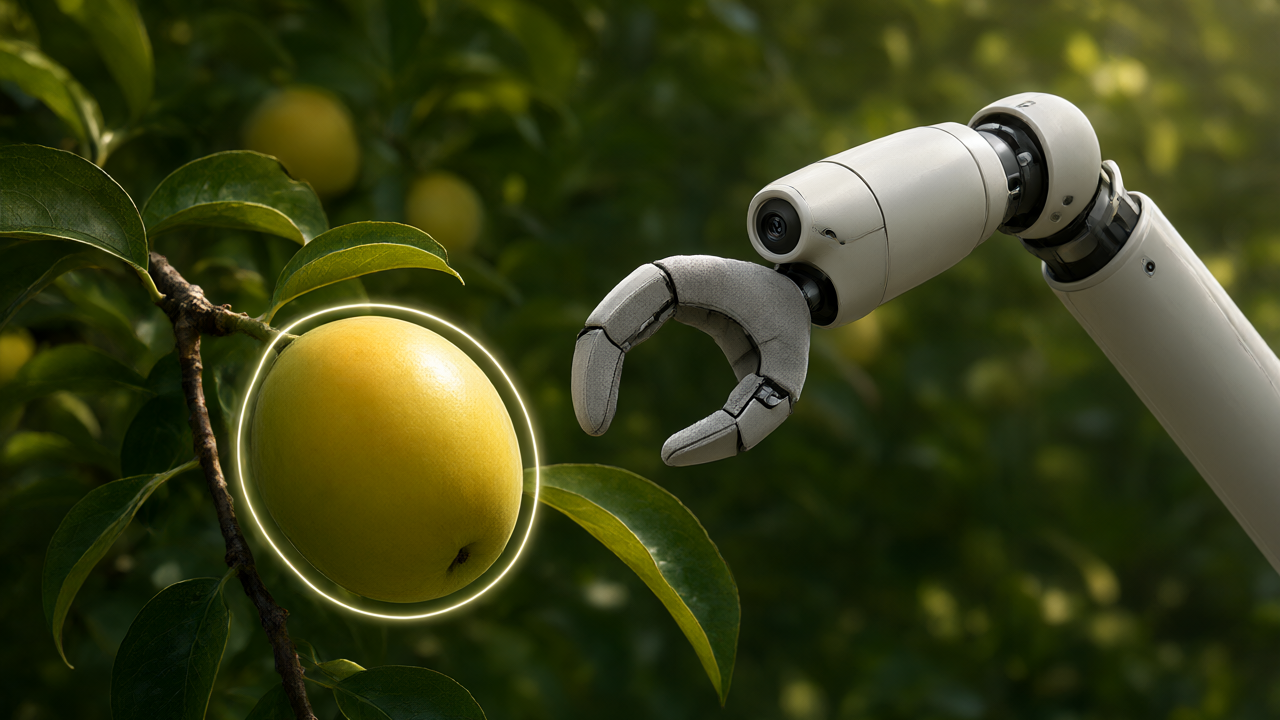
The proposed one-shot detection method achieved 29.93 mAP on the COCO benchmark, surpassing previous methods including Halluc, SFOT, and Norm-VAE. In real-world agricultural tests, the model achieved 57.78 mAP, 79.10 AP50, and 48.72 AP75 across datasets of kumquats, apples, cluster tomatoes, strawberries, and pears. Notably, the system outperformed the fully supervised YOLO11n baseline by 4.00, 7.07, and 2.53 percentage points respectively, despite being pretrained only on COCO without fine-tuning on fruit-specific data.
Technical Details
The workflow consists of four stages: information gathering, support object generation, candidate generation, and feature matching. The system utilizes a Segment Anything-style architecture to convert a single click into a segmentation mask. A deep Siamese network based on a ResNet-50 autoencoder encodes the support object and candidate regions into 1024-dimensional feature vectors, which are then compressed to 512, 256, and 128 dimensions via a multilayer perceptron. Candidates are accepted if the Euclidean distance between embedding pairs is below 0.71.
A separate refinement network predicts shifts in center coordinates, width, and height to produce precise bounding boxes. The system was tested on an NVIDIA RTX 4090 GPU, recording an average processing time of 34.42 milliseconds per image (29.06 fps) and peak GPU memory usage of 0.24 gigabytes.
Background & Context
Traditional harvesting robots require extensive datasets and retraining to recognize new crops. To test robustness, the team evaluated the system under four conditions: dense occlusion (51.87% mAP), shadows (57.46% mAP), motion blur (46.85% mAP), and small fruits (38.92% mAP). The latter proved the most challenging due to limited visual information.
Significance & Outlook
Deployment on integrated robots using UR5 and FR5 arms showed high recognition rates: 91.53% for kumquats (216 of 236 objects) and 96.33% for apples (105 of 109 objects). While effective for individual fruits, the authors note that recognizing entire clusters as single units remains difficult, and future work will focus on model compression for embedded deployment.
Get our weekly technology intelligence — free
Receive an infographic that lets you judge at a glance whether each field’s analysis report is worth reading.
Subscribe Free — Weekly Tech Intelligence
By subscribing, you’ll receive Troy-Technical’s weekly technology intelligence newsletter.
- Your email and selected fields are used only to deliver the newsletter.
- We never share your information with third parties.
- You can unsubscribe anytime via the link in each email.
See our Privacy Policy for details.
Takes about a minute · Unsubscribe anytime