


Key Findings
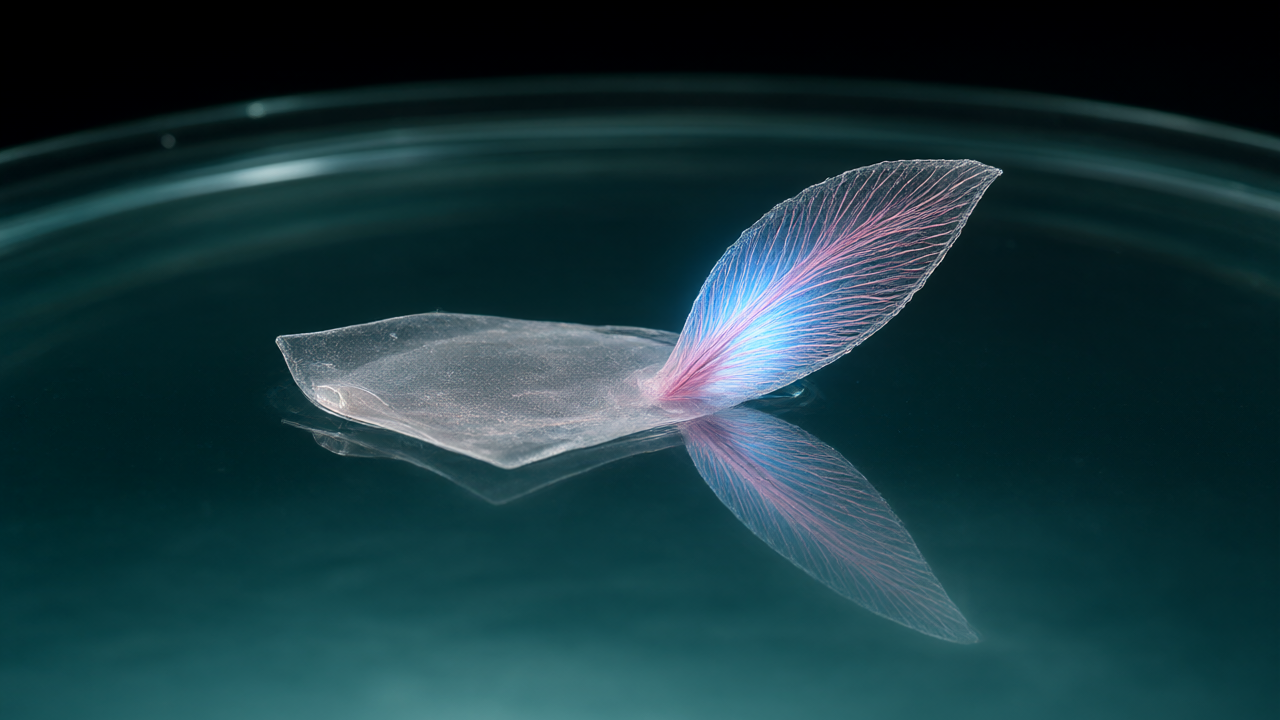
MIT researchers have demonstrated the first thin, two-dimensional biohybrid robot capable of swimming. The robot utilizes a single layer of living muscle tissue to propel itself through water, achieving a top speed of approximately 4 times its own length every minute. This performance is comparable to the average cruising speed of certain shark species.
Technical Details
The robot’s chassis consists of a flexible gel film approximately half a millimeter thick, divided into two fin-like sections. Each fin is coated with a layer of living muscle cells thinner than a human hair. These cells are genetically engineered to contract in response to light, allowing researchers to control speed and direction by manipulating the light source.
To achieve the necessary force for aquatic movement, the team optimized the scaffold supporting the muscle cells:
- Material: The team transitioned to gelatin methacrylate (GelMA), utilizing stiffer versions to provide better support for organized muscle growth.
- Geometry: Square-bottomed grooves were etched into the gel surface to encourage more uniform alignment of muscle fibers compared to curved grooves.
- Training: The tissue underwent a “workout” via repeated flashes of light to increase strength before final installation.
Background & Context
Previous biohybrid designs typically relied on bulky, three-dimensional chunks of lab-grown skeletal muscle requiring millions of cells. Earlier work from Ritu Raman’s laboratory produced an iris-inspired system, but movements were limited to approximately 100 microns, which was insufficient for robotics applications. The current design reduces the amount of tissue required while significantly increasing force output.
Significance & Outlook
Living muscle offers advantages over traditional actuators, including energy efficiency, softness, environmental responsiveness, and the ability to self-repair. This proof-of-concept indicates that thin biohybrid machines can operate in demanding aquatic environments. Future applications include environmental monitoring and exploring fragile or unpredictable ecosystems. The team’s next objective is to optimize the body design to increase swimming speed.
Source: https://www.techexplorist.com/mit-paper-thin-robot-swims-power-living-cells/105888/
Get our weekly technology intelligence — free
Receive an infographic that lets you judge at a glance whether each field’s analysis report is worth reading.
Subscribe Free — Weekly Tech Intelligence
By subscribing, you’ll receive Troy-Technical’s weekly technology intelligence newsletter.
- Your email and selected fields are used only to deliver the newsletter.
- We never share your information with third parties.
- You can unsubscribe anytime via the link in each email.
See our Privacy Policy for details.
Takes about a minute · Unsubscribe anytime