

Key Findings
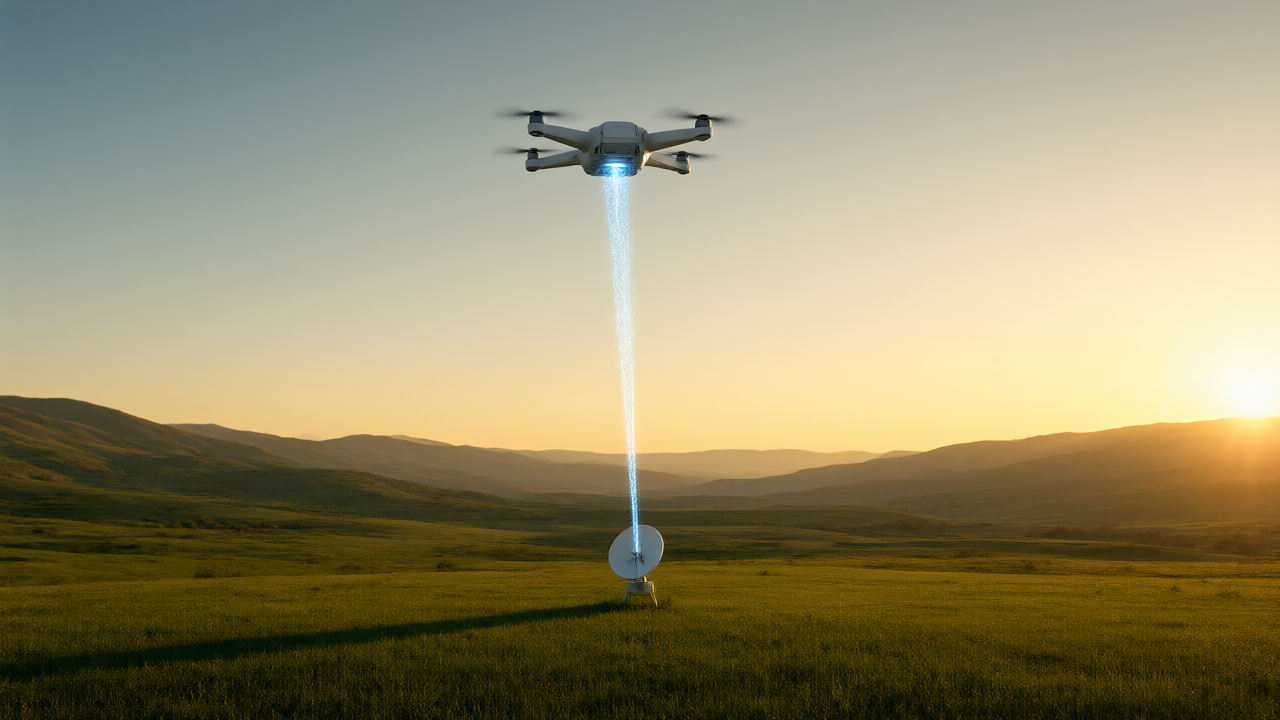
Reach Power has successfully completed a demonstration of a 10-hour autonomous drone flight powered by wireless power beaming. This achievement extended the flight duration of the test quadcopter by approximately 400 times compared to its baseline battery-only flight time of 90 seconds. The flight was conducted on September 22 at the Virginia Tech Advanced Computing Institute as part of the “2026 Energy Sentry” event by Operational Energy Innovation (OE-I).
Technical Details
The system integrates on-board visual navigation, autonomous energy management, and on-demand remote power delivery. Notably, the flight was achieved without the use of GPS, external flight tracking sensors, physical tethers, or manual flight control. The technical implementation includes:
- Autonomous Energy Management: The drone’s internal processor monitors battery levels in real-time. It autonomously disconnects from the power beam upon reaching full charge and returns to the charging position to request power once a programmed threshold is met.
- M2M Communication: The drone and transmitter handle all power cycles via machine-to-machine (M2M) communication without operator intervention.
- Dynamic RF Beam Steering: Software-defined electronics direct energy toward the receiver without requiring mechanical movement of the transmitter.
- Hardware Compliance: The system utilizes NDAA-compliant components and a primary drone system manufactured in the U.S. by ModalAI.
Background & Context
The demonstration was live-streamed to participants from the Pentagon. Reach Power is funded through the Operational Energy Capability Improvement Fund (OECIF) managed by OE-I. This project addresses the critical limitation of small unmanned aircraft systems (sUAS), which typically require battery replacement or recharging every 30 to 40 minutes.
Significance & Outlook
By eliminating the need for charging infrastructure and manual battery swaps, this technology reduces the personnel required for continuous operations. While developed with defense applications in mind—specifically for intelligence, surveillance, and reconnaissance (ISR) and communication relay—Reach Power indicates the technology is applicable to industrial robotics, infrastructure inspection, and public safety markets.
Source: https://drone.jp/news/20261030150149130275.html
Get our weekly technology intelligence — free
Receive an infographic that lets you judge at a glance whether each field’s analysis report is worth reading.
Subscribe Free — Weekly Tech Intelligence
By subscribing, you’ll receive Troy-Technical’s weekly technology intelligence newsletter.
- Your email and selected fields are used only to deliver the newsletter.
- We never share your information with third parties.
- You can unsubscribe anytime via the link in each email.
See our Privacy Policy for details.
Takes about a minute · Unsubscribe anytime