

Key Findings
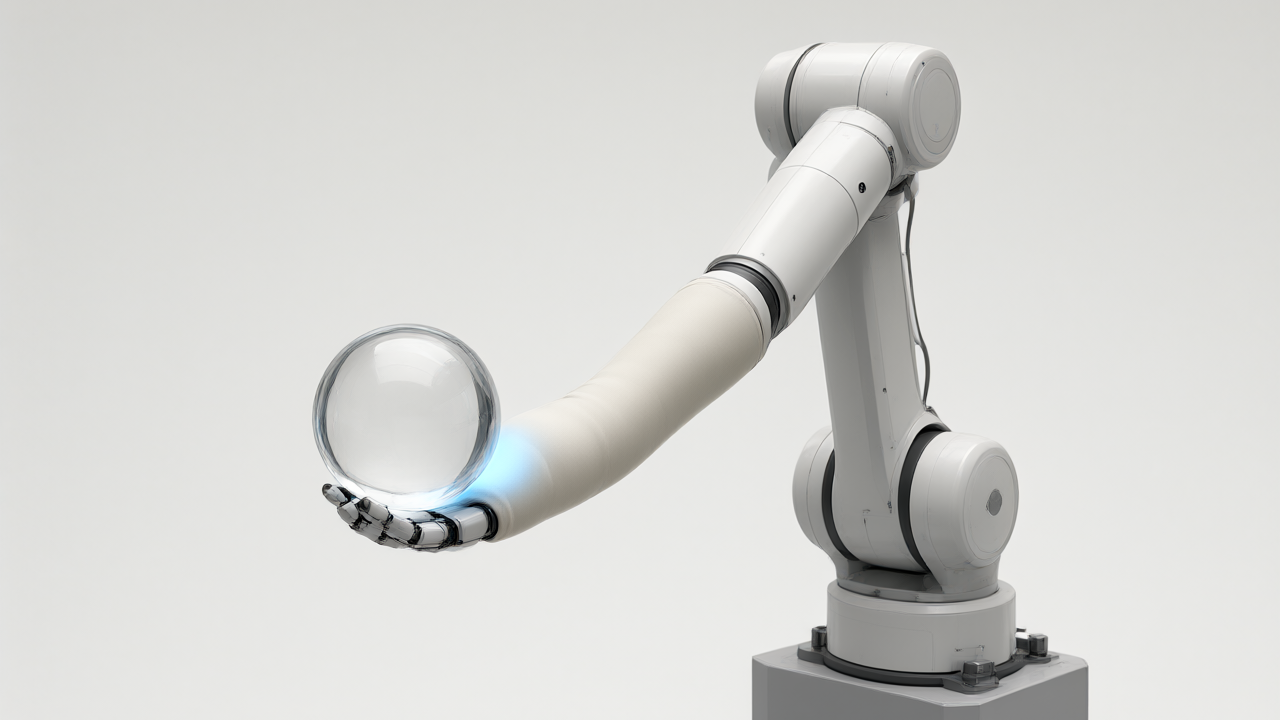
The Hong Kong University of Science and Technology (HKUST) has developed EmArm, an integrated sensorimotor robotic arm capable of human-like tactile perception. By integrating a soft optical tactile skin onto a rigid mechanical skeleton, the system can analyze contact information across the upper arm and forearm. This allows the robot to distinguish between different tactile interactions, such as gentle tapping and tickling, and respond in real time to avoid obstacles.
Technical Details
EmArm’s architecture is inspired by the human bone-muscle-skin structure. The technical specifications include:
- Coverage: More than 71,000 square millimeters of soft tactile skin covering the upper arm and forearm.
- Sensing Mechanism: Internal submillimeter-scale cameras that analyze force distribution.
- Resolution: A spatial resolution of 0.085 millimeters and a two-point discrimination threshold of 18.2 millimeters, which outperforms the typical 30–50 millimeter range of human arm skin.
- Robustness: The optical approach is resistant to thermal, acoustic, humidity-related, optical, and electromagnetic interference, maintaining 97.9 percent accuracy across five types of interference.
The system maintains positioning repeatability comparable to conventional robotic arms and shows no appreciable adverse effect on performance under heavy loads.
Background & Context
To move beyond simple sensing, the team implemented a perception-action loop. This framework integrates proprioceptive input (joint-angle data) with exteroceptive input (tactile information) in real time. The system extracts data on contact position, force, contact area, and the number of contact points, feeding this information directly into the motion-control system for autonomous decision-making.
Significance & Outlook
EmArm marks a shift from visual dominance toward multimodal integration and intrinsic intelligence. The researchers indicate that this technology can be extended to other body parts, such as torsos and legs. Potential applications include humanoid robots for medical assistance, industrial environments, and domestic services, as well as advancements in embodied artificial intelligence where AI learns from physical interaction with the real world.
Get our weekly technology intelligence — free
Receive an infographic that lets you judge at a glance whether each field’s analysis report is worth reading.
Subscribe Free — Weekly Tech Intelligence
By subscribing, you’ll receive Troy-Technical’s weekly technology intelligence newsletter.
- Your email and selected fields are used only to deliver the newsletter.
- We never share your information with third parties.
- You can unsubscribe anytime via the link in each email.
See our Privacy Policy for details.
Takes about a minute · Unsubscribe anytime