Key Findings
The convergence of advancements in reusable rocket technology and the expanding capabilities of space-based computing is igniting a new growth cycle within the commercial space industry. Reusable rockets significantly slash launch costs, making the deployment and operation of space infrastructure far more economically feasible, which in turn accelerates investment in ‘space-based computing.’ This surge in computational power in orbit necessitates the development of novel photovoltaic materials that are highly efficient, lightweight, and exceptionally radiation-resistant. This trend is expected to deepen technological collaboration across diverse industries, including energy, materials science, and semiconductors, acting as a powerful catalyst for scaling the space economy and fostering innovation and business opportunities beyond Earth.
Technical Details
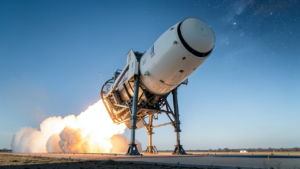
Reusable rockets, through Vertical Takeoff and Vertical Landing (VTVL) technologies and optimized recovery and refurbishment processes, dramatically reduce launch costs compared to traditional expendable rockets. This enables more frequent and affordable payload deployment to orbit, accelerating the expansion of various satellite services such as Earth observation, telecommunications, and navigation. In the context of space-based computing, performing parts of AI model training and data processing on-orbit minimizes data latency and allows for on-demand, sophisticated analysis. To realize this capability, solar cells that can reliably operate in the harsh space radiation environment, are lightweight, and offer high power generation efficiency are essential. Next-generation photovoltaic materials, such as perovskite solar cells and further refinements of III-V multi-junction solar cells, are key candidates. These materials require both robust radiation tolerance for long-term space operation and high efficiency to deliver maximum power from limited installation areas.
Background and Industry Context
Over the past decade, private companies like SpaceX have revolutionized the space industry by establishing reusable rocket technology, which has drastically lowered the cost of access to space. This has made the deployment of mega-constellations of thousands of satellites, space tourism, and even extraterrestrial resource extraction more tangible. Space-based computing is positioned as a core technology supporting these burgeoning activities. Space offers unique advantages and challenges compared to terrestrial data centers, including an unimpeded global view, microgravity environments, and unrestricted global data collection capabilities. Simultaneously, however, it presents severe operational conditions such as extreme temperature fluctuations, intense space radiation, and the risk of debris collisions. Overcoming these challenges necessitates robust and efficient power supply systems, particularly radiation-hardened solar cell technologies.
Strategic Significance and Outlook
The synergy between AI and reusable rocket technology is set to accelerate a paradigm shift in the commercial space industry. Enhanced space-based computing capabilities will drive innovation across a wide range of applications, including real-time analysis of Earth observation data, accelerated inter-satellite communication, and autonomous spacecraft operations. This trend will create new demand for radiation-hardened semiconductor chips, advanced thermal management systems, and especially highly energy-efficient photovoltaic materials. Consequently, large-scale investment and technological innovation are anticipated not only within the aerospace sector but also across related industries such as energy, materials science, and semiconductor manufacturing. Ultimately, this will lead to a future where space is established not just as a domain for research, but as a new economic zone, creating sustainable business opportunities that expand humanity’s frontier.
Source: https://eu.36kr.com/en/p/3988217539116038
Get our weekly technology intelligence — free
Receive an infographic that lets you judge at a glance whether each field’s analysis report is worth reading.
Subscribe Free — Weekly Tech Intelligence
By subscribing, you’ll receive Troy-Technical’s weekly technology intelligence newsletter.
- Your email and selected fields are used only to deliver the newsletter.
- We never share your information with third parties.
- You can unsubscribe anytime via the link in each email.
See our Privacy Policy for details.
Takes about a minute · Unsubscribe anytime





Comments