Key Findings
A research team at Georgia Institute of Technology has engineered an innovative radiation-hardened ferroelectric NAND memory chip designed to withstand the extreme radiation environments of space. This new memory chip demonstrates approximately 30 times greater durability than conventional flash memory, capable of enduring radiation doses equivalent to 100 million X-ray exposures. This technology holds the potential to fundamentally resolve data corruption challenges in deep-space missions and dramatically enhance the long-term operational reliability of spacecraft.
Technical & Clinical Details
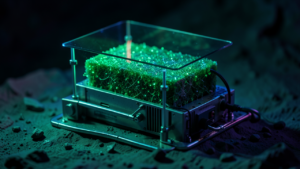
This groundbreaking memory chip utilizes the phenomenon of “ferroelectricity.” Ferroelectric materials possess the unique property of retaining a permanent spontaneous electric polarization even without an external electric field. This polarization state is exceptionally resistant to disruption by radiation, allowing for highly stable data retention. Specifically, the chip has been verified to withstand extreme cumulative radiation exposure of up to 1 MGy (1 million Grays, or 100 million rads). While conventional flash memory has always faced the risk of bit flips or data loss due to radiation, ferroelectric memory overcomes these challenges. This radiation hardness ensures that AI processors and autonomous systems onboard spacecraft can maintain data integrity and system stability throughout extended deep-space missions.
Background & Industry Context
Deep-space exploration missions operate outside the protective sphere of Earth’s magnetosphere, constantly exposed to high-energy radiation from solar flares and galactic cosmic rays. In such environments, standard electronic components are prone to failure or data corruption, making extremely robust “radiation-hardened” components indispensable for spacecraft. However, existing radiation-hardened memory solutions have typically been expensive and capacity-limited. Georgia Tech’s research offers a high-performance, highly durable, and potentially cost-effective solution to these challenges. This technology is expected to revolutionize data storage and processing for a wide range of deep-space applications, including lunar bases, Mars missions, and long-duration exploration rovers.
Future Outlook
The development of this radiation-hardened ferroelectric NAND memory chip opens new frontiers for space exploration. More reliable data storage will enhance the success rate of deep-space missions and significantly improve the quality and quantity of scientific data collected. Furthermore, by increasing spacecraft autonomy, it will mitigate challenges posed by communication delays from Earth, enabling complex tasks to be processed onboard in real-time. In the future, this technology is expected to be applied to commercial satellites and Low Earth Orbit (LEO)-based AI data centers, contributing to the overall reliability and performance enhancement of space infrastructure. This breakthrough strengthens the foundation for humanity to operate longer and more safely in the harsh environment of space.
Source: https://www.universetoday.com/articles/the-flash-memory-that-space-cant-destroy



Comments