Key Findings
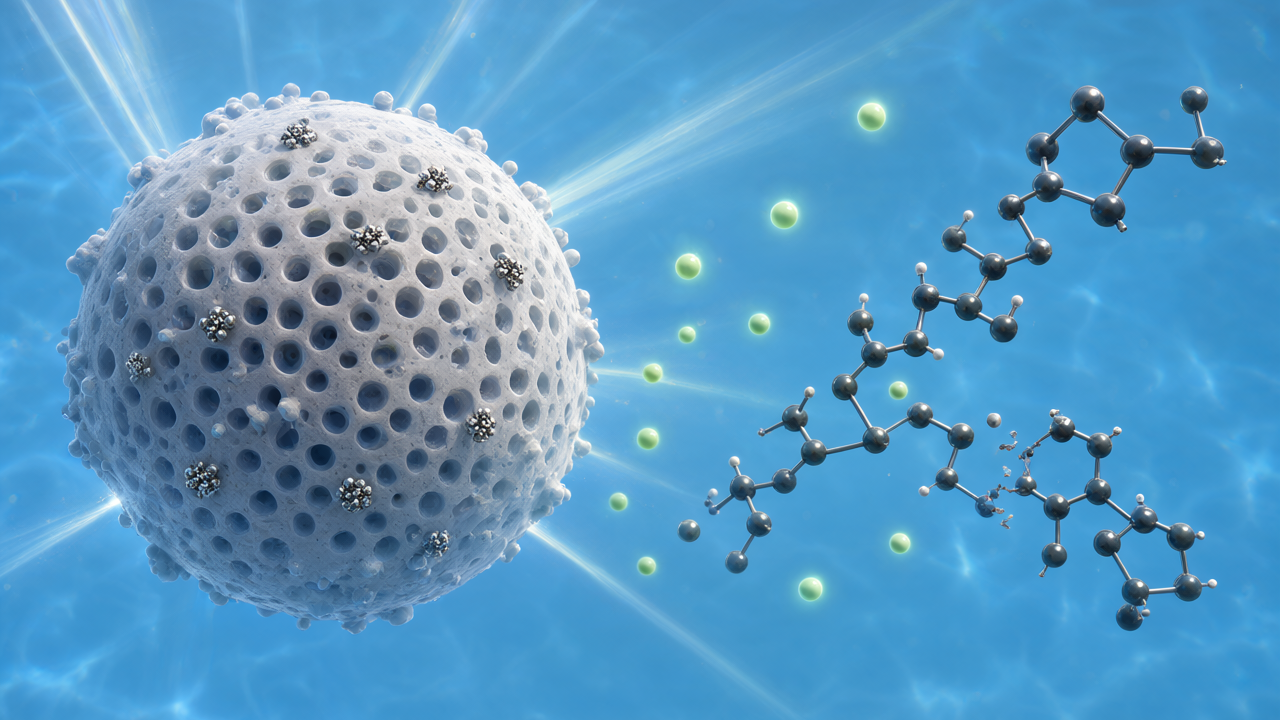
A breakthrough study published in Nature Water in September 2026 demonstrated that a light-driven approach, employing ultra-small palladium and platinum nanocatalysts supported on aminated mesoporous silica nanoparticles, is remarkably effective in the reductive defluorination of PFAS (per- and polyfluoroalkyl substances). This method achieved stoichiometric or near-stoichiometric fluoride release for compounds like PFOA (perfluorooctanoic acid) and PFOS (perfluorooctanesulfonic acid) under ambient temperature conditions, representing a significant leap in environmental remediation.
Technical/Clinical Details
- Nanocatalyst Composition: The system is built upon aminated mesoporous silica nanoparticles with high surface area, where noble metal nanocatalysts of palladium and platinum, typically a few nanometers in size, are uniformly dispersed. The mesoporous structure of the silica enables efficient adsorption of PFAS molecules and optimal access to the catalytic active sites.
- Light-Driven Reaction Mechanism: Upon exposure to light energy, the noble metal nanocatalysts generate electrons that facilitate a reductive reaction, severing the carbon-fluorine bonds in PFAS molecules. This reaction effectively releases fluorine atoms as fluoride ions into the water, transforming the harmful PFAS into benign forms. The ability to perform this reaction at room temperature significantly reduces energy costs and simplifies the overall process.
- Defluorination Efficiency: Experiments confirmed near 100% stoichiometric fluoride release for PFOA and PFOS. This indicates virtually complete degradation of the PFAS molecules, a level of efficiency that has been challenging to achieve with conventional PFAS treatment methods such as adsorption or incineration.
Background & Context
PFAS, known as ‘forever chemicals’ due to their exceptional stability and resistance to degradation, are a pervasive and severe cause of water contamination globally. Their widespread detection and toxicological concerns necessitate stricter drinking water regulations and the development of highly effective removal and degradation technologies. Current PFAS treatment methods often suffer from high costs, risks of secondary pollution, or insufficient degradation efficiency. This light-driven nanocatalyst technology offers an innovative solution to these persistent challenges.
Strategic Significance & Outlook
This novel nanocatalyst technology has the potential to enable effective and sustainable treatment of PFAS-contaminated water, significantly reducing environmental PFAS loads. Its ability to degrade PFAS with high efficiency at low energy consumption is a major advantage for applications in large-scale water treatment plants and even point-of-use purification systems. Future research will focus on field testing and scale-up studies, with high expectations for its implementation in addressing real-world environmental contamination issues globally. This innovation marks a critical advancement in the global fight against persistent organic pollutants.
Get our weekly technology intelligence — free
Receive an infographic that lets you judge at a glance whether each field’s analysis report is worth reading.
Subscribe Free — Weekly Tech Intelligence
By subscribing, you’ll receive Troy-Technical’s weekly technology intelligence newsletter.
- Your email and selected fields are used only to deliver the newsletter.
- We never share your information with third parties.
- You can unsubscribe anytime via the link in each email.
See our Privacy Policy for details.
Takes about a minute · Unsubscribe anytime






Comments