

Key Findings
A study published in Communications Engineering reveals that the transparent electrode substrate, specifically indium tin oxide (ITO), acts as a source of extrinsic contaminants that degrade perovskite solar cells. While researchers previously attributed performance decay to volatile organic components and halide ions within the perovskite itself, this research demonstrates that oxygen leaks from the ITO substrate into the device when temperatures rise, accumulating at the buried interface and disrupting electrical contact quality.
Technical Details
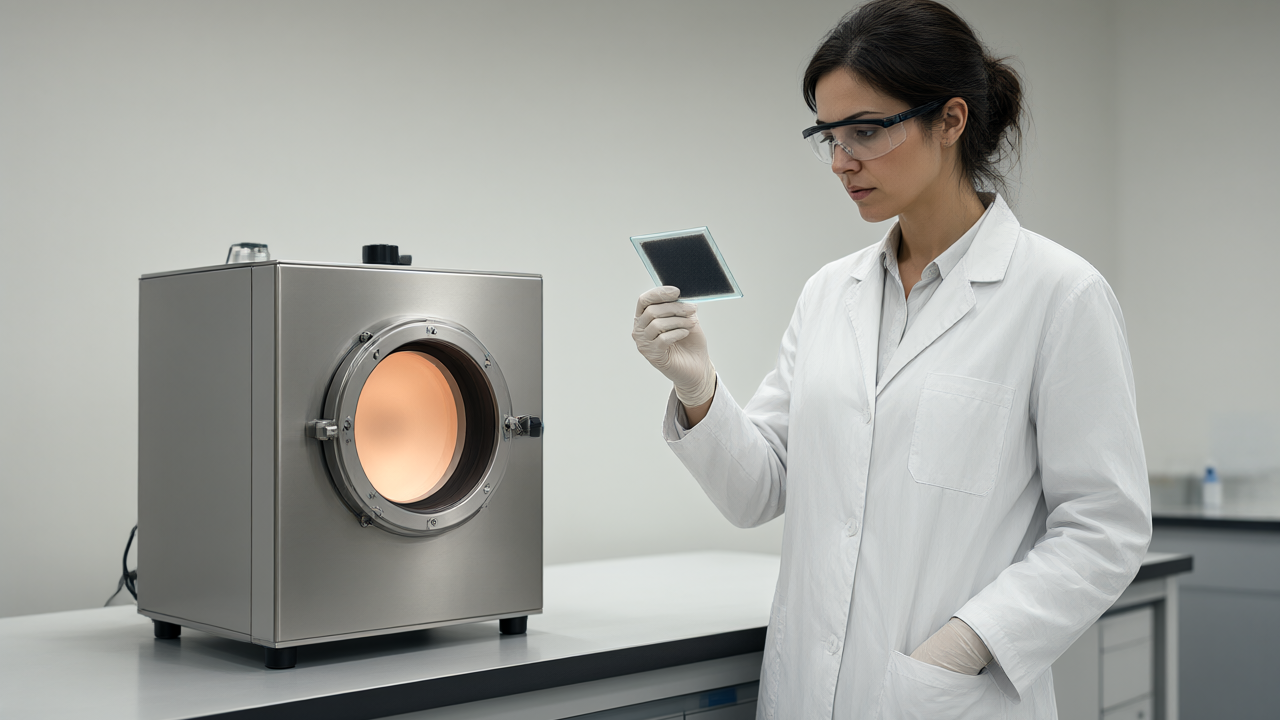
To track atomic-scale migration, the team from the University of North Texas Ion Beam Laboratory and Arizona State University used Rutherford Backscattering Spectrometry (RBS). The experiment involved depositing methylammonium lead triiodide thin films on ITO-coated glass and thermally aging them at 45, 65, and 85 degrees Celsius for 96 hours under a nitrogen atmosphere.
- Observation: RBS measurements showed that lead and iodine redistributed during aging, but unexpectedly, oxygen piled up at the perovskite-electrode interface.
- Verification: Non-annealed control samples showed no such accumulation, while aged samples showed measurable oxygen loss and surface roughening of the ITO substrate, confirming thermally activated out-diffusion.
- Mitigation: The researchers inserted a self-assembled monolayer of [2-(3,6-Dimethoxy-9H-carbazol-9-yl) ethyl] phosphonic acid between the ITO and the perovskite to act as an interfacial diffusion barrier.
Background & Context
Perovskite solar cells are noted for high efficiency and cheap solution processing, but they suffer from instability when exposed to heat. ITO is the standard transparent electrode for thin-film photovoltaics due to its conductivity and transparency. However, this study proves that ITO is not an inert component; its oxygen sublattice serves as a reservoir of mobile species at elevated temperatures.
Significance & Outlook
This discovery reframes the problem of front-contact breakdown in perovskite devices. By identifying the substrate as an active participant in device decline, engineers can now focus on interfacial barriers to prevent oxygen migration, which otherwise disrupts band alignment and accelerates degradation pathways.
Get our weekly technology intelligence — free
Receive an infographic that lets you judge at a glance whether each field’s analysis report is worth reading.
Subscribe Free — Weekly Tech Intelligence
By subscribing, you’ll receive Troy-Technical’s weekly technology intelligence newsletter.
- Your email and selected fields are used only to deliver the newsletter.
- We never share your information with third parties.
- You can unsubscribe anytime via the link in each email.
See our Privacy Policy for details.
Takes about a minute · Unsubscribe anytime