


Key Findings
The textured rounded-cone hemispherical cell demonstrated superior performance across incidence angles from 0° to 50°, achieving an average short-circuit current density of 25.47 mA/cm² and an average maximum power output of 28.25 mW/cm². Light absorption for this design exceeded 95%. In comparison, the smooth hemispherical cell reached 24.03 mA/cm² and the planar device reached 22.52 mA/cm² for average short-circuit current density.
Technical Details
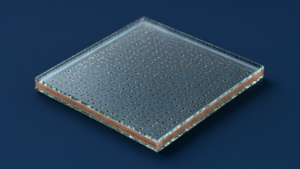
The research team modeled five distinct architectures: planar, nanowire, smooth hemispherical, and hemispherical structures featuring either rounded-cone or textured rounded-cone front surfaces. The device stack consists of the following layers:
- Indium tin oxide (ITO) electrode
- Phenyl-C61-butyric acid methyl ester (PCBM) electron transport layer
- Methylammonium lead iodide (CH₃NH₃PbI₃) perovskite absorber
- Nickel oxide (NiO) hole transport layer
- Silver (Ag) rear electrode
Simulations were conducted using Lumerical software to analyze electromagnetic fields, scattering, and light absorption across wavelengths from 300 nm to 800 nm. The hemispherical geometry facilitates radial charge collection, while the textured surface scatters light in multiple directions to enhance absorption. Additionally, Mie resonances induced within the perovskite shell ensure efficient light trapping.
Background & Context
While perovskite solar cells are recognized for low manufacturing costs and high power conversion efficiency, conventional planar cells suffer from optical losses when the solar incidence angle varies. These losses lead to power fluctuations that compromise the viability of the technology for renewable energy generation.
Significance & Outlook
The study, published in Solar Energy by scientists from the Chinese Academy of Sciences and Jilin Normal University, concludes that the three-dimensional hemisphere symmetry enables balanced carrier transport. By effectively decoupling performance from the incident light angle, this design overcomes a critical challenge in maintaining stable power output for perovskite photovoltaics.
Get our weekly technology intelligence — free
Receive an infographic that lets you judge at a glance whether each field’s analysis report is worth reading.
Subscribe Free — Weekly Tech Intelligence
By subscribing, you’ll receive Troy-Technical’s weekly technology intelligence newsletter.
- Your email and selected fields are used only to deliver the newsletter.
- We never share your information with third parties.
- You can unsubscribe anytime via the link in each email.
See our Privacy Policy for details.
Takes about a minute · Unsubscribe anytime