


Key Findings
The TI-CTC metamaterial significantly outperforms conventional architected topologies in blast attenuation. In simulations, the TI-CTC core reduced peak base stress by 78.5 percent relative to a pyramidal lattice benchmark and delayed the arrival of the peak stress by a factor of 13.6. Unlike traditional crushable absorbers that rely on permanent plastic deformation, this material achieves stable dissipation up to a nominal strain of 0.25 and is capable of self-recovery.
Technical Details
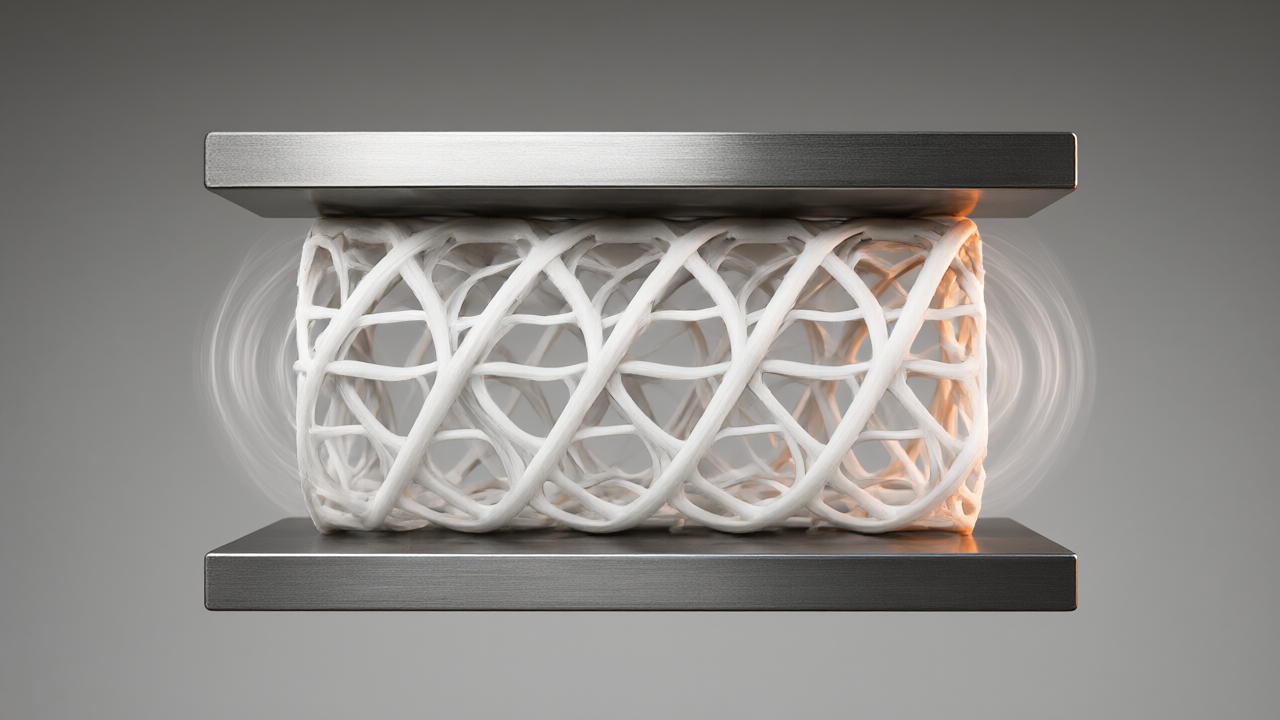
The system utilizes a compression–torsion coupling strategy to reorganize mechanical energy dissipation. While classical topological interlocking assemblies rely on passive sliding, this design arranges interlocking elements so that axial compression is converted into relative rotation between layers. This twist amplifies the relative motion between struts, increasing the frictional sweep across contacting surfaces and extracting more energy per unit of input displacement.
Self-recovery is achieved by embedding interlocking elements within a torsion-coupling framework. Elastic members store strain energy during the twisting phase of compression and release it during unloading, actively rotating the blocks back to their initial registry. Additionally, the material exhibits progressive stiffening, where resistance grows as deformation accumulates, limiting the total stroke consumed before the structure becomes rigid.
Design Methodology
To navigate the high-dimensional design space of the interlocking geometry, researchers employed a neural network surrogate model trained on simulated responses. This was coupled with the NSGA-II multi-objective genetic algorithm to optimize competing objectives, including maximizing energy dissipation, controlling peak transmitted force, and preserving self-recovery. This approach produced a Pareto front of candidate designs rather than a single optimum.
Significance and Outlook
The combination of progressive stiffening, stable dissipation, and self-recovery distinguishes this architecture from previous frictional metamaterials. For crash absorbers, this provides a predictable, self-limiting compression stroke; for seismic isolation bearings, it prevents the system from bottoming out as ground displacement increases.
Get our weekly technology intelligence — free
Receive an infographic that lets you judge at a glance whether each field’s analysis report is worth reading.
Subscribe Free — Weekly Tech Intelligence
By subscribing, you’ll receive Troy-Technical’s weekly technology intelligence newsletter.
- Your email and selected fields are used only to deliver the newsletter.
- We never share your information with third parties.
- You can unsubscribe anytime via the link in each email.
See our Privacy Policy for details.
Takes about a minute · Unsubscribe anytime