

Key Findings
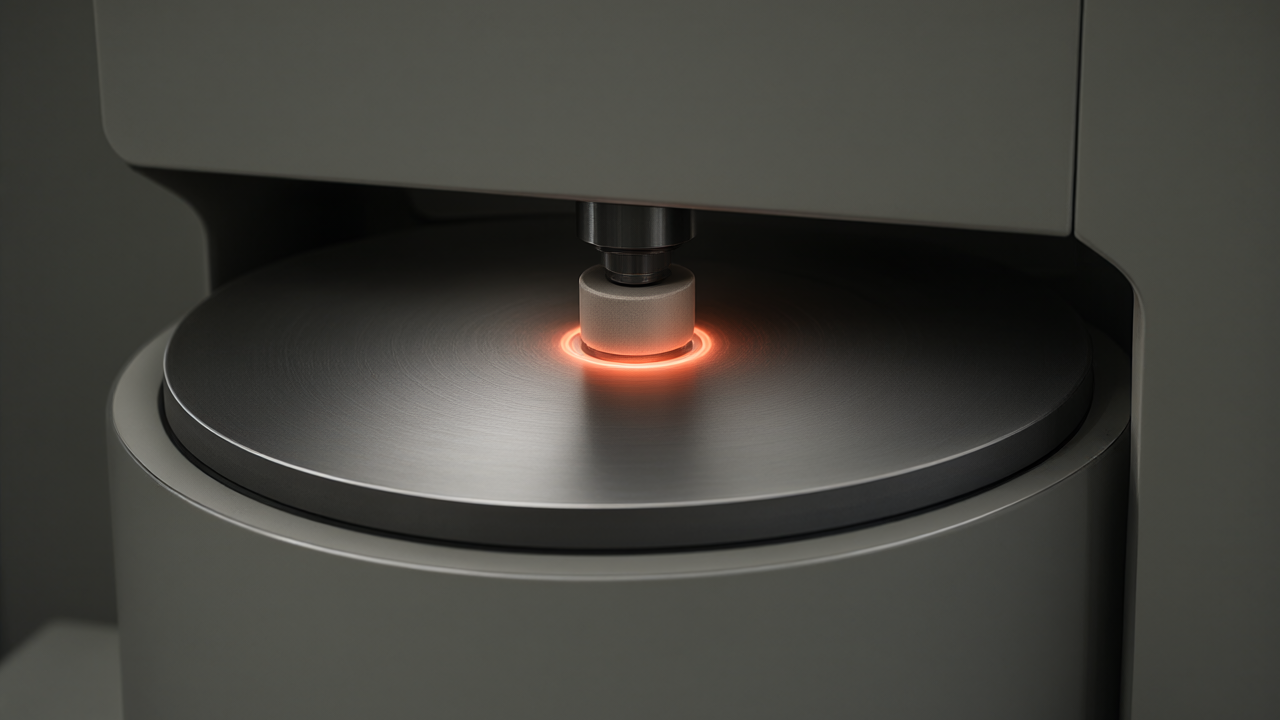
The addition of high-entropy ceramic particles significantly enhances the tribological performance of molybdenum. A composite containing 3 percent by weight of (Hf0.25Ta0.25Nb0.25Ti0.25)C demonstrated a wear rate reduction of 52.8 percent under a 30-newton load and 28 percent under 40 newtons. Surface hardness increased from 212 HV in pure molybdenum to 253.3 HV for the 3 percent composite and 264.9 HV for the 5 percent composite. While the 3 percent composite showed the lowest material loss, the 5 percent composite exhibited a higher wear rate, indicating that excessive ceramic loading may weaken interfacial bonding.
Technical Details
The high-entropy carbide was synthesized using a 1:1:1:1 molar ratio of HfCl4, TaCl5, NbCl5, and TiCl4 dissolved in absolute ethanol, with triethylamine and acetylacetone used for stabilization and a phenolic resin as the carbon source. The powder underwent carbothermal reduction at 1600 degrees Celsius under argon. The final composite was produced via high-energy ball milling and spark plasma sintering at 2000 degrees Celsius under 50 megapascals of pressure.
Microstructural analysis revealed:
- Uniformly embedded ceramic particles without micro-voids or large-scale agglomeration.
- A chemically continuous interfacial transition layer between the (111) plane of the carbide and the (110) plane of body-centered cubic molybdenum.
- Increased dislocation density, with KAM values rising from 0.92 degrees in pure molybdenum to 1.01 degrees in the composites.
Background & Context
Molybdenum is valued in aerospace, electronics, and nuclear engineering for its high melting point and thermal conductivity. However, its poor wear resistance limits its application in turbine blades and piston rings. High-entropy ceramics, which utilize multiple principal elements on a single crystal lattice to generate high configurational entropy, provide the necessary hardness and thermal stability to mitigate this weakness.
Significance & Outlook
This research closes a gap in the application of high-entropy ceramics within molybdenum alloys. By creating a robust load transfer mechanism through atomic interdiffusion, these composites offer a pathway toward a new generation of refractory metal alloys designed for extreme high-temperature wear conditions.
Get our weekly technology intelligence — free
Receive an infographic that lets you judge at a glance whether each field’s analysis report is worth reading.
Subscribe Free — Weekly Tech Intelligence
By subscribing, you’ll receive Troy-Technical’s weekly technology intelligence newsletter.
- Your email and selected fields are used only to deliver the newsletter.
- We never share your information with third parties.
- You can unsubscribe anytime via the link in each email.
See our Privacy Policy for details.
Takes about a minute · Unsubscribe anytime