

Key Findings
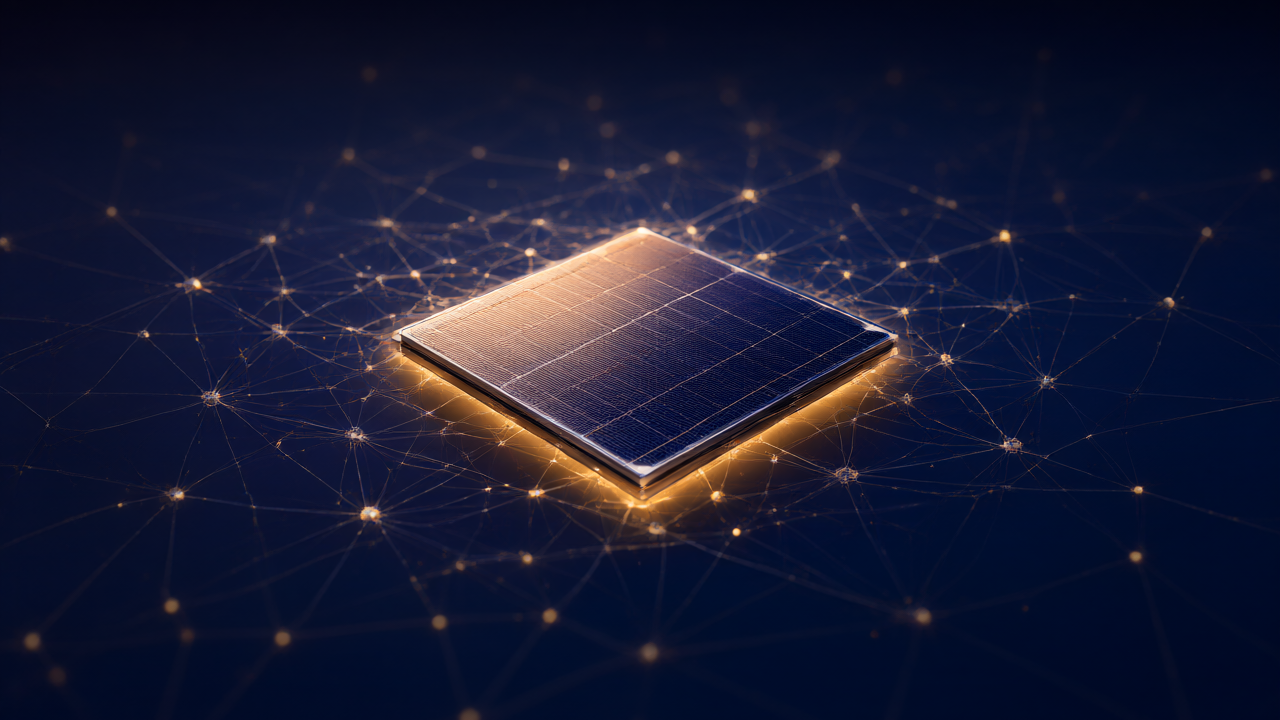
The integration of an AI-designed molecule, designated as AI-1, has pushed the power-conversion efficiency of perovskite solar cells to 27.2%. Beyond efficiency, the devices demonstrated significant durability, maintaining more than 95% of their initial efficiency after 2,000 hours of maximum-power-point tracking at 65 °C. This result is particularly meaningful as it represents sustained operation under continuous load at elevated temperatures.
Technical Details
The discovery process employed a pipeline combining a graph neural network for retrosynthetic route prediction, density functional theory (DFT) for high-throughput screening, and expert chemical judgment. From an initial pool of 308 molecular fragments, the system generated over 90,000 candidate structures, which were eventually narrowed down to 300 finalists.
To ensure laboratory viability, the team used a composite score based on eight descriptors. These included:
- Synthesizability
- Hole reorganization energy (λh)
- Heteroatom content
- Aromaticity
- Intrinsic electronic properties
The resulting AI-1 molecule forms robust S–Pb coordination bonds at the buried interface between the monolayer and the perovskite crystal. Mechanistic studies identified a multifunctional methylthio side chain as the critical feature, which reinforces interfacial bonding and balances passivation with chemical robustness to resist the harsh chemistry of the perovskite surface.
Background & Context
Self-assembled monolayers are single-molecule-thick films used to anchor charge extraction in solar devices. A primary challenge in this field is “non-radiative recombination,” where excited charge carriers annihilate each other. AI-1 suppresses this wasteful process by strengthening the connection at the interface.
Significance & Outlook
This workflow provides a systematic alternative to traditional discovery by scoring synthesizability and stability alongside electronic performance from the outset. The authors argue that AI-guided design can consistently deliver monolayers that unite high efficiency with long-term operational stability, offering general principles for future interface engineering in photovoltaic technology.
Get our weekly technology intelligence — free
Receive an infographic that lets you judge at a glance whether each field’s analysis report is worth reading.
Subscribe Free — Weekly Tech Intelligence
By subscribing, you’ll receive Troy-Technical’s weekly technology intelligence newsletter.
- Your email and selected fields are used only to deliver the newsletter.
- We never share your information with third parties.
- You can unsubscribe anytime via the link in each email.
See our Privacy Policy for details.
Takes about a minute · Unsubscribe anytime