
Key Findings
The study demonstrates that unsupervised machine learning via PCA can systematically organize spectral data from degrading epoxy adhesives to identify dominant degradation themes. The analysis identified three primary spectral components: moisture-related variations (3000 to 3600 per centimeter), oxidation-associated processes (near 1700 and 1100 per centimeter), and filler-phase features related to calcium carbonate (near 700, 900, and 1400 per centimeter). Notably, the AMAM system exhibited a non-monotonic tensile strength profile, where strength initially dropped, partially recovered, and then fell again.
Technical Details
The researchers tested three curing agents mixed into a common base resin from Cemedine Co., Ltd. containing epoxy resin, CTBN-modified epoxy, silica, calcium carbonate, and calcium oxide:
- TETA (aliphatic polyamine): Cured at 100 °C for one hour.
- MDA (aromatic diamine): Cured at 160 °C for one hour.
- AMAM (commercial amidoamine): Cured at 100 °C for 30 minutes.
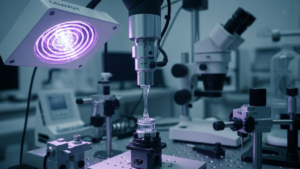
Accelerated aging was conducted via water immersion at 63 °C and 87 °C, and humid air exposure at 120 °C (100 percent relative humidity). The 120 °C tests were terminated after one week due to rapid degradation. Data was collected using a handheld FTIR spectrometer with the attenuated total reflection method on 0.3-millimeter-thick specimens.
Background & Context
To ensure raw variations were captured, spectra were left unprocessed except for common offset adjustments. PCA was applied with mean centering but no variance scaling, with the first three components capturing approximately 90 percent of the variance. Bootstrap resampling with 100 iterations confirmed the robustness of loading patterns, with Pearson correlation coefficients between 0.923 and 0.999.
Significance & Outlook
The method’s sensitivity allowed the detection of anomalies, such as 168-hour observations in the AMAM system that deviated from temporal trajectories. The findings suggest that while initial strength loss is consistent with plasticization, later stages of degradation—particularly in the AMAM system—may involve network relaxation or filler-interfacial changes.
Get our weekly technology intelligence — free
Receive an infographic that lets you judge at a glance whether each field’s analysis report is worth reading.
Subscribe Free — Weekly Tech Intelligence
By subscribing, you’ll receive Troy-Technical’s weekly technology intelligence newsletter.
- Your email and selected fields are used only to deliver the newsletter.
- We never share your information with third parties.
- You can unsubscribe anytime via the link in each email.
See our Privacy Policy for details.
Takes about a minute · Unsubscribe anytime