


Key Findings
The developed bilayer polyurethane-urea (PUU) coating, specifically the BS750 formulation, achieves an ultra-low ice shear strength of 2 kPa at –20 °C. As temperatures decrease to –40 °C, the ice shear strength rises to 11 kPa. The coating demonstrates high durability, maintaining stable ice shear strength below 10 kPa across icing/de-icing cycles even after exposure to UV ageing, heating, freezing, sandpaper wear, and falling-sand abrasion.
Technical Details
The coating consists of two distinct layers:
- Base Layer: Composed of polyaspartic ester (F420), polycaprolactone (PCL) triol, HDI trimer, and an NCO-terminated prepolymer.
- Hydrophilic Surface Layer: Formed by grafting and crosslinking methoxy poly(ethylene glycol) (MPEG), polyethylene glycol (PEG), polypropylene glycol (PPG), glycerol, and HDI trimer onto the base.
SEM analysis indicates the presence of ridge-like bulges on the surface, which are more prominent and densely packed in the BS750 formulation. DSC analysis revealed an endothermic peak at –22.5 °C, indicating a phase change of bound water. This unfrozen bound water or loose ice at the interface creates a lubricating hydration layer, allowing ice to detach under natural forces such as wind or gravity.
Background & Context
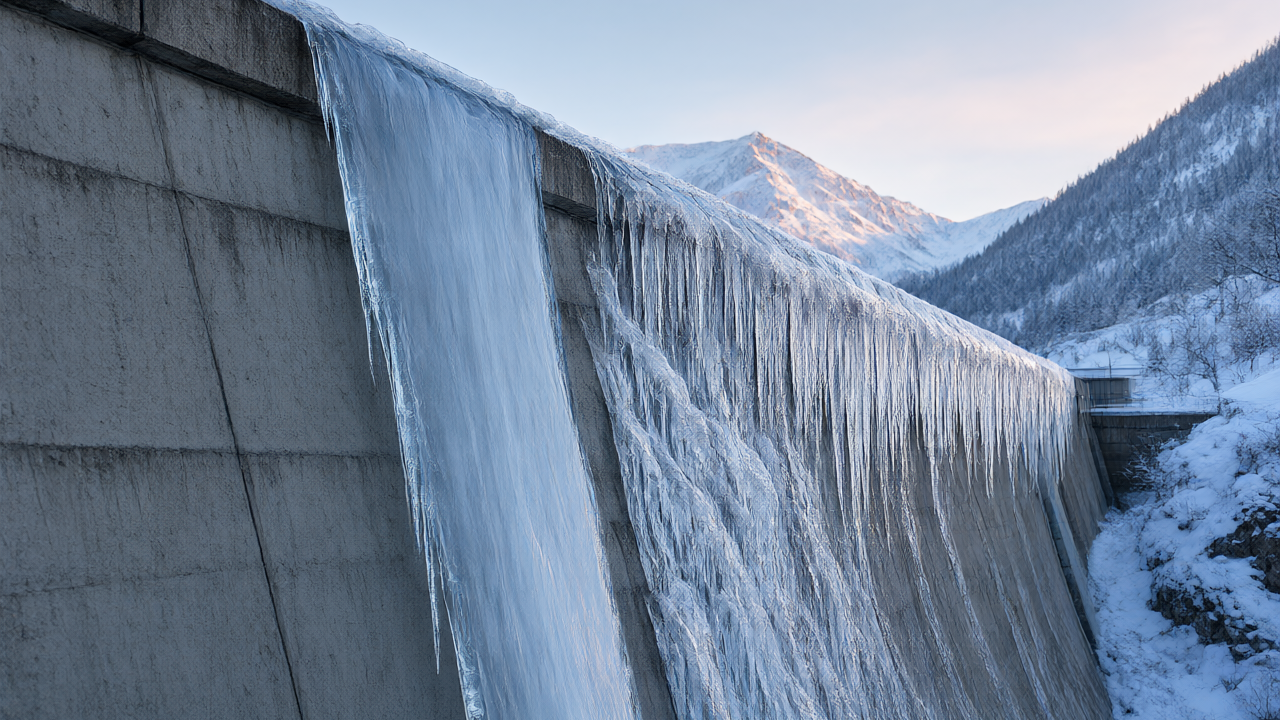
Hydraulic concrete dams in cold regions face structural damage from ice-pullout loads on thermal insulation layers. Previous passive anti-icing methods, such as superhydrophobic coatings and lubricant-infused surfaces, have proven insufficient due to lubricant depletion, environmental concerns regarding fluorinated materials, or loss of ice-phobicity in static, high-humidity environments. The PUU coating addresses these issues by utilizing a hydrophilic surface layer rather than distributing hydrophilic components throughout the entire matrix.
Significance & Outlook
By combining mechanical durability with ultra-low ice adhesion and avoiding the use of leachable lubricants or fluorinated materials, this bilayer PUU coating offers a sustainable passive anti-icing solution. It addresses a long-standing engineering challenge regarding the protection of insulating layers in cold-climate hydraulic infrastructure.
Get our weekly technology intelligence — free
Receive an infographic that lets you judge at a glance whether each field’s analysis report is worth reading.
Subscribe Free — Weekly Tech Intelligence
By subscribing, you’ll receive Troy-Technical’s weekly technology intelligence newsletter.
- Your email and selected fields are used only to deliver the newsletter.
- We never share your information with third parties.
- You can unsubscribe anytime via the link in each email.
See our Privacy Policy for details.
Takes about a minute · Unsubscribe anytime