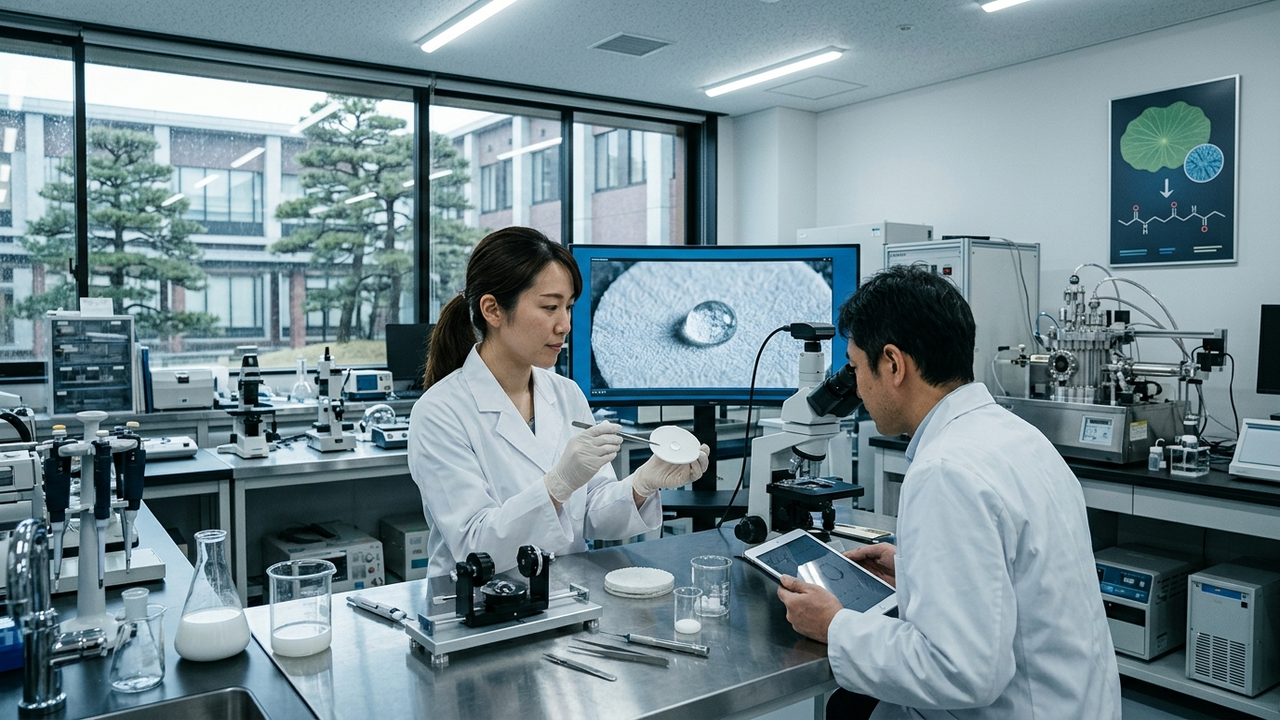
Researchers at Kyoto University’s Institute for Integrated Cell-Material Sciences (iCeMS) have developed an innovative foaming technology that simultaneously achieves vibrant white color and water repellency, drawing inspiration from structural colors found in nature. This was accomplished without the use of environmentally harmful chemicals like titanium dioxide pigments or fluorinated compounds (PFAS). This research, published in the international scientific journal Nature, is garnering significant attention as a major advancement in the field of sustainable materials science.
Key Findings
- Developed a vibrant white, water-repellent material using nature-inspired foaming technology, without TiO₂ pigments or PFAS.
- Groundbreaking achievement published in Nature, offering a new platform for sustainable material development.
- Expected to replace environmentally burdensome white pigments and water repellents, with broad industrial applications.
- Achieved high performance through the synergistic effect of structural color and surface texture.
Technical Details
This new foaming technology generates white color by precisely controlling the microstructure of micro-sized air bubbles within a foamed polymer, leveraging light scattering principles. In nature, numerous examples of structural color, such as polar bear fur and white bird feathers, appear white without containing pigments. The research team mimicked these natural principles, developing a polymer foam with optimized bubble size and density. This porous structure achieves high whiteness by uniformly scattering incident light in all directions. Concurrently, the fine surface texture imparts hydrophobicity (water-repelling property), demonstrating excellent water repellency without fluorinated coatings. Since the material forms through self-assembly, the manufacturing process is relatively simple and consumes less energy. This technology holds significant importance as a sustainable alternative to conventional titanium dioxide pigments, which raise health and environmental concerns due to nanoparticles, and PFAS, which are problematic due to their environmental persistence and bioaccumulation, often referred to as ‘forever chemicals.’
Background & Context
White is widely used as a fundamental color in various products including paints, plastics, paper, and textiles. Historically, titanium dioxide (TiO₂) pigments have been primarily used to produce white, but their manufacturing involves high energy consumption and environmental burdens, and concerns exist regarding the health effects of nanoscale TiO₂ particles. Similarly, fluorinated polymers (PFAS) have been extensively used for water-repellent materials, but PFAS, often called ‘forever chemicals,’ degrade very slowly in the environment, posing a global problem for ecosystems and human health. Against this backdrop, international organizations like the United Nations Environment Programme (UNEP) and various governments are strongly promoting the development of sustainable and environmentally friendly materials. The research by Kyoto University iCeMS provides a groundbreaking solution that addresses these environmental regulations and market needs.
Strategic Significance & Outlook
The PFAS-free white water-repellent material developed by Kyoto University iCeMS represents a crucial step towards realizing a sustainable society. Its application fields are very broad, including food packaging materials, construction materials, apparel, printing inks, and automotive interior materials, among others. Particularly, this technology will offer a significant competitive advantage in European and North American markets where PFAS regulations are becoming stricter. Future efforts will focus on further reducing manufacturing costs, establishing scale-up production techniques, and fine-tuning material properties for specific applications. This ‘nature-inspired’ approach is expected to create a new trend in environmentally conscious material innovation, fostering paradigm shifts across various industrial sectors.
Source: https://www.icems.kyoto-u.ac.jp/en/news/11675/
Get our weekly technology intelligence — free
Receive an infographic that lets you judge at a glance whether each field’s analysis report is worth reading.
Subscribe Free — Weekly Tech Intelligence
By subscribing, you’ll receive Troy-Technical’s weekly technology intelligence newsletter.
- Your email and selected fields are used only to deliver the newsletter.
- We never share your information with third parties.
- You can unsubscribe anytime via the link in each email.
See our Privacy Policy for details.
Takes about a minute · Unsubscribe anytime






Comments