

Key Findings
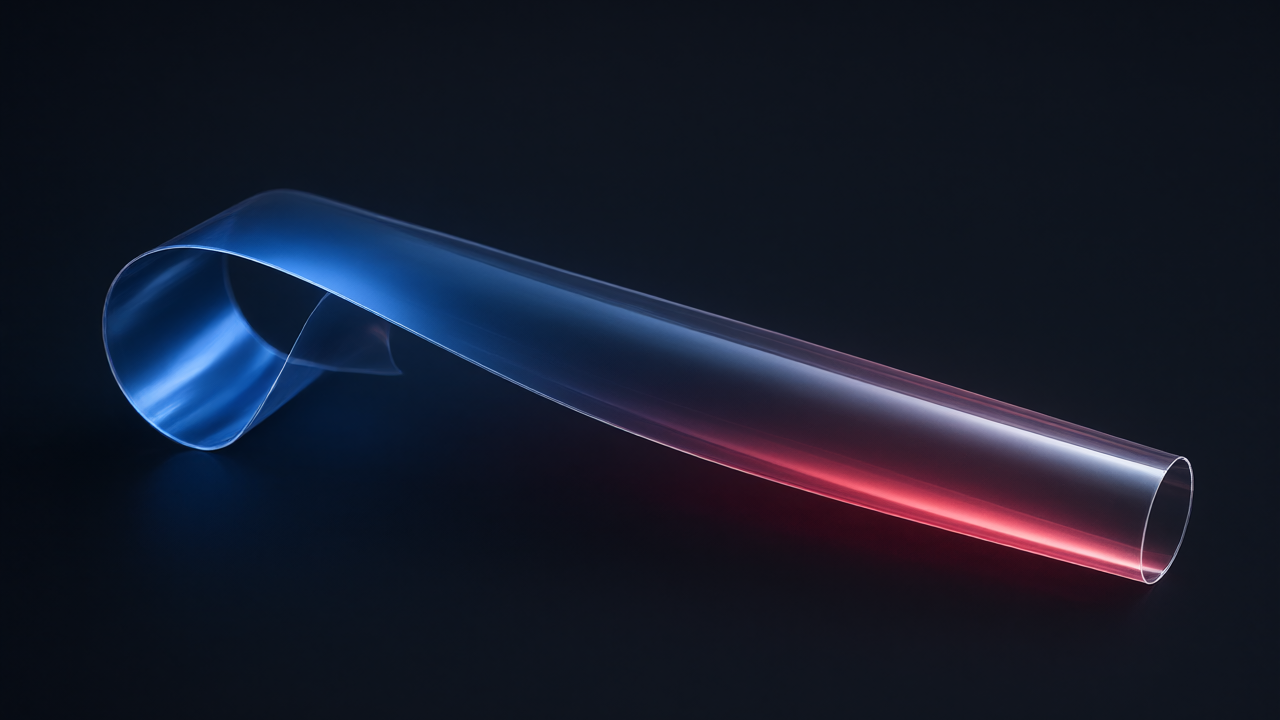
The developed flexible active-matrix electrochromic display enables simultaneous optical communication for human eyes and machine vision systems. By utilizing a single active layer, the platform provides high reflectance contrast across two spectral bands. In the visible spectrum, the device demonstrates a hue variation of 167.2 degrees, while in the near-infrared (NIR) range, it achieves a reflectance change of 38 percent at 1270 nm. Switching dynamics are characterized by a rise time of 88 ms and a fall time of 165 ms.
Technical Details
The display architecture combines a conducting polymer, PEDOT:PSS, with an electrically tunable dual-band Gires-Tournois resonator. The modulation is driven by electrochemical doping of the PEDOT:PSS, which alters the polymer’s complex refractive index under a low voltage range of −2.0 V to +1.0 V. To demonstrate scalability, the team fabricated a 4 × 4 active-matrix pixel array on a flexible thin-film transistor backplane. This array features:
- Independent pixel-level control.
- An on–off ratio of approximately 10^6.
- Low off current and high spatial uniformity to suppress pixel crosstalk.
Background and Context
While reflective displays are valued for their ultralow power consumption and compatibility with wearable platforms, previous dynamically tunable versions, such as electrophoretic displays, have been limited to the visible spectral range. This limitation has hindered their reliability in environments where information must be transmitted to both human observers and robotic sensors under varying illumination conditions.
Significance and Outlook
The integration of visible and NIR modulation into one active layer eliminates the need to stack separate display mechanisms for each band. The researchers validated the system through dual-band recognition under bright conditions and robust NIR pattern recognition in low-light and haze conditions. This low-voltage, flexible platform is positioned for mixed human-machine viewing scenarios, particularly where NIR sensors must operate in challenging lighting environments.
Get our weekly technology intelligence — free
Receive an infographic that lets you judge at a glance whether each field’s analysis report is worth reading.
Subscribe Free — Weekly Tech Intelligence
By subscribing, you’ll receive Troy-Technical’s weekly technology intelligence newsletter.
- Your email and selected fields are used only to deliver the newsletter.
- We never share your information with third parties.
- You can unsubscribe anytime via the link in each email.
See our Privacy Policy for details.
Takes about a minute · Unsubscribe anytime