


Key Findings
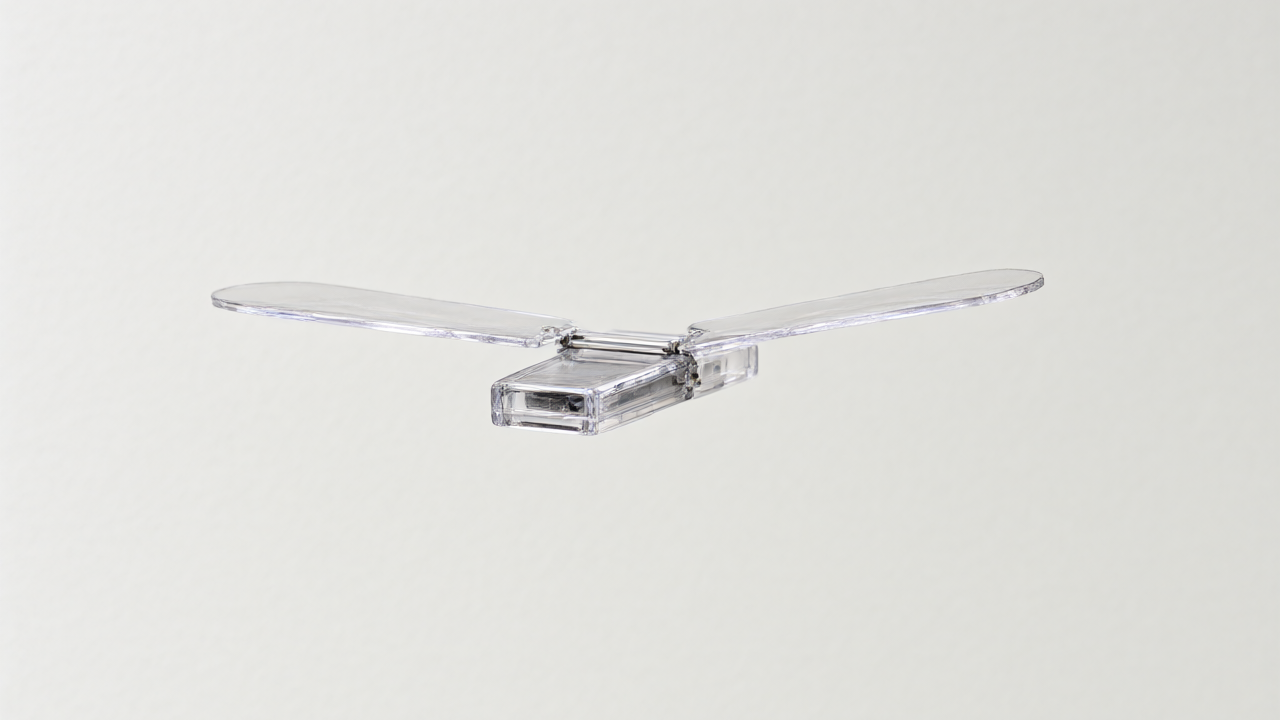
A research team from the University of California, Los Angeles (UCLA) and the University of California, Davis (UC Davis) has developed a tiny, all-polymer flying robot capable of withstanding significant physical collisions. The prototype weighs 185 mg and can generate lift equal to three times its own body weight, enabling a climb speed of 0.4 m/s. During resilience testing, the robot remained operational after being hit by a flyswatter and after being subjected to a load 11,000 times its weight.
Technical Details
The robot’s flight system relies on the following polymer-based components:
- Actuation: An electrically actuated soft muscle made of a thin layer of relaxor ferroelectric polymer. This material expands via electrostriction when an electric field is applied, driving the wings without additional mechanics.
- Wing Design: Flexible, cone-shaped wings that are aerodynamically asymmetric.
- Impact Resistance: The polymer structure allows wings to deform upon contact with hard materials without creating creases or kinks, providing high resistance to impacts.
Background and Context
Traditional micro aerial robots designed for search and rescue or inspection in confined spaces often utilize delicate components, making them vulnerable to collisions. To address this, the researchers sought to mimic the resilience of insects, which can repeatedly strike surfaces and continue flying. The findings were published in the study “Takeoff of an all-polymer micro aerial flying robot” in Science Robotics.
Significance and Outlook
The robot currently operates via an external electrical connection. Future development will focus on integrating sensors and an onboard power source to enable operation outside of laboratory environments. The goal is to leverage the robot’s “mechanical intelligence” to allow it to autonomously resume missions after experiencing collisions in the field.
Source: https://www.heise.de/en/news/Tough-soft-flying-robot-keeps-going-after-collisions-11509017.html
Get our weekly technology intelligence — free
Receive an infographic that lets you judge at a glance whether each field’s analysis report is worth reading.
Subscribe Free — Weekly Tech Intelligence
By subscribing, you’ll receive Troy-Technical’s weekly technology intelligence newsletter.
- Your email and selected fields are used only to deliver the newsletter.
- We never share your information with third parties.
- You can unsubscribe anytime via the link in each email.
See our Privacy Policy for details.
Takes about a minute · Unsubscribe anytime