


Key Findings
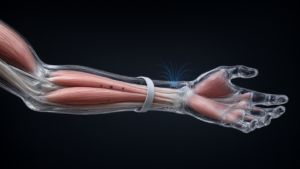
The developed wearable pMUT array operates at a low driving voltage of 5 Vp while maintaining an 81.7% broadband response. In vitro testing using wire phantoms demonstrated a penetration depth of up to 9 cm, with axial and lateral resolutions of 0.64 mm and 1.27 mm, respectively. In vivo applications showed high-fidelity B-mode and M-mode imaging of the radial, brachial, and carotid arteries within a 4 cm depth, performing comparably to commercial rigid probes.
Technical Details
To overcome the physical trade-off between driving voltage and acoustic bandwidth, the study implemented two primary innovations:
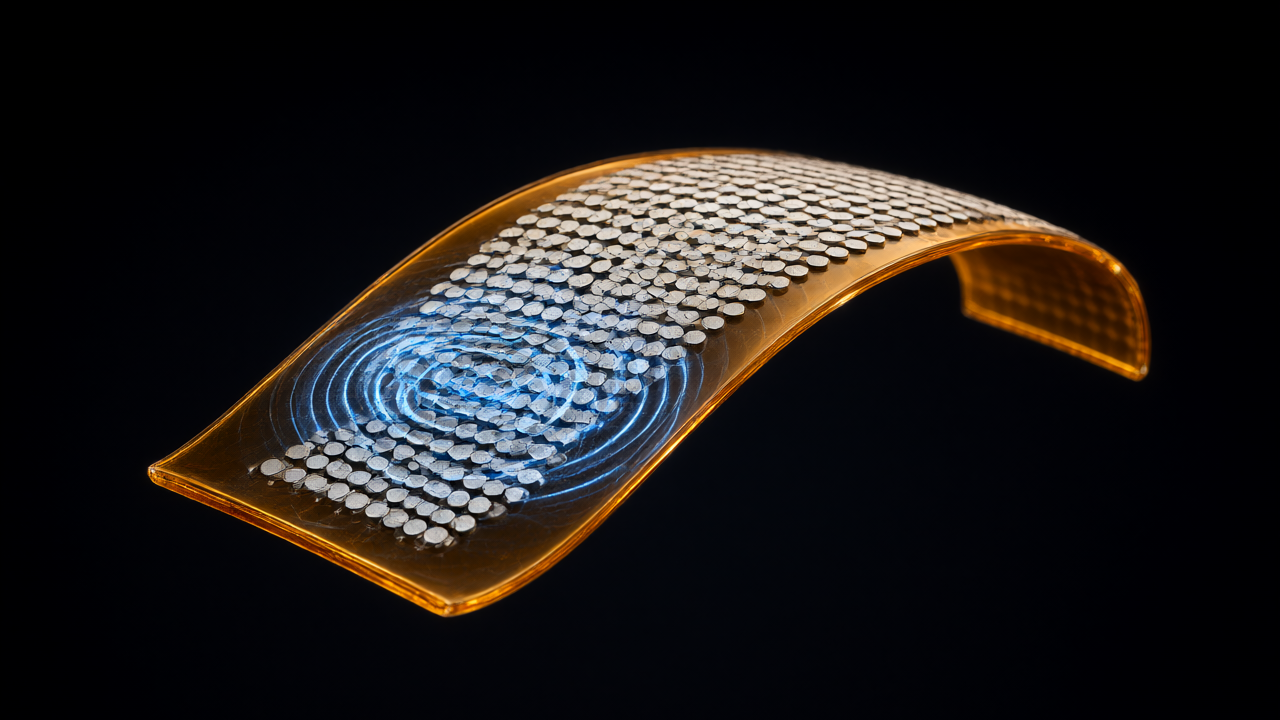
- Frequency-Merging Design: A novel design, quantified via an equivalent circuit model, was used to decouple the voltage-bandwidth trade-off.
- Wafer-Scale Fabrication: A scalable silicon-on-insulator (SOI) wafer-level fabrication process was utilized to enable semiconductor batch manufacturing.
The device supports continuous hemodynamic monitoring for up to 9 hours during daily postural activities. Inter-subject validation confirmed precise blood pressure measurements, showing deviations of 2.2 mmHg compared to FDA-approved clinical monitors.
Background & Context
Continuous non-invasive monitoring of central hemodynamics is critical for cardiovascular care. Previous wearable ultrasound devices typically relied on bulk piezoelectric ceramics (PZT) or 1–3 composites. While these materials offer high penetration and fidelity, they require high excitation voltages—generally ranging from 10 V to over 90 V—to overcome human tissue attenuation. Such high voltages increase system complexity, expand the hardware footprint, and increase battery consumption due to the need for specialized ASICs or charge pumps.
Significance & Outlook
By operating within the standard low-voltage logic levels of complementary metal-oxide-semiconductor (CMOS) technologies (typically below 5 V), this pMUT framework removes the need for high-voltage components. This alignment with standard semiconductor manufacturing provides a feasible path toward highly integrated, mass-producible cardiovascular ultrasound systems-on-chip (SoC).
Source: https://doi.org/10.1038/s41378-026-01451-6
Get our weekly technology intelligence — free
Receive an infographic that lets you judge at a glance whether each field’s analysis report is worth reading.
Subscribe Free — Weekly Tech Intelligence
By subscribing, you’ll receive Troy-Technical’s weekly technology intelligence newsletter.
- Your email and selected fields are used only to deliver the newsletter.
- We never share your information with third parties.
- You can unsubscribe anytime via the link in each email.
See our Privacy Policy for details.
Takes about a minute · Unsubscribe anytime