


Key Findings
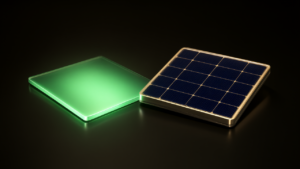
The integration of a specifically engineered molecule, TPE-BTA3, has pushed the power conversion efficiency of perovskite-organic tandem solar cells to 26.5%, with independent certification confirming 25.8%. This achievement is driven by the molecule’s ability to maintain high luminescence when clustered, which significantly reduces the open-circuit voltage (VOC) deficit typically found in organic solar materials.
Technical Details
TPE-BTA3 utilizes a three-dimensional rotor-stereo configuration to implement Aggregation-Induced Emission (AIE). Unlike conventional non-fullerene acceptors that suffer from aggregation-caused quenching (ACQ)—where tight packing leads to energy loss as heat—TPE-BTA3’s geometry restricts internal motion when clustered, forcing energy emission as light. This results in a photoluminescence quantum yield (PLQY) of 68%.
The researchers employed a ternary strategy, adding TPE-BTA3 as a third component to a binary organic bulk-heterojunction. This configuration provided two primary technical advantages:
- Voltage Increase: The boosted PLQY of the alloy-acceptor system reduced non-radiative losses, lifting the open-circuit voltage.
- Current Increase: The molecule strengthened the absorption of near-infrared photons, increasing the short-circuit current.
The final tandem architecture pairs this optimized organic bottom cell with a wide-bandgap perovskite top cell operating at 1.85 eV.
Background & Context
Perovskite-organic tandem cells stack layers to capture a broader solar spectrum, but the organic layer often loses more voltage than theoretical limits suggest. This is caused by non-radiative recombination, where electrons and holes annihilate without producing current or light. While AIE materials have been used in bioimaging and sensing, their application in photovoltaics has remained largely unexplored until this conceptual shift.
Significance & Outlook
The success of TPE-BTA3 demonstrates that luminescence-focused molecular engineering can effectively mitigate energy losses in next-generation solar technologies. The primary remaining questions for the field are whether this AIE approach can be extended to other material systems, scaled up, and transitioned into manufacturable devices.
Source: https://energiesmedia.com/molecule-glows-clusters-solar-efficiency/
Get our weekly technology intelligence — free
Receive an infographic that lets you judge at a glance whether each field’s analysis report is worth reading.
Subscribe Free — Weekly Tech Intelligence
By subscribing, you’ll receive Troy-Technical’s weekly technology intelligence newsletter.
- Your email and selected fields are used only to deliver the newsletter.
- We never share your information with third parties.
- You can unsubscribe anytime via the link in each email.
See our Privacy Policy for details.
Takes about a minute · Unsubscribe anytime