


Key Findings
Researchers from Keio University and Otsuka Electronics have achieved the non-destructive measurement of the three-dimensional refractive index distribution within optical waveguides made of resin and optical glass. By applying this technique, the team developed an athermal optical waveguide that maintains a mode field diameter of 4.2μm across a temperature range of 25 to 75°C. This represents a reduction in the temperature dependence of the refractive index difference by approximately one order of magnitude compared to two conventional material combinations.
Technical Details
The measurement system utilizes Otsuka Electronics’ 3D Optical Wave Field Microscope (3D-OWFM, product name: MINUK). The research group applied this to resin optical waveguides with circular cores produced via the “mosquito method” developed by Keio University. This approach allows for the direct measurement of the refractive index difference between the core and cladding without requiring the materials to be processed into films or prisms. By heating the samples during measurement, the team was able to evaluate the temperature dependence of the refractive index difference.
Background and Context
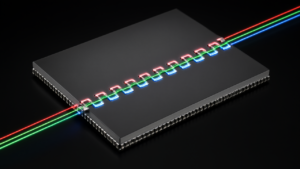
The rise of generative AI has increased the demand for high-speed, large-capacity communication and reduced power consumption in data centers. CPO technology, which integrates electronic and optical integrated circuits within the same package, is being developed to meet these needs. In CPO, micro-optical waveguides are critical for connecting optical integrated circuits to optical fibers. Because the refractive index of waveguide materials changes with temperature, transmission characteristics can fluctuate in high-temperature environments, potentially increasing connection losses.
Significance and Outlook
The ability to measure refractive indices in actual waveguide shapes enables the optimization of material combinations to suppress thermal fluctuations. Future goals include improving measurement accuracy, automating the process, and expanding application to semiconductor materials such as silicon. The researchers also intend to apply this to the simultaneous measurement of thermal expansion coefficients and thermo-optic constants, as well as the evaluation of adhesive curing processes for next-generation optoelectronic fusion modules. These results are scheduled for presentation at the IEEE CPMT Symposium (ICSJ2026) from November 10 to 12 at Ritsumeikan University’s Shugakuin Campus.
Source: https://optronics-media.com/news/20261109/113771/
Get our weekly technology intelligence — free
Receive an infographic that lets you judge at a glance whether each field’s analysis report is worth reading.
Subscribe Free — Weekly Tech Intelligence
By subscribing, you’ll receive Troy-Technical’s weekly technology intelligence newsletter.
- Your email and selected fields are used only to deliver the newsletter.
- We never share your information with third parties.
- You can unsubscribe anytime via the link in each email.
See our Privacy Policy for details.
Takes about a minute · Unsubscribe anytime