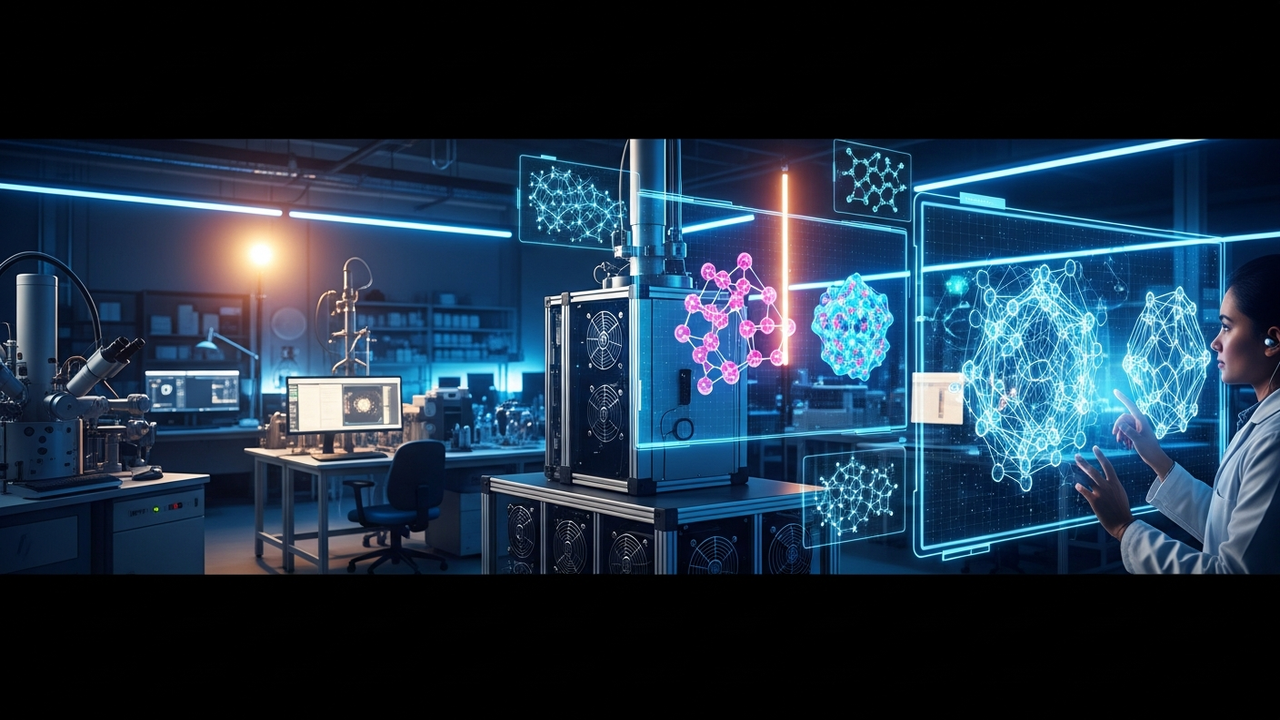
Background
The discovery and development of new materials are foundational to advancements across critical sectors, including sustainable energy, high-performance electronics, and advanced medicine. Solid solutions, in particular, are highly attractive due to their vast range of tunable properties, making them crucial for applications from advanced alloys to semiconductors. However, predicting their complex structure-property relationships has historically been a significant hurdle due to the intricate arrangement of different elements within their crystal lattices.
Machine learning, especially Graph Neural Networks (GNNs), has rapidly gained traction in materials science due to its ability to directly process material structures as input. The advent of SSNGNN marks a significant leap forward, expanding the applicability of GNNs to highly complex material systems like solid solutions and further advancing the field of materials informatics.
Key Findings
Researchers at the University of Edinburgh have unveiled the Solid Solution Nested Graph Neural Network (SSNGNN), a versatile AI framework designed to dramatically enhance the prediction accuracy of properties for chemically complex solid solution crystals. SSNGNN achieves superior performance compared to existing geometric deep learning models by adeptly addressing the challenges posed by localized structural disorder inherent in solid solutions.
SSNGNN’s primary innovations lie in its unique architectural features:
- Nested Graph Architecture: SSNGNN represents local, atomic-level information and global, crystal-lattice-wide information within distinct hierarchical graph structures. This allows the model to simultaneously capture individual atomic environment changes and their broader impact on the overall crystal. For instance, it can precisely model how subtle alterations in composition or bonding around a single atom influence the electronic states or phonon properties of distant atoms within the lattice.
- Integrated Compositional and Structural Information: Unlike conventional models that often process compositional and structural information separately or combine them superficially, SSNGNN deeply integrates these within its nested graph framework. This holistic integration enables the model to learn more sophisticated feature representations, leading to precise predictions of how subtle structural elements—such as atomic substitutions, defects, and local strains—in solid solutions influence their macroscopic properties.
- Superior Performance: SSNGNN has demonstrated significantly higher accuracy in predicting diverse properties of solid solution crystals, including band gaps, elastic moduli, and thermal conductivity, when benchmarked against existing GNN-based models. This superior performance underscores SSNGNN’s capacity to effectively discern critical relationships between local disorder and global crystal topology, particularly vital in chemically complex systems.
This pioneering approach establishes a scalable machine learning paradigm for complex materials design, laying the groundwork for faster and more accurate discovery of novel materials. It holds particular relevance for the development of high-performance functional materials, such as advanced alloys, thermoelectric materials, and semiconductors, where solid solutions play a pivotal role.
Strategic Significance & Outlook
The introduction of SSNGNN opens transformative new avenues for the design and optimization of solid solution crystals. This robust framework is poised to accelerate the discovery of high-performance functional materials, ranging from high-temperature superconductors to efficient catalysts, thereby expanding the frontiers of computational materials science. Future research is expected to focus on further generalizing SSNGNN and applying it to an even wider array of material systems.
Furthermore, the integration of SSNGNN with automated experimental systems, such as self-driving laboratories, could drastically shorten discovery cycles. This synergy promises to accelerate the global market introduction of chemically complex novel materials, pushing the boundaries of what’s possible in advanced materials engineering.
Source: https://www.pure.ed.ac.uk/ws/files/586167578/manuscript-NCS.pdf
Get our weekly technology intelligence — free
Receive an infographic that lets you judge at a glance whether each field’s analysis report is worth reading.
Subscribe Free — Weekly Tech Intelligence
By subscribing, you’ll receive Troy-Technical’s weekly technology intelligence newsletter.
- Your email and selected fields are used only to deliver the newsletter.
- We never share your information with third parties.
- You can unsubscribe anytime via the link in each email.
See our Privacy Policy for details.
Takes about a minute · Unsubscribe anytime







Comments