Key Findings
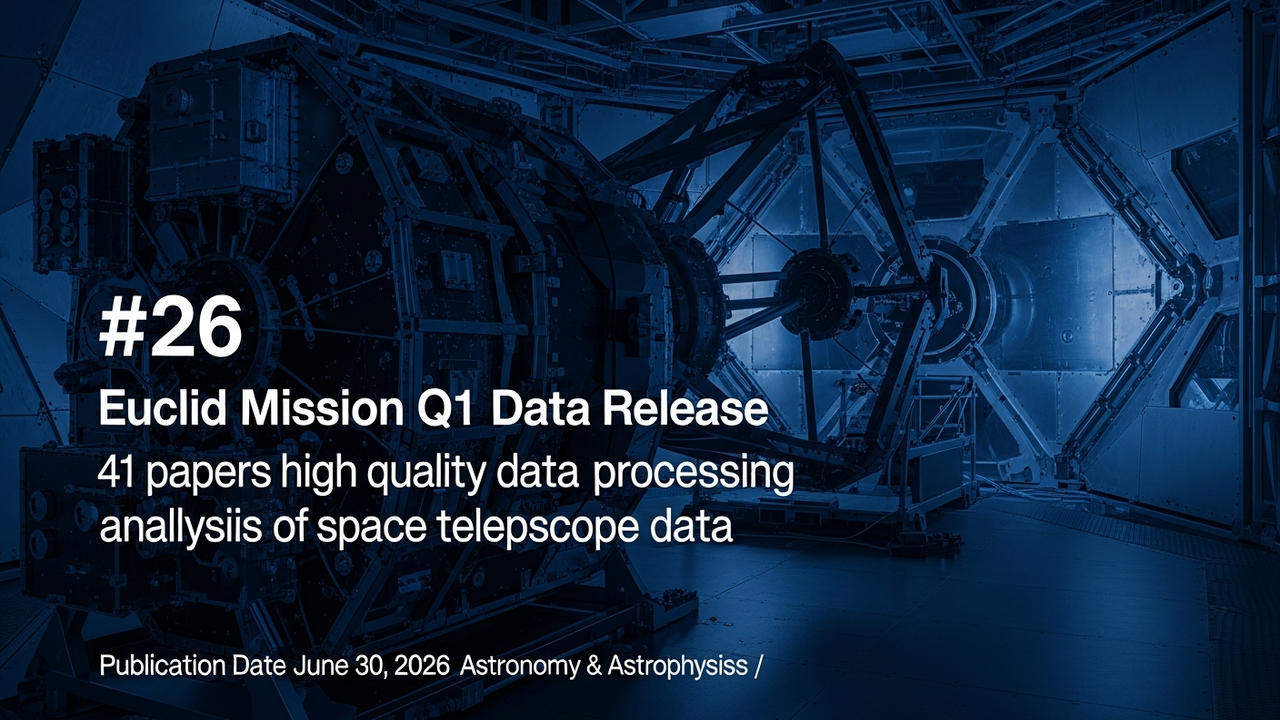
A special issue of ‘Astronomy & Astrophysics’ has been released, featuring 41 papers related to the first quarter (Q1) data release from the European Space Agency (ESA)’s Euclid mission. These papers provide detailed descriptions of the initial scientific data acquired by the Euclid wide-field survey, its innovative data processing methodologies, and the first results of astrophysical analyses, marking significant progress in our understanding of cosmology.
Data and Analysis Details
- Euclid Mission Objectives: The Euclid space telescope was designed to unravel the nature of dark energy and dark matter, and to map the evolutionary history of the universe. It achieves this by observing galaxy distribution, galaxy cluster structures, and gravitational lensing effects in detail through high-resolution images and spectroscopic data across vast sky regions.
- Contents of Q1 Data Release: The 41 papers in the special issue are primarily based on data collected during the initial observation phase of the Euclid telescope, focusing on observation strategies, instrument calibration, data pre-processing (such as noise reduction and artifact correction), and initial scientific interpretations. This includes galaxy shape and redshift data from hundreds of square degrees of the sky.
- Development of Data Processing and Analysis Tools: A significant portion of this special issue is dedicated to the development of new data processing pipelines and analysis tools designed to maximize the utility of the high-quality Euclid data. These tools are crucial for data scientists and astrophysicists to efficiently extract meaningful information from complex datasets.
- First Suite of Astrophysical Analyses: Using the initial data, fundamental astrophysical analyses were performed, such as galaxy morphological classification, redshift determination for distant galaxies, and measurements of weak gravitational lensing effects. These analyses demonstrate Euclid’s capability to meet its design goals and pave the way for full-scale cosmological research.
Background & Industry Context
Cosmology faces major unsolved mysteries dominated by unknown components: dark energy and dark matter. The Euclid mission is expected to provide crucial clues to unlock these mysteries by complementing previous ground-based observations and missions like the Hubble Space Telescope, offering broader coverage and higher precision data.
In such large-scale scientific missions, not only data collection but also the technology and community collaboration for processing and analyzing that data are indispensable. This special issue highlights crucial progress in this initial phase and underscores the importance of cooperation within the international astronomical community.Future Outlook
The Euclid mission’s Q1 data release and associated papers set a new benchmark for cosmological research. As more data is released and more sophisticated analysis methods are developed, our understanding of the universe’s structure and evolution is expected to advance dramatically. This data holds the potential to answer fundamental cosmological questions, such as the nature of dark energy, neutrino mass, and the physics of the early universe. This special issue will be essential reading for researchers, engineers, and anyone interested in the future of space science.
Source: https://www.euclid-ec.org/q1-special-issue-aa/
Get our weekly technology intelligence — free
Receive an infographic that lets you judge at a glance whether each field’s analysis report is worth reading.
Subscribe Free — Weekly Tech Intelligence
By subscribing, you’ll receive Troy-Technical’s weekly technology intelligence newsletter.
- Your email and selected fields are used only to deliver the newsletter.
- We never share your information with third parties.
- You can unsubscribe anytime via the link in each email.
See our Privacy Policy for details.
Takes about a minute · Unsubscribe anytime









Comments