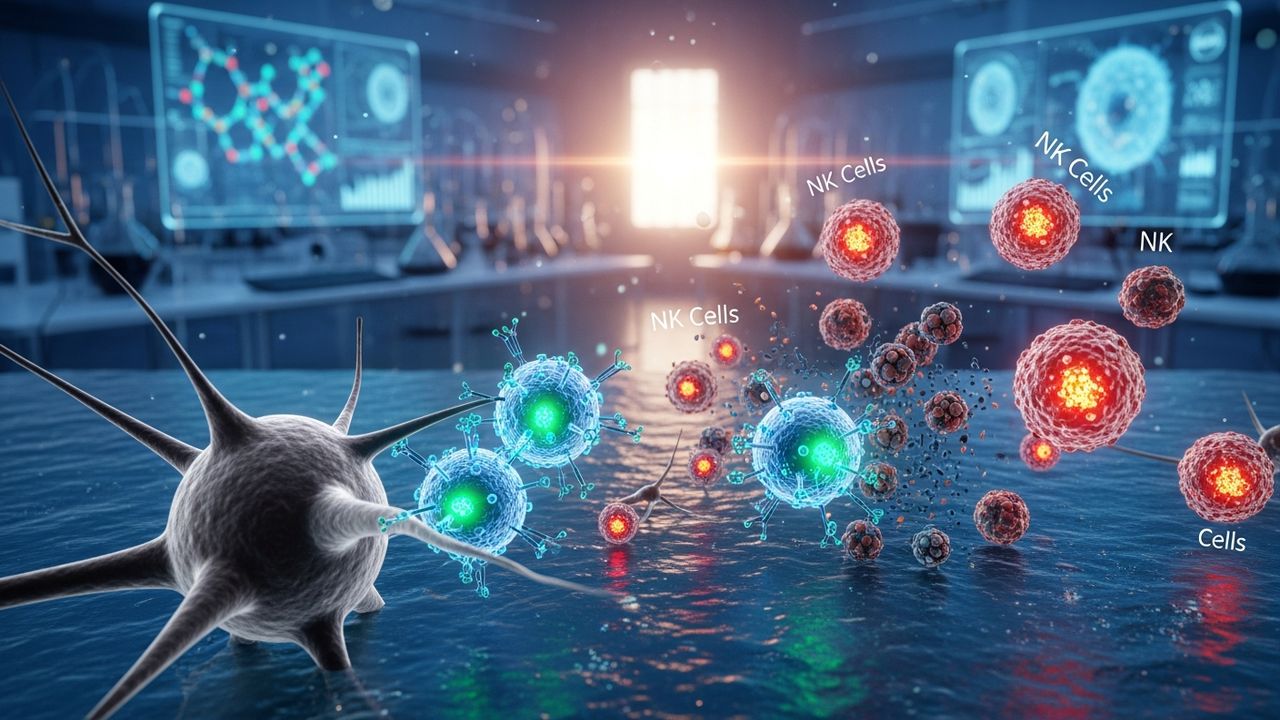
Key Findings: NK Cell Activation Predicts CAR T Therapy Success in Glioblastoma
Researchers from the Perelman School of Medicine and the Abramson Cancer Center at the University of Pennsylvania have reported that directly infusing a dual-target CAR T-cell therapy into the cerebrospinal fluid (CSF) of glioblastoma patients elicits a broad systemic immune response. Crucially, activation of natural killer (NK) cells was significantly associated with favorable patient outcomes and long-term survival.
Technical & Clinical Details: Balancing Immunity in the Brain Tumor Microenvironment
Glioblastoma, one of the most aggressive brain tumors, presents a formidable challenge for CAR T-cell therapy due to its highly infiltrative nature and the profoundly immunosuppressive tumor microenvironment. This study utilized a regional delivery approach, administering the CAR T-cells directly into the cerebral ventricles. This dual-target CAR T-cell therapy is designed to address antigen escape mechanisms by targeting multiple antigens present on glioblastoma cells. Investigators observed robust activation of not only T cells but also non-specific immune cells, particularly NK cells, in the CSF of patients who responded to treatment. Conversely, patients who failed to respond showed a higher proportion of activated regulatory T cells (Tregs) in their CSF. Given Tregs’ role in suppressing immune responses, their dominance likely hinders CAR T-cell anti-tumor activity. These results underscore the critical importance of balancing effector cells (CAR T, NK cells) and suppressive cells (Tregs) for successful CAR T-cell therapy.
Background & Context: Overcoming Solid Tumor Challenges for CAR T
While CAR T-cell therapies have achieved remarkable success in hematological malignancies, their efficacy in solid tumors has been limited. This is attributed to factors such as the complex immunosuppressive microenvironment of solid tumors, tumor antigen heterogeneity, and poor CAR T-cell infiltration into solid masses. This research suggests that combining regional delivery with a multi-target approach could enhance CAR T-cell efficacy even in challenging solid tumors like glioblastoma. The identification of NK cell activation as a potential prognostic factor offers new avenues for biomarker development and combination therapy strategies to maximize treatment benefit.
Strategic Significance & Outlook: Optimizing Therapy and Biomarker Development
These findings provide critical insights for improving the success rates of CAR T-cell therapy in glioblastoma patients. Specifically, pre-treatment assessment of NK cell activation status and exploring combination therapies that suppress Treg function could lead to enhanced clinical outcomes. Furthermore, strategies to boost NK cell activation and real-time immune profiling of CSF will likely become focal points for future research. This will enable the personalization and optimization of CAR T-cell therapies, aiming to achieve durable responses in a greater number of patients and pushing the boundaries of what is possible in neuro-oncology.
Get our weekly technology intelligence — free
Receive an infographic that lets you judge at a glance whether each field’s analysis report is worth reading.
Subscribe Free — Weekly Tech Intelligence
By subscribing, you’ll receive Troy-Technical’s weekly technology intelligence newsletter.
- Your email and selected fields are used only to deliver the newsletter.
- We never share your information with third parties.
- You can unsubscribe anytime via the link in each email.
See our Privacy Policy for details.
Takes about a minute · Unsubscribe anytime




Comments