Key Findings
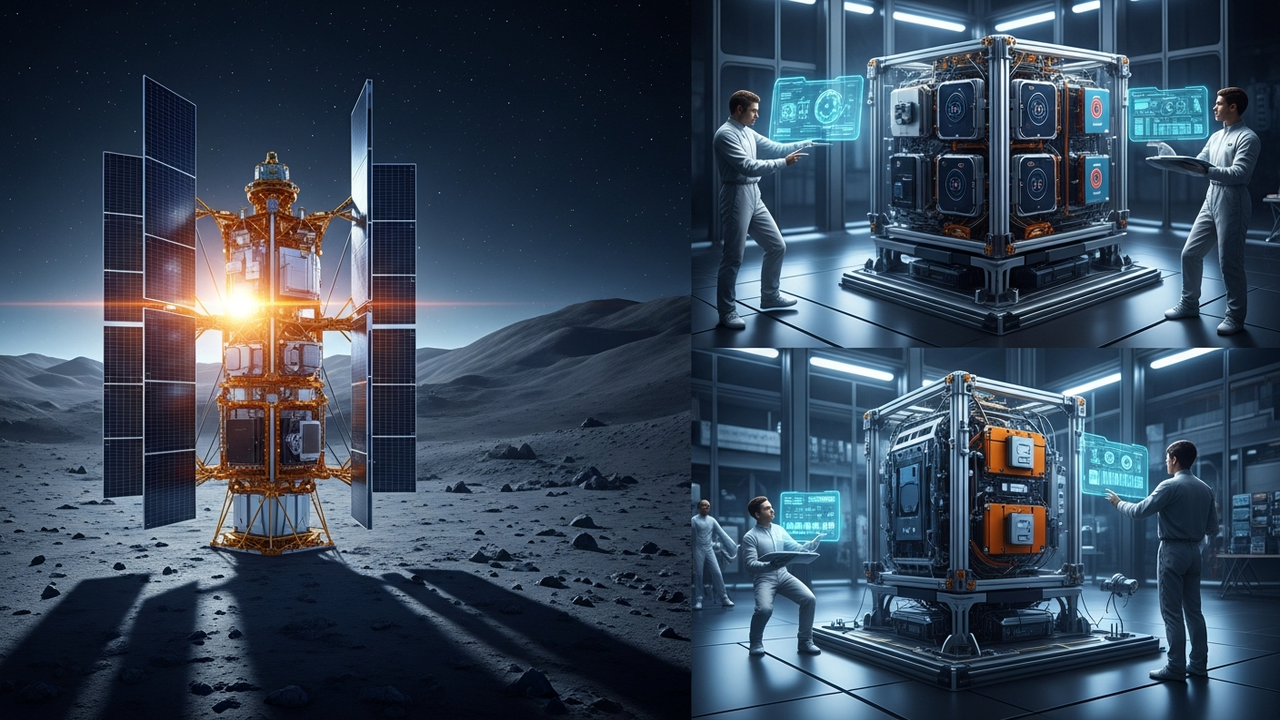
NASA is vigorously pursuing the development of several critical lunar technologies, including groundbreaking Vertical Solar Array Technology (VSAT) and advanced radiation-hardened flight computers, to enable future long-duration crewed and robotic missions to the Moon. These technologies are indispensable for ensuring the continuous power supply and robust information processing capabilities required for sustained lunar activities.
Technical Details
Vertical Solar Array Technology (VSAT) is specifically engineered to address unique challenges of the lunar surface, particularly the low sun angles encountered at the poles. This system deploys its arrays vertically to efficiently generate power even when sunlight is incident at near-horizontal angles. VSAT is also designed for autonomous deployment, retraction, and repositioning to accommodate uneven lunar terrain, guaranteeing a stable power supply for lunar bases and exploration rovers. Concurrently, NASA is intensely focused on developing radiation-hardened flight computers. The lunar surface, lacking Earth’s protective atmosphere and magnetosphere, is constantly exposed to high levels of radiation from galactic cosmic rays and solar particle events. This radiation can cause soft errors and permanent damage to electronic components. Radiation-hardened flight computers utilize specialized materials, design architectures, and redundancy techniques to maintain high reliability and computational capability under these harsh conditions, enabling safe system integration and operation for lunar exploration.
Background & Industry Context
NASA’s Artemis program ultimately aims to return humans to the Moon and establish a sustainable lunar presence. Achieving this goal necessitates robust power generation, communication, navigation, and infrastructure capable of withstanding extreme environments. Traditional technologies have proven insufficient for supporting long-duration and widespread lunar operations. Innovative power solutions like VSAT are crucial for resource exploration in lunar polar regions and the construction of permanent bases, while radiation-hardened flight computers will play a central role in ensuring the autonomy, data processing capabilities, and safety of lunar probes and astronauts. These technological developments are also foundational for the growth of a lunar economy and preparation for crewed missions to Mars.
Strategic Significance & Outlook
The development of VSAT and radiation-hardened flight computers significantly expands the possibilities for long-term lunar habitation and scientific exploration. Moving forward, these technologies are planned for integration into various Artemis missions following extensive validation testing in the lunar environment. VSAT, in particular, will be critical for missions targeting the exploration and utilization of water ice at the lunar poles. Moreover, more powerful and robust flight computers will enhance the orbital processing capabilities for AI-driven autonomous systems and complex scientific experiments, further advancing future space exploration. These technological strides are set to accelerate humanity’s push into deep space, using the Moon as a vital stepping stone.
Source: https://www.nasa.gov/lunar-surface-technology/
Get our weekly technology intelligence — free
Receive an infographic that lets you judge at a glance whether each field’s analysis report is worth reading.
Subscribe Free — Weekly Tech Intelligence
By subscribing, you’ll receive Troy-Technical’s weekly technology intelligence newsletter.
- Your email and selected fields are used only to deliver the newsletter.
- We never share your information with third parties.
- You can unsubscribe anytime via the link in each email.
See our Privacy Policy for details.
Takes about a minute · Unsubscribe anytime



Comments